
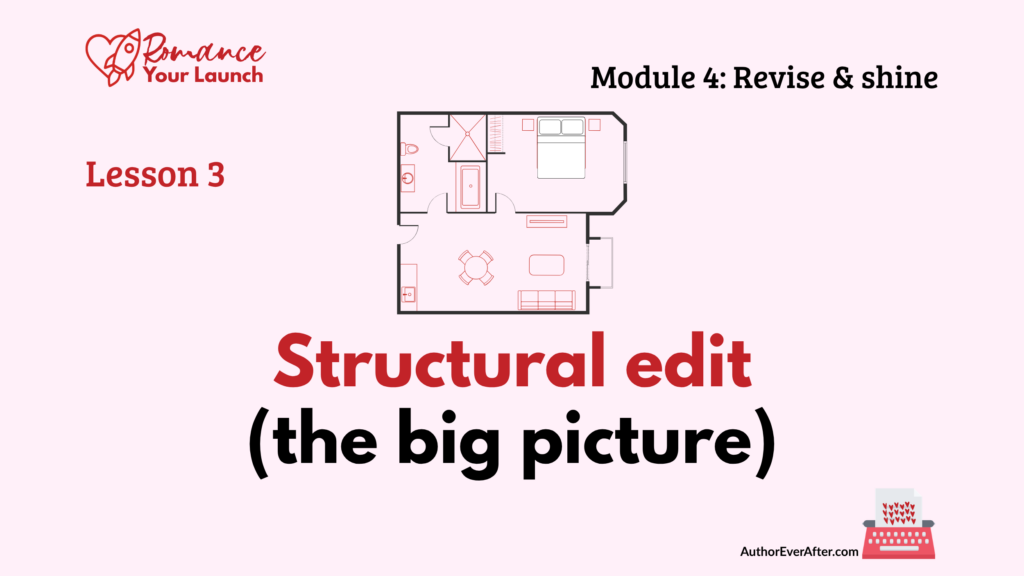
Structural edit for a romance novel that actually works
A structural edit for a romance novel is where you stop fussing over sentences and zoom all the way out to the story. You’re not thinking about dialogue tags or comma placement or whether your chapter endings are punchy enough; you’re looking at the romance arc, the emotional beats, the characters and their journeys, the world they move through, and whether all of it is doing the job you promised when a reader read your blurb and downloaded the book.
This is the big-picture pass that makes everything else worth doing. There’s no point polishing the words in a scene that eventually might need to be cut, or perfecting a snappy exchange in a chapter your reader will skim because the pacing has stalled.
Your structural edit tells you what to keep, what to fix, what to move, and what to let go before you’ve spent hours doing pretty line work on the wrong parts of the book.
Your goal is simple to say but messier to execute: make sure your romance works.
Not just that events happen in order, but that the story delivers a complete, emotionally satisfying love journey that fits your sub-genre, your heat level, and the tropes you’ve promised.
How to read your draft for structure
Before you start making changes, you need to see the whole thing clearly. That means one read‑through where your only job is to notice, not fix.
Read like a reader with a pen.
Move through the manuscript without stopping to rewrite anything.
In the margins or in a paper notebook, use simple shorthand to track your experience: B for bored, C for confused, a heart for something that genuinely works. That’s it.
You’re mapping the reader’s emotional experience, not editing the sentences or words. The urge to tinker with sentences as you go will be strong. Don’t give in.
When you’re done, look at what you’ve marked. The B’s and C’s are your structural to‑do list in rough form. The hearts are the moments worth protecting: the scenes, lines, and beats that are already doing exactly what the story needs.
From there, map your romance arc. List your major scenes or chapters and note, briefly, two things beside each one:
- what changes for the plot, and
- what changes for the relationship.
This map will show you, faster than anything else, where the story drags, where it sprints past important beats, and whether the love story is actually progressing or stalling for twenty pages while other things happen.
What you’re looking for across the whole arc are the beats a romance reader expects to feel:
- the collision or meet‑cute that sparks everything,
- the shift from awareness to genuine attraction,
- the first point where the relationship feels in real danger,
- the “all is lost” moment where love seems genuinely gone, and
- the earned, believable resolution that closes the emotional promise.
If any of those beats are missing, rushed, or buried under so much subplot that a reader might not register them, that’s structural edit work.
Character arcs and the relationship journey
Readers show up for the tropes. They stay because they care about the people.
Structural editing means checking whether your characters’ internal journeys are doing enough work to support the external love story, because a romance arc that isn’t grounded in who these specific people are, and why love is specifically hard for them, will feel generic even if all the “right” plot events technically happen.
At the structural level, you’re asking:
Does each main character want something that isn’t just the other person?
Do their fears and wounds make sense of their behaviour?
- Is it clear, to a reader who isn’t you, why this person keeps pushing love away?
- Does each character move?
- Do they start the story believing one thing about themselves or about love, crash into the relationship and everything it stirs up, and arrive somewhere different by the end?
- Not perfectly healed or magically transformed, but genuinely changed in a way that feels earned.
You’re also checking that the relationship itself evolves in stages a reader can feel. The move from strangers or antagonists to intrigued, to emotionally vulnerable, to genuinely committed should have texture: scenes that mark each shift, moments that make the deepening feel real rather than just announced in the narration.
On this pass, you’re hunting for character behaviour you haven’t adequately prepared the reader for.
- Emotional beats that should exist but don’t.
- The missing bridge between “I want nothing to do with you” and “I’m falling for you” that the story skips past entirely.
- Subplots that were fun to write but are pulling focus away from the romance arc they were supposed to support.
Note these things first. You’ll fix them by adding or adjusting scenes, strengthening motivations, or trimming distractions. But you need to see the whole picture before you start moving furniture around.
Setting and world‑building
In romance, setting is not wallpaper. The small town, the office, the fantasy realm, the campus—these are the spaces where your couple is brought together, pushed apart, and forced to reckon with each other. They should be working for the story, not just existing as a neutral backdrop.
At the structural level, you’re asking whether the places your couple moves through are actually in service of the romance.
- Does the setting match your sub‑genre promise?
- Does it feel like the kind of world this kind of story lives in?
- Do readers have enough grounding to picture where they are, or are scenes floating in a sort of featureless void?
- Do recurring locations (the bar, the bakery, the training ground, the shared apartment) evolve with the relationship so that the place means something different at the end than it did at the beginning.
If your book involves world‑building like magic systems, paranormal rules, workplace dynamics, or cultural context you’re checking whether you’re over‑explaining in big lumps that stop the story, or under‑explaining in ways that leave readers confused. Both are structural problems, not line problems. The question isn’t whether your world‑building sentences are beautifully written. It’s whether the information is in the right place, in the right amount, doing work for the romance instead of competing with it.
Point of view and voice
Point of view and voice are part of your story’s architecture, and inconsistency here breaks reader immersion in ways that are hard to diagnose from inside the story. The structural edit is the right time to check whether your choices about perspective are working before you spend the scene‑level pass making sure you add deep POV to each character’s voice.
Look at your POV choices across the manuscript.
- Are you in first person, third limited, dual POV?
- Do you slip into a perspective you didn’t intend?
- Do you do a head‑hop that gives the reader a thought that doesn’t belong to the POV character?
- Do perspective switches happen at clear, logical moments, or do they jump mid‑scene in ways that disorient?
Then check whether each POV character sounds like themselves. Not just in dialogue, but in thought, observation, the way they process what’s happening around them, even the way they describe setting. This called deep POV and your story needs it.
- Does your heroine’s internal voice sound like a person of her age, background, and emotional state?
- Does your hero’s perspective have a different texture, or do they both sound like the same person narrating from slightly different angles?
- Can you remove your dialogue tags and still know who’s speaking based on how they express themselves? (You should be able to in 80% of dialogue! Okay, I made up that number, but way more than half).
Finally, check whether the overall tone matches the book you’re trying to be. Light and bantery. Dark and intense. Cozy and reflective. Wild and chaotic. These are tonal promises you make on the first page, and the structure of the story needs to hold them. A slapstick scene slammed up against raw trauma without any scaffolding isn’t just a line problem, it’s a structural one, and this read-through is when you flag it.
Building your structural to‑do list
When you’ve worked through these four areas:
- overall structure,
- character arcs,
- setting, and
- POV,
distill what you’ve found into a short, manageable list of structural changes.
Not twenty things. Not every scribble in the margins. Aim for three to five big moves, prioritized.
For example:
- Add one more genuine connection scene before they move to sexy times.
- Move a flashback earlier so her fear is established before the reader needs to understand it.
- Cut the work subplot in the middle because it’s stalling the romance for thirty pages.
- Strengthen the black moment so it feels like genuine loss, not a misunderstanding a single conversation could fix.
That list is what you work from. You’ll revise at the level of scenes and beats not at the level of sentences, adding, cutting, moving, and rewriting the turning‑point moments that aren’t landing. The beautiful sentences can come later. Right now, you’re making sure the structure can hold it.
Where the structural edit ends and the scene‑level edit begins
The structural edit is finished when you can honestly answer yes to this question:
Is this a complete, coherent, emotionally satisfying romance for the readers I want?
The structure holds. The romance arc is on the page, not just in your head. The characters move. The setting is working. The POV is coherent. The core beats are there.
When you’re in that place, you’re ready for the scene‑level edit, where you move from the architecture into the individual rooms and ask whether each scene, each emotional beat, and each key trope moment is doing everything it can for your reader’s experience. That’s where the detailed, satisfying work begins but only because the structural edit has made it worth doing.
Key takeaway
A structural edit for a romance novel is you stepping back to make sure the story itself can carry the love journey you’re promising, before you touch a single sentence. When you read for big‑picture issues—romance arc, character change, setting support, and POV/voice—then turn that into a short list of intentional structural changes, every editing pass that follows becomes clearer, faster, and a lot less painful.
Join Author Ever After
You’ll get immediate and full access to the Romance Your Launch program (all 11 modules), a worksheet for every lesson, plus three weekly, small group support meetings to answer all your questions, and a freaking amazing community of pre-published and early career romance authors who are building their indie publishing careers alongside you.
Get more details about the community here.
Or, go straight to the application form.
Get every lesson in the Romance Your Launch course
—> Click this link and I’ll send you two to three lessons a week, starting with Lesson 1.
—>Or, join my regular email list if you’d rather just pick up from the current lesson.
This lesson is part of Module 4: Revise & shine in the Romance Your Launch program.
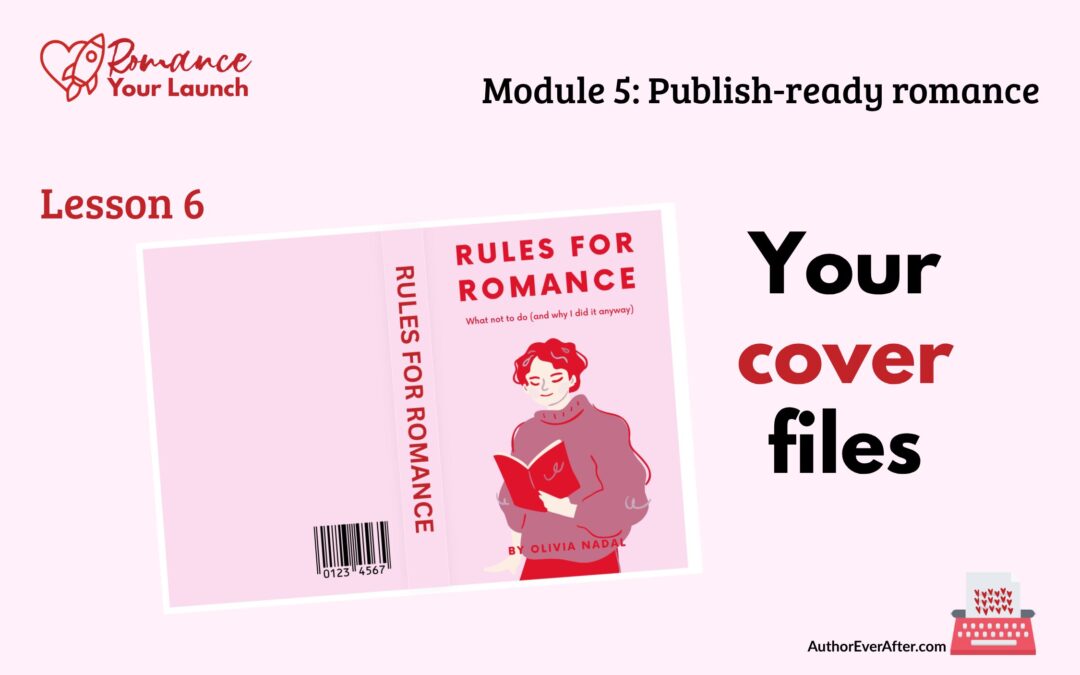
5.6 Book cover file specs for self-publishing authors
Book cover file specs for self-publishing authors Your cover designer has delivered your files. They're beautiful. You love them. You're ready to upload and get this book into the world. Understanding book cover file specs for self-publishing is the one thing standing...
5.5 Formatting check before you publish your romance novel
Your cover is beautiful. But a stunning cover file that fails a platform’s technical requirements can mean reprints, rejected uploads, or colours that shift dramatically between screen and print. Here’s how to get your book cover file specs right before anything goes live.
5.4 How to format a romance novel for self-publishing
Good formatting is invisible. Bad formatting costs you reviews you didn’t see coming. Here’s how to format a romance novel for self-publishing so your pages disappear and your readers stay in the story.
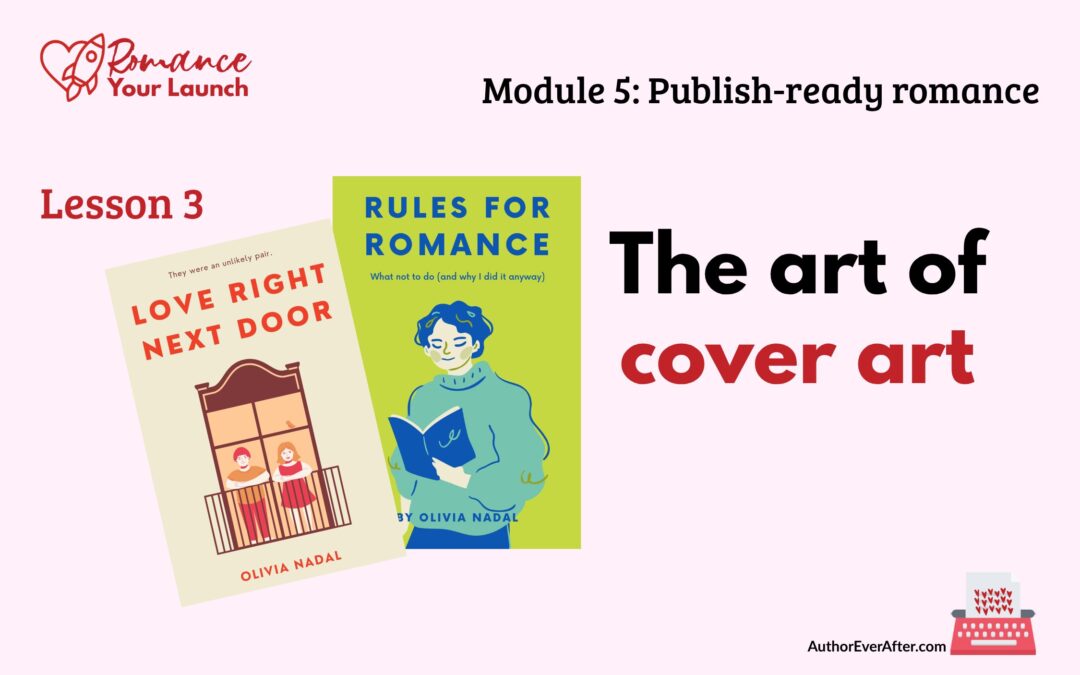
5.3 Romance book cover design guide for indie authors
Your feelings about what looks beautiful are almost beside the point. A romance cover is a signal, not self-expression. This romance book cover design guide shows you exactly what that signal needs to say and how to say it.

5.2 ISBNs for self-published authors: what you need to know
Before you upload your manuscript anywhere, you need to make one decision that affects every version of your book and every platform it lives on. Here’s what to know about ISBNs for self-published authors before you hit publish.

5.1 Romance novel metadata tips for self-published authors
Your book deserves to be found. But even a great romance novel stays invisible if your metadata isn’t doing its job. These romance novel metadata tips for self-published authors will help you get it right before you hit publish.
4.6 Final manuscript review before publishing your romance
“Almost there” is where a lot of authors stall out. In this lesson, you’ll walk through a final manuscript review before publishing so you can read like a reader, catch small issues that break immersion, and finally feel confident calling your romance done.

4.5 Line edit for a romance novel that feels polished
The line edit is where your romance stops feeling like a draft and starts feeling like a book. In this lesson, you’ll learn how to make your sentences clearer, sharper, and more intentional—without turning your voice into bland, beige prose.
4.4 Scene level edit for a romance novel that hits harder
Scene level edit for a romance novel that readers actually feel The structural edit asked whether your story works; the scene level edit for a romance novel asks whether your story feels. You've fixed the bones: the romance arc is present, the beats are in the right...

4.2 Beta readers for romance authors who want better books
Before you sink weeks into polishing sentences, you need to know if the story actually works for anyone who isn’t you. In this lesson, you’ll learn how to find and brief beta readers for romance authors so you get targeted, story-level feedback that makes revision easier instead of overwhelming.
4.1 Self-editing tips for romance authors who want readers
Self-editing is not a punishment for an imperfect draft; it’s how you give your romance a second life with a clearer head and a sharper eye. In this lesson, you’ll set yourself up with mindset, tools, and support so your edits actually help you reach more readers.
3.5 Social media strategy for romance authors
You do not need to be everywhere online to sell romance. In this lesson, you’ll choose one platform, decide what you actually want social media to do for your career, and build a sustainable posting rhythm that turns curiosity into clicks on your lead magnet.
3.4 Simple romance author websites
Your author website doesn’t have to impress anyone. It has to exist and give readers one clear place to go. In this lesson, you’ll pick an easy platform, claim your URL, write your copy, and build a simple, on‑brand home that points straight to your books and your list.
3.3 Email list setup for romance authors
Followers belong to the platform. Your list belongs to you. In this lesson, you’ll connect your lead magnet to a clean email setup and draft a four‑email welcome sequence so every new romance reader is welcomed, warmed up, and ready when you launch your book.
3.2 Romance lead magnet ideas to grow your email list
Your lead magnet is not a throwaway freebie. It is often the first story a new reader ever sees from you. In this lesson, you’ll choose the right format, length, and emotional promise for your romance lead magnet so it attracts the readers who will go on to buy your books.
Need to go back to a previous lesson?
Return to Module 4: Revise & Shine to see all six lessons.
Or go back to the Romance Your Launch home page to see all the modules and links to their hub pages.
Want the next lesson in your inbox?
This post is part of the Romance Your Launch series—a lesson-by-lesson guide to self-publishing your romance novel, written for pre-published and early career romance authors.
.
—> Click this link, drop in your name and email address, and I’ll send you two to three lessons a week, starting with Lesson 1.
.
—> If you’d rather just pick up where the series is, join my regular email list from this link.