
Formatting check before you publish your romance novel
You’ve been through structural edits, scene-level revisions, and a line edit. Your story is solid. Your sentences are clean. You’ve read this manuscript so many times that you could recite whole scenes from memory. And yet, there’s one more read it needs before it goes anywhere near an upload screen.
Not for story. Not for grammar. Not for anything your editor was looking for.
This read is specifically for formatting, and doing a thorough formatting check before you publish your romance novel is one of the most skipped steps in the entire self-publishing process. Authors who skip it often find out why they shouldn’t have when a reader emails to say there’s a blank page in the middle of chapter seven, or a review mentions that the chapter headers are inconsistent, or they notice themselves (after publication) that the dedication page is in a completely different font from everything else.
A formatting beta read catches those things first. It takes one careful reader and a clear brief. And it’s the right thing to do before you upload a single file.
What a formatting beta read actually is
A formatting beta read is a targeted, functional read of your fully formatted manuscript (your actual EPUB or PDF file, not your Word document) by someone who is specifically looking for formatting problems rather than story problems. Think of it as your ebook formatting checklist brought to life by a human being with fresh eyes and no emotional attachment to your story.
The distinction matters more than it might seem. A story beta reader is reading for plot, pacing, character, and emotional resonance. A formatting beta reader is reading the way a quality control inspector reads: methodically, with their eyes on the structure of the document rather than the content of the story. These are two completely different jobs that call for two completely different headspaces. You can ask the same person to do both, but not at the same time. If you’re asking someone to be your formatting beta reader, brief them clearly so they understand that story feedback, while welcome, is not the purpose of this read.
Why your own eyes aren’t enough
When you read your manuscript in your writing or editing software, you’re looking at a version of the document that is not what readers will experience. Your formatter (whether that’s you or a professional you hired) takes your manuscript and transforms it into an EPUB for ebook readers and a PDF for print. Things can go wrong in that transformation that are completely invisible in the source document. That’s exactly why a self-publishing quality check on the actual output files matters so much.
A misplaced page break can push a chapter opening onto a blank page. A scene break symbol that looked fine in Word can disappear entirely in EPUB. A font that was embedded correctly can render strangely on certain Kindle devices. A print PDF can have margins that are technically within spec but feel uncomfortably tight on the physical page. A running header that says “Chapter Eight” can sit above what is clearly Chapter Nine because a template was copied and one line was missed.
None of these things will be caught by your proofreader, who read the manuscript before it was formatted. None will be caught by Amazon’s upload system, which checks for technical compliance, not whether your chapter numbers are correct. And none will be caught by you, because you have read this document so many times that your brain autocorrects everything it sees.
They will be caught by a fresh pair of eyes reading the actual formatted file. That’s the whole point of this step.
What your formatting beta reader is looking for
When you brief your formatting beta reader, give them a clear checklist and ask them to note the location or page number of anything they find, not to fix it, just to flag it and move on. The worksheet for this lesson includes the full ebook formatting checklist to send them. Here’s what it covers.
For the ebook file, they’re checking:
- Chapter headers are consistent in font, size, and style throughout
- Chapter numbers match the actual chapter sequence
- Each new chapter starts cleanly on a fresh screen
- Scene break symbols are consistent and haven’t rendered as strange characters or disappeared entirely
- Table of contents links (if included) work and go to the right places
- Back matter links (to your newsletter, website, next book) are working and go where they’re supposed to
- Text reflows correctly when a reader changes the font size on their device
For the print PDF, they’re checking:
- Margins feel comfortable and text isn’t running dangerously close to the spine or the trim edge
- All chapters start on a new page with consistent header styling
- Running headers and page numbers are correct throughout and correctly absent from front matter pages
- Scene break symbols are consistent and correctly positioned
- Any graphic elements (chapter ornaments, maps, illustrations) are sharp and sitting within the safe zone
Both lists sound long written out. In practice, a careful reader can easily move through a formatted romance novel in two thours or less with this brief in hand. It’s a fast read because they’re skimming for problems rather than reading for pleasure. This is not a full proofread-the-formatted-book situation. It’s a structural and visual check, nothing more.
Who should do this read
Your formatting beta reader needs three things: fresh eyes on the document, access to an actual e-reader or reading app for the EPUB file, and the willingness to read methodically rather than get pulled into the story.
Good candidates include:
- A trusted author friend who writes in your sub-genre and understands what a clean self-publishing quality check looks like in practice
- An Author Ever After community member willing to swap formatting beta reads with you (an easy ask, and one that benefits both of you)
- A detail-oriented reader from your ARC team who you trust to work through an ebook formatting checklist carefully
If you hired a professional formatter, it’s entirely reasonable to ask them to confirm they’ve done a final quality check on the delivered files before handing them over. Most do this as a matter of course, but asking explicitly is not an unreasonable request.
What you want to avoid is asking someone who loves your writing so much that they’ll get absorbed in the story and forget to notice that chapter twelve has the wrong header. That person is a gift as an ARC reader. They are not the right person for this job.
How to send the files
Send your formatting beta reader the actual output files: the EPUB for the ebook read, and the PDF for the print read. Not a Word document. Not a Google Doc. The whole point of doing a formatting check before you publish your romance novel is to catch problems that only appear in the formatted file, and those problems are invisible in the source.
For the ebook, ask them to load it onto an actual e-reader device if they have one, not just a desktop app. Some formatting issues only surface on specific devices, and a Kindle and a phone app can render the same file differently. If they can check both, that’s better. This is especially important for the items on your ebook formatting checklist that relate to text reflow and scene break rendering, since those behave differently across devices.
For the print PDF, ask them to read it at 100% zoom: the actual print size rather than zoomed in or out. Margin and spacing issues that are invisible at 150% are very visible at actual size.
Give them a specific deadline that leaves you time to act on what they find before your upload date. A week is usually enough. This is a faster read than a story beta because they’re working through a checklist, not living in the experience.
Acting on the feedback
When the notes come back, fix everything on the list, or make a deliberate, conscious decision not to fix something and know why. A slightly inconsistent scene break symbol that you barely notice is exactly the kind of thing a reader might mention in a review. A back matter link that goes to a 404 page is a list-building opportunity you’ll never recover. Neither of those things has anything to do with your story quality, but both affect how professional your book feels to the person reading it.
What a self-publishing quality check is really protecting isn’t your manuscript. It’s your reader’s experience of it.
Once the fixes are in, do a quick final check yourself: open the corrected file, navigate to each flagged location, and confirm the fix is there. When you’re satisfied the file is clean, you’re ready for Lesson 5.6, where we’ll talk about the cover files that need to be checked and prepared before anything gets uploaded.
Key takeaway
A formatting check before you publish your romance novel isn’t a perfectionist move. It’s a practical one. The formatting issues that slip through to readers are almost never story problems. They’re invisible-in-the-source-file problems that a fresh pair of eyes with a clear ebook formatting checklist will catch in a few hours. Brief your reader well, send the actual formatted files, give yourself enough time to act on what they find, and treat this as the self-publishing quality check it is. Your readers will never know you did this. That’s exactly the point.
Join Author Ever After
You’ll get immediate and full access to the Romance Your Launch program (all 11 modules), a worksheet for every lesson, plus three weekly, small group support meetings to answer all your questions, and a freaking amazing community of pre-published and early career romance authors who are building their indie publishing careers alongside you.
Get more details about the community here.
Or, go straight to the application form.
Get every lesson in the Romance Your Launch course
—> Click this link and I’ll send you two to three lessons a week, starting with Lesson 1.
—>Or, join my regular email list if you’d rather just pick up from the current lesson.
This lesson is part of Module 5: Publish-ready romance in the Romance Your Launch program.
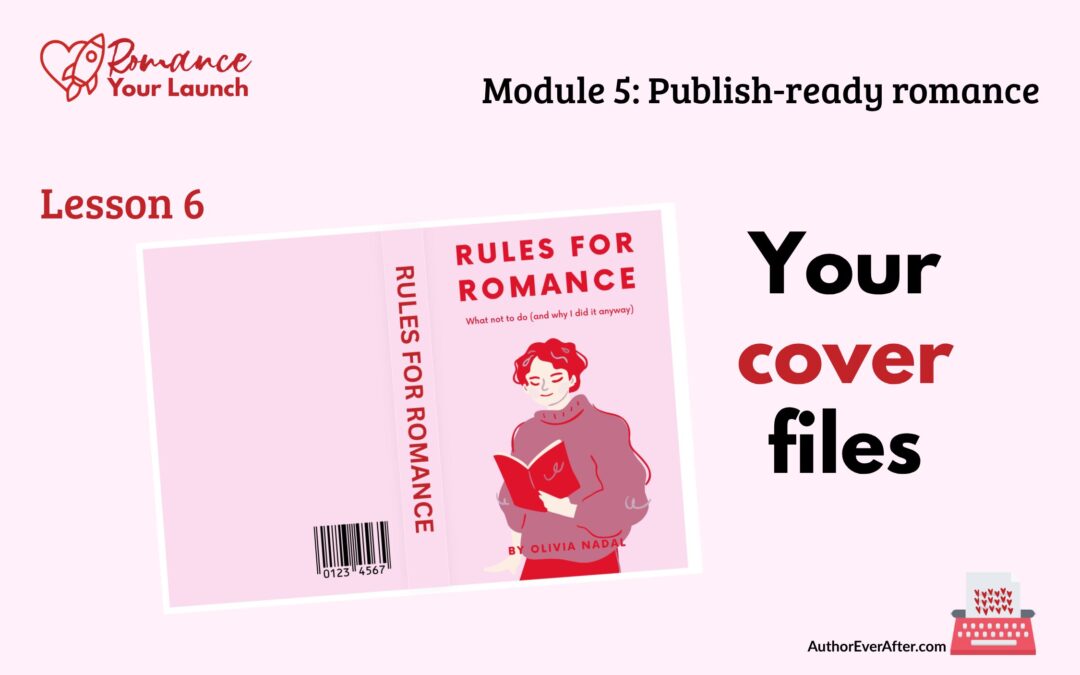
5.6 Book cover file specs for self-publishing authors
Book cover file specs for self-publishing authors Your cover designer has delivered your files. They're beautiful. You love them. You're ready to upload and get this book into the world. Understanding book cover file specs for self-publishing is the one thing standing...
5.4 How to format a romance novel for self-publishing
Good formatting is invisible. Bad formatting costs you reviews you didn’t see coming. Here’s how to format a romance novel for self-publishing so your pages disappear and your readers stay in the story.
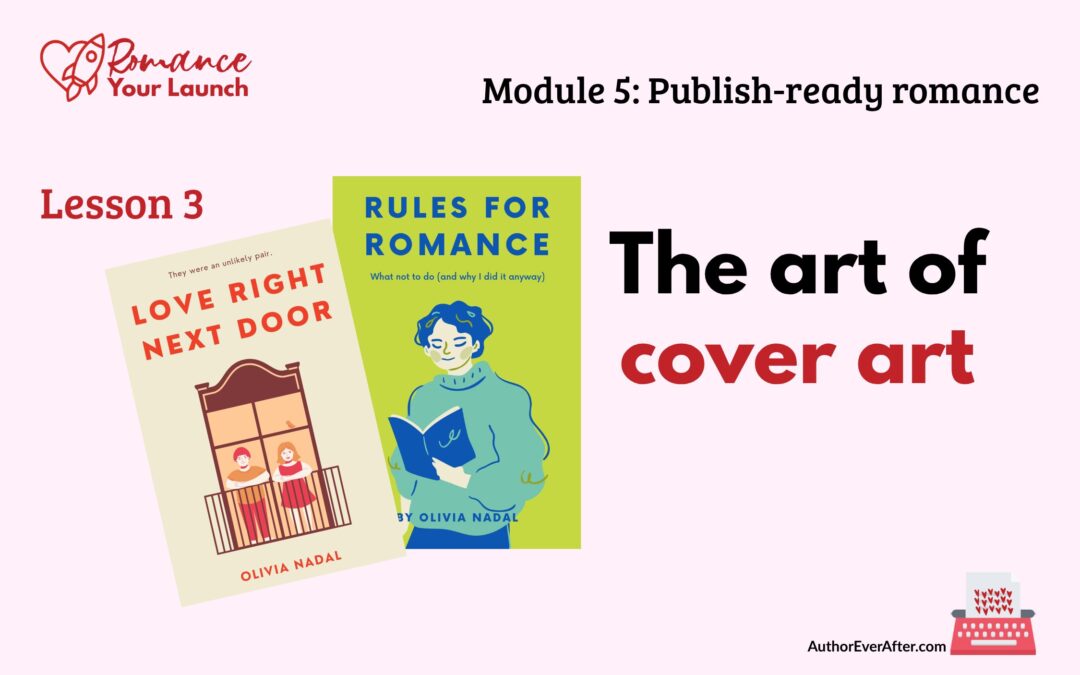
5.3 Romance book cover design guide for indie authors
Your feelings about what looks beautiful are almost beside the point. A romance cover is a signal, not self-expression. This romance book cover design guide shows you exactly what that signal needs to say and how to say it.

5.2 ISBNs for self-published authors: what you need to know
Before you upload your manuscript anywhere, you need to make one decision that affects every version of your book and every platform it lives on. Here’s what to know about ISBNs for self-published authors before you hit publish.

5.1 Romance novel metadata tips for self-published authors
Your book deserves to be found. But even a great romance novel stays invisible if your metadata isn’t doing its job. These romance novel metadata tips for self-published authors will help you get it right before you hit publish.
4.6 Final manuscript review before publishing your romance
“Almost there” is where a lot of authors stall out. In this lesson, you’ll walk through a final manuscript review before publishing so you can read like a reader, catch small issues that break immersion, and finally feel confident calling your romance done.

4.5 Line edit for a romance novel that feels polished
The line edit is where your romance stops feeling like a draft and starts feeling like a book. In this lesson, you’ll learn how to make your sentences clearer, sharper, and more intentional—without turning your voice into bland, beige prose.
4.4 Scene level edit for a romance novel that hits harder
Scene level edit for a romance novel that readers actually feel The structural edit asked whether your story works; the scene level edit for a romance novel asks whether your story feels. You've fixed the bones: the romance arc is present, the beats are in the right...

4.3 Structural edit for a romance novel that actually works
A structural edit is where you stop fussing over sentences and zoom all the way out to your romance as a whole. In this lesson, you’ll learn how to read your draft for structure, map the romance arc, and spot the big changes that will make everything you revise next actually worth the effort.

4.2 Beta readers for romance authors who want better books
Before you sink weeks into polishing sentences, you need to know if the story actually works for anyone who isn’t you. In this lesson, you’ll learn how to find and brief beta readers for romance authors so you get targeted, story-level feedback that makes revision easier instead of overwhelming.
4.1 Self-editing tips for romance authors who want readers
Self-editing is not a punishment for an imperfect draft; it’s how you give your romance a second life with a clearer head and a sharper eye. In this lesson, you’ll set yourself up with mindset, tools, and support so your edits actually help you reach more readers.
3.5 Social media strategy for romance authors
You do not need to be everywhere online to sell romance. In this lesson, you’ll choose one platform, decide what you actually want social media to do for your career, and build a sustainable posting rhythm that turns curiosity into clicks on your lead magnet.
3.4 Simple romance author websites
Your author website doesn’t have to impress anyone. It has to exist and give readers one clear place to go. In this lesson, you’ll pick an easy platform, claim your URL, write your copy, and build a simple, on‑brand home that points straight to your books and your list.
3.3 Email list setup for romance authors
Followers belong to the platform. Your list belongs to you. In this lesson, you’ll connect your lead magnet to a clean email setup and draft a four‑email welcome sequence so every new romance reader is welcomed, warmed up, and ready when you launch your book.
3.2 Romance lead magnet ideas to grow your email list
Your lead magnet is not a throwaway freebie. It is often the first story a new reader ever sees from you. In this lesson, you’ll choose the right format, length, and emotional promise for your romance lead magnet so it attracts the readers who will go on to buy your books.
Need to go back to a previous lesson?
Return to Module 5: Publish-ready romance to see all six lessons.
Or go back to the Romance Your Launch home page to see all the modules and links to their hub pages.
Want the next lesson in your inbox?
This post is part of the Romance Your Launch series—a lesson-by-lesson guide to self-publishing your romance novel, written for pre-published and early career romance authors.
.
—> Click this link, drop in your name and email address, and I’ll send you two to three lessons a week, starting with Lesson 1.
.
—> If you’d rather just pick up where the series is, join my regular email list from this link.