
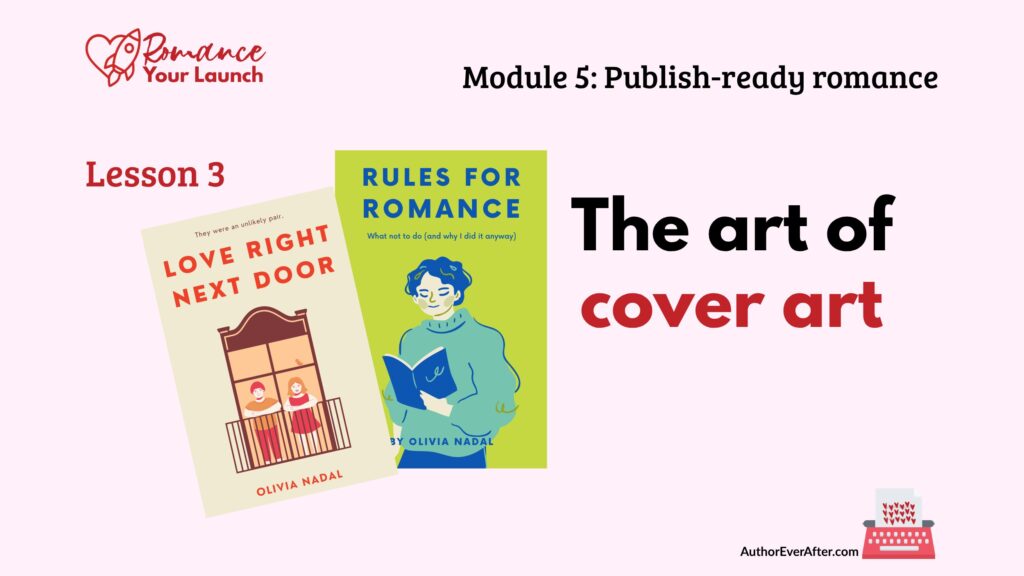
Romance book cover design guide for indie authors
You probably don’t want to hear this, but your feelings about what looks good on a book cover are almost beside the point. That’s not a criticism of your taste. It’s just how genre fiction covers actually work. This romance book cover design guide for indie authors exists because a romance cover isn’t personal expression. It’s a signal. And in the half-second a reader spends glancing at a thumbnail on her phone screen, that signal either stops her scroll or it doesn’t.
If the cover answers her three unspoken questions correctly (what kind of romance is this, how spicy is it, and how is it going to make me feel), she slows down. If it doesn’t, she keeps scrolling and never knows your book existed.
This lesson is about learning to create a brief for a self-published romance cover that gets those answers right, whether you’re hiring a designer or doing it yourself.
Start with the shelf, not your feelings
Before you open Canva or email a designer, your first job is research. Not into what you find beautiful, but into what your sub-genre’s readers have already been trained to recognise and respond to. This is the foundation of any good romance book cover design guide, and it’s where most first-time authors either rush or skip entirely.
Go to Amazon and open the Top 100 in romance. Use the left sidebar to find your exact sub-genre. Pick a book that would be a comp for yours.
Then scroll down to the “Customers also bought or read” carousel and find a few more authors you want to sit beside. Screenshot or save anything that stops you, and start looking for patterns:
- What’s the imagery style? Photographic couples, manchest models, illustrated characters, silhouettes, or setting-only covers?
- What’s the colour palette, and does it shift depending on heat level or tone? (if you’re not sure, do the research to figure it out).
- What do the fonts look like: script, block, serif?
- How much skin is visible, and how close are the bodies?
- What’s the overall emotional register: dark and moody, bright and playful, soft and cozy, sharp and intense?
You’re not copying any one cover. You’re learning the visual language your readers already speak fluently. They’ve bought hundreds of romances in this sub-genre. They know, without being able to articulate it, what a cover in this corner of the market looks like, and when a cover doesn’t match, something feels off even if they can’t say why. Your job is to understand that language well enough to speak it.
The worksheet walks you through this research systematically. Don’t skip it. Authors who skip this step are the ones who end up with a cover they love that their target readers scroll past without a second glance.
The three promises your cover must make
Once you’ve done your shelf research, you can start naming what your specific self-published romance cover needs to communicate.
Every romance cover makes three silent promises: sub-genre, heat level, and tone. These aren’t separate design decisions. They’re woven into every element of the cover simultaneously, which is why romance cover design tips always come back to the same starting point:
know your sub-genre conventions cold before you make a single design choice.
Sub-genre
is signalled through imagery style and setting cues. Small-town romcoms often lean toward illustrated art or bright, happy couple photos with warm colour palettes. Dark motorcycle club romance leans toward gritty photography, deep shadows, and high contrast. Paranormal romance reaches for otherworldly colour and symbolic imagery. Readers in each sub-genre have strong, intuitive responses to these cues. A cover that sends the wrong sub-genre signal will attract the wrong readers, and those readers will leave reviews saying the book wasn’t what they expected aka 1- and 2-star reviews.
Heat level
is signalled through how bodies are positioned, how much skin is visible, how suggestive the posing and expressions are, and how close the characters are to each other. A closed-door romance signals its heat level through softer imagery, more distance between characters, and emphasis on setting or mood rather than bodies. A steamy romance moves the bodies closer, shows more skin, and uses more charged expressions. Dark or taboo romance tends toward moodier lighting, deeper shadows, and intensity in faces and posture rather than explicit imagery.
That’s not to say there aren’t explicit images on covers. If you’re familiar with BookFunnel promos you’ve likley seen more almost naked ladies butts than anyone has a need for. But books with covers like these are generally tossed into the “dungeon” on Amazon and are much harder to find. Not a great strategy for a new author who doesn’t already have readers looking for her name. (More on this below).
Tone
lives in colour and font choices more than anywhere else. Romcoms use bright colours, playful or quirky fonts, and visual lightness. Dark romance uses deeper palettes, strong contrast, and bold fonts. Cozy romance reaches for warm, comforting colours and gentle imagery: bookshops, bakeries, small towns in golden light.
If your cover promises one thing and your story delivers another, readers will feel misled. They’ll tell you so in reviews, and those reviews will undermine every marketing effort you make. Getting the three promises right from the beginning is far easier than trying to course-correct after publication.
Platform rules and the cost of getting them wrong
On top of romance book cover conventions, you need to understand what the platforms will and won’t allow, particularly if your book leans toward the steamier end of the heat spectrum.
Amazon has what indie authors call “the dungeon”: an effective search suppression that kicks in when your cover is judged too explicit. A dungeon’d book may not appear in organic search results for broader terms. Readers can only find it if they search your exact title and author name. You lose the casual browser who’s just looking for a good steamy romance on a Thursday night, which is a significant portion of your potential readership. What triggers it isn’t always predictable. Too much skin, overly suggestive poses, certain combinations of pose and expression and clothing can all attract the algorithm’s attention.
Meta advertising has its own, stricter rules. If you plan to run Facebook or Instagram ads (and most indie authors eventually do), your cover needs to pass Meta’s content review, which is even more conservative than Amazon’s. Male chests can be an issue. Nipples are an automatic rejection, even on a cover that’s perfectly acceptable in the store itself.
I learned this the hard way with First In: Cheeky with the Fire Chief. My original cover featured a bare-chested man with his back to the camera, no nipple visible, nothing I’d consider explicit. My Meta ads kept getting rejected, repeatedly, and I couldn’t figure out why. It turned out Meta’s bots weren’t reading a man in firefighting gear. They were reading his light khaki turnout pants as skin and deciding he wasn’t wearing anything at all. I had to change the cover to get ads approved.
The lesson: if you’re going steamy and you plan to advertise, design with the bots in mind as well as the humans. Suggestive-but-safe almost always outperforms technically-allowed-but-flagged when you look at the full economics of a launch. This is one of those romance cover design tips that nobody puts in the beginner guides, and it costs authors real money when they find out about it the hard way.
Working with a designer versus going DIY
You have two main paths to a finished cover: hire a professional designer, or DIY using templates and design tools. What this lesson gives you, and what the worksheet helps you build, is the cover design brief you need regardless of which path you take.
If you’re hiring a designer,
knowing how to brief a cover designer well is as important as finding a good one. What you bring to them matters as much as what they bring to you. Come with your sub-genre, tropes, and heat level; a small collection of on-genre covers you love (and a few you don’t, with notes on why); a short vibe summary in plain language; and any representation requirements that need to be visible on the cover. The worksheet member of Author Ever After get helps you organise all of this into a one-page brief you can hand over with confidence.
If you’re going DIY,
use tools built for book cover design: Canva, BookBrush, or the templates available through your publishing platform. Start from a template that already lives in romancelandia rather than building from scratch. The three things that trip up most DIY covers are:
- Legibility at thumbnail size: shrink your draft down to the size it will appear in an also-bought carousel on a phone and check whether you can still read the title and your name. This is the single most important test for any ebook cover design for romance authors, because the thumbnail is where most readers will first encounter your book.
- Contrast: your title text needs to read clearly against the background image.
- Visual hierarchy: the eye should know what to look at first, which is almost always the title, then the author name, then the imagery.
Whether you work with a designer or go DIY, consider posting a draft in a romance reader or author community with one specific question: “Based on this cover, what kind of romance would you expect, and how spicy?” The answers will tell you quickly whether the cover is speaking the right language.
Planning for ebook and print
Your ebook cover is a single front image, optimised for digital storefronts and thumbnail visibility. This is the version you’ll use in most of your marketing, and it’s the one where ebook cover design decisions matter most, because small imperfections that disappear in print are unforgiving at thumbnail size.
Your print cover is a full wrap: front, spine, and back. The back needs your blurb, author name, ISBN and barcode, and your imprint name if you’re using one. The exact dimensions depend on your trim size and final page count, which you’ll confirm in the formatting lesson. You don’t need those numbers yet, but if you’re working with a designer now, let them know a print wrap will be needed so they design the front with that in mind.
What you’re walking away with
By doing the work described in this lesson, you won’t have a finished cover. You’ll have something more useful at this stage: a romance book cover design guide specific to your book, including a clear description of your sub-genre, tropes, heat, and tone; a collection of on-genre comps you’d be happy to sit beside; your decisions on imagery style, colour direction, and font feel; a note on platform constraints that will shape your choices; and a short list of hard nos (the things you don’t want regardless of what’s trending).
With that in hand, you’ll be ready to brief a designer with confidence, or to open a DIY tool and make intentional choices rather than guessing. Either way, you’ll be designing toward a cover that tells the right reader, in half a second, that this book was written for her.
Key takeaway
Your cover is not about your taste. It’s about your reader’s expectations, and those expectations are shaped by every romance novel she’s bought before yours. A strong self-published romance cover speaks the visual language of its sub-genre, signals heat level and tone accurately, and passes platform content rules without sacrificing appeal. Knowing how to brief a cover designer (or how to make smart DIY choices) comes down to one thing: do your shelf research first, name the three promises your cover needs to make, and let those decisions drive everything else. Getting those things right before you commission or design a cover isn’t a creative constraint. It’s the whole job.
Join Author Ever After
You’ll get immediate and full access to the Romance Your Launch program (all 11 modules), a worksheet for every lesson, plus three weekly, small group support meetings to answer all your questions, and a freaking amazing community of pre-published and early career romance authors who are building their indie publishing careers alongside you.
Get more details about the community here.
Or, go straight to the application form.
Get every lesson in the Romance Your Launch course
—> Click this link and I’ll send you two to three lessons a week, starting with Lesson 1.
—>Or, join my regular email list if you’d rather just pick up from the current lesson.
This lesson is part of Module 5: Publish-ready romance in the Romance Your Launch program.
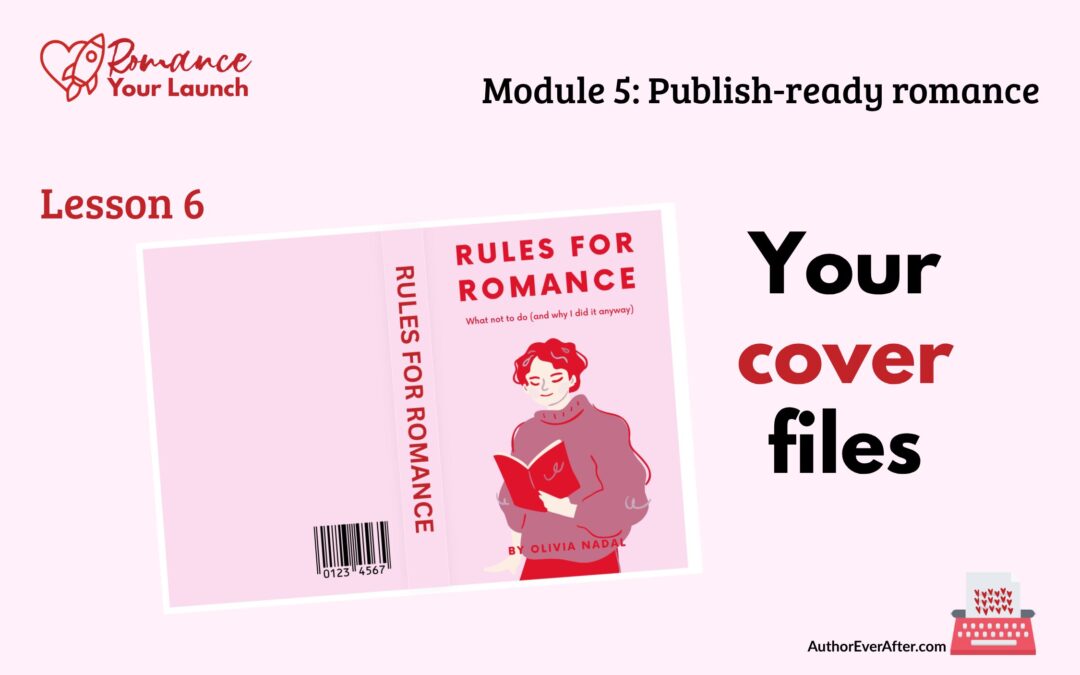
5.6 Book cover file specs for self-publishing authors
Book cover file specs for self-publishing authors Your cover designer has delivered your files. They're beautiful. You love them. You're ready to upload and get this book into the world. Understanding book cover file specs for self-publishing is the one thing standing...
5.5 Formatting check before you publish your romance novel
Your cover is beautiful. But a stunning cover file that fails a platform’s technical requirements can mean reprints, rejected uploads, or colours that shift dramatically between screen and print. Here’s how to get your book cover file specs right before anything goes live.
5.4 How to format a romance novel for self-publishing
Good formatting is invisible. Bad formatting costs you reviews you didn’t see coming. Here’s how to format a romance novel for self-publishing so your pages disappear and your readers stay in the story.

5.2 ISBNs for self-published authors: what you need to know
Before you upload your manuscript anywhere, you need to make one decision that affects every version of your book and every platform it lives on. Here’s what to know about ISBNs for self-published authors before you hit publish.

5.1 Romance novel metadata tips for self-published authors
Your book deserves to be found. But even a great romance novel stays invisible if your metadata isn’t doing its job. These romance novel metadata tips for self-published authors will help you get it right before you hit publish.
4.6 Final manuscript review before publishing your romance
“Almost there” is where a lot of authors stall out. In this lesson, you’ll walk through a final manuscript review before publishing so you can read like a reader, catch small issues that break immersion, and finally feel confident calling your romance done.

4.5 Line edit for a romance novel that feels polished
The line edit is where your romance stops feeling like a draft and starts feeling like a book. In this lesson, you’ll learn how to make your sentences clearer, sharper, and more intentional—without turning your voice into bland, beige prose.
4.4 Scene level edit for a romance novel that hits harder
Scene level edit for a romance novel that readers actually feel The structural edit asked whether your story works; the scene level edit for a romance novel asks whether your story feels. You've fixed the bones: the romance arc is present, the beats are in the right...

4.3 Structural edit for a romance novel that actually works
A structural edit is where you stop fussing over sentences and zoom all the way out to your romance as a whole. In this lesson, you’ll learn how to read your draft for structure, map the romance arc, and spot the big changes that will make everything you revise next actually worth the effort.

4.2 Beta readers for romance authors who want better books
Before you sink weeks into polishing sentences, you need to know if the story actually works for anyone who isn’t you. In this lesson, you’ll learn how to find and brief beta readers for romance authors so you get targeted, story-level feedback that makes revision easier instead of overwhelming.
4.1 Self-editing tips for romance authors who want readers
Self-editing is not a punishment for an imperfect draft; it’s how you give your romance a second life with a clearer head and a sharper eye. In this lesson, you’ll set yourself up with mindset, tools, and support so your edits actually help you reach more readers.
3.5 Social media strategy for romance authors
You do not need to be everywhere online to sell romance. In this lesson, you’ll choose one platform, decide what you actually want social media to do for your career, and build a sustainable posting rhythm that turns curiosity into clicks on your lead magnet.
3.4 Simple romance author websites
Your author website doesn’t have to impress anyone. It has to exist and give readers one clear place to go. In this lesson, you’ll pick an easy platform, claim your URL, write your copy, and build a simple, on‑brand home that points straight to your books and your list.
3.3 Email list setup for romance authors
Followers belong to the platform. Your list belongs to you. In this lesson, you’ll connect your lead magnet to a clean email setup and draft a four‑email welcome sequence so every new romance reader is welcomed, warmed up, and ready when you launch your book.
3.2 Romance lead magnet ideas to grow your email list
Your lead magnet is not a throwaway freebie. It is often the first story a new reader ever sees from you. In this lesson, you’ll choose the right format, length, and emotional promise for your romance lead magnet so it attracts the readers who will go on to buy your books.
Need to go back to a previous lesson?
Return to Module 5: Publish-ready romance to see all six lessons.
Or go back to the Romance Your Launch home page to see all the modules and links to their hub pages.
Want the next lesson in your inbox?
This post is part of the Romance Your Launch series—a lesson-by-lesson guide to self-publishing your romance novel, written for pre-published and early career romance authors.
.
—> Click this link, drop in your name and email address, and I’ll send you two to three lessons a week, starting with Lesson 1.
.
—> If you’d rather just pick up where the series is, join my regular email list from this link.