
Social media strategy for romance authors
Social media should serve your writing, not smother it. This lesson helps you build a focused social media strategy for romance authors: you’ll choose one platform, sharpen a hook that actually attracts your ideal reader, and use simple content pillars to send the right people from every post straight to your free story and your email list.
Let me start by saying the thing most social media marketing advice refuses to say.
You do not need social media to build a successful indie romance author career.
Books sell through algorithms, email lists, reader communities, word of mouth, and the compounding effect of publishing more books. Authors with no social presence at all have built sustainable incomes. Authors who post daily on three platforms have burned out and quit before their second book. Having a TikTok account does not guarantee anything. Not having one does not doom you.
So why are we talking about it?
Because when you use social media intentionally, with a clear purpose, a realistic commitment, and a direct line to your email list, it can speed up the path between you and the readers who would love your books. The authors who use it well are not the ones posting the most. They’re the ones who know exactly what they’re trying to accomplish and do just enough to accomplish it.
That’s what this lesson is about.
Why you need a reason before you need a platform
The most common social media mistake romance authors make is starting with the wrong question. They ask,
“Which platform should I be on?” before they’ve asked,
“What do I actually want social media to do for me?”
Those two questions have very different answers.
If your goal right now is to attract readers into your lead magnet and onto your email list, your social strategy will look one way. If your goal is to connect with comp authors for future cross-promotion, it will look quite different. If your goal is to test how readers respond to your hook and tropes before your book is live, that’s different again, and honestly, it’s one of the most valuable and underused things a pre-published author can do with a social account.
Before you think about content, platforms, or posting schedules, sit with this question:
What do I want this time to do for my author career?
A clear answer is the foundation of a social strategy that actually works. Without it, you’re posting into the void and wondering why nothing happens.
For most authors at this stage, the most useful answer is some version of this: I want social media to bring the right readers to my lead magnet and onto my email list.
That answer shapes everything, including which platform you choose, what you post, how often you post, and how you’ll know whether it’s working.
One platform. Genuinely.
I know you’ve heard this before, and I know there’s probably a voice in your head insisting you should really be on at least three platforms to maximize reach. That voice is wrong, and I say that with love.
But I do have one caveat: claim all the social media platforms with your name, whether you eventually plan to use them or not. You don’t want some fakey-fake person using your name to take it and confuse your future readers when they land on the feed of a death metal singer when they were looking for some small town love stories.
Spreading yourself across multiple platforms at this stage does not maximize reach. It maximizes exhaustion while diluting the quality of what you’re making everywhere. The authors building genuine audiences right now are doing it by going deep on one platform, not skimming across five.
Here’s how to choose yours.
You did reader research in Lesson 1. You know roughly where your ideal reader spends her time online. Use that.
If you’re writing contemporary romance, romantasy, dark romance, or anything trope-heavy that lends itself to enthusiastic, community-driven discovery, TikTok and Instagram Reels can be genuinely powerful. And you do not need to dance, lip-sync, or do anything that makes you want to close the app and never come back. A talking-to-camera video, a text-on-screen clip, or a simple slideshow Reel with a strong hook can perform just as well, sometimes better.
If your books skew cozier, such as small-town romance, sweet romance, or later-in-life love stories, or if your readers tend to gather in communities rather than scroll feeds, Facebook groups may be more effective than they get credit for. Your readers may be in a small-town romance Facebook group rather than on TikTok at all.
If you’re writing for a niche or fandom-adjacent readership, such as paranormal romance, dark romance, or fantasy romance, there may be specific communities on Discord, Reddit, or other dedicated spaces where your readers are intensely present in a way that general social media cannot replicate.
Choose the one place where your specific reader is most likely to see you. Commit to it for six months before you even consider adding a second. Write it down and stop reconsidering.
The decision you make now is not permanent. You can change platforms if yours is not working. But you cannot fairly evaluate whether something is working if you’re constantly second-guessing whether you should be somewhere else.
Your hook is your most valuable piece of content
If social media has one highest-value job for you at this stage, it’s this: testing and refining your hook in public before your book is live.
Your hook is the shorthand description that makes a reader instantly understand whether your book is for her. The formula that often works best, borrowed from film and television pitching and adapted beautifully for romance, is the comp formula: X meets Y in this adjective, adjective, sub-genre.
Here’s what that can look like in practice:
- Virgin River meets Schitt’s Creek in this steamy, small-town romcom.
- Sons of Anarchy meets Hades and Persephone in this dark, high-heat mafia romance.
- Legends & Lattes meets Practical Magic in this cozy, queer romantasy.
- Swoony, slightly spicy fantasy romance with Little Mermaid vibes and a protective hero (this is how Anthea Sharpe describes her special edition of Crown of Sea and Storm).
Notice what’s happening in each example. The comp titles do two jobs at once. They tell the reader the emotional tone and the world, and they signal the reader community she belongs to. Someone who lights up at Legends & Lattes meets Practical Magic knows almost immediately whether that’s her book, without reading a single line of the blurb.
Write a version with trope language. And a third that focuses on the emotional promise of your book.
Draft two or three versions of each hook and then do something most authors skip: post them.
Put each version out on your social platform several times. Early on, your audience will probably be too small to make a confident judgement from a single post. Watch what gets saved, shared, and commented on, and let readers tell you which version lands. This is some of the most direct market research available to you, and it costs nothing.
Once you have a hook that’s working, use it everywhere and use it often. Put it in your bio, in the text overlay on your videos, in your captions, on your website, in your email signature, and on your lead magnet landing page.
Repetition is not a failure of creativity. It’s how a hook becomes a brand signal.
If you need one more reason to come up with your killer hook that links your book to other titles, know that readers are turning more and more to their favourite AI, like ChatGPT, Gemini, and Claude, to tell them what they might enjoy as their next read. They’re typing in requests like, “Give me something like ACOTAR but with a grumpy sunshine hero and zero love triangle,” or “I want a small‑town romcom that feels like Book X, only sapphic.” The more clearly your hooks talk in the language of an answer to a reader recommendation question, the easier it is for those tools to surface your book instead of skipping past you.
What to actually post
The most useful framework for not staring at a blank content calendar is content pillars: three or four recurring themes your posts rotate through.
Pillars give you guardrails so you’re not starting from scratch every time you open the app, and they keep your content coherent enough that a new follower can scroll your feed and immediately understand what you’re about.
For a pre-published romance author, four pillars tend to work well.
1. Book and world teasers
This can include snippets from your work in progress or your lead magnet, such as lines, short passages, out-of-context quotes, or trope teasers.
“Grumpy single dad plus loud-mouthed nanny plus one-bed snowstorm” is a post. A three-line excerpt that captures your voice is a post. A mood-board image with a quote from your opening chapter is a post.
These are the posts that attract exactly the readers who are already looking for what you write.
2. Reader-facing value
This includes trope recommendations, sub-genre lists, and “if you loved X, try Y” content.
This positions you as someone who genuinely knows and loves this genre, which matters, because readers follow authors they trust to point them toward good books, not just authors who promote their own work.
3. Behind the scenes and author identity
This is where you share why you write what you write, what your writing life actually looks like, the playlist you’re listening to for this book, the detail you cannot stop putting in every story, or the moment you realized you were a romance author.
These posts do the relationship-building work. They’re where readers start to feel like they know you, and that is what makes them care whether your book comes out.
4. Lead magnet invitation
These are the most direct posts you’ll write. Here’s the free story, here’s who it’s for, and here’s where to get it.
You do not need to post these constantly, but you do need to post them regularly, because your audience is always changing. The person who followed you last week has not seen the lead magnet post you shared in January.
Consistency over intensity, every single time
Social media rewards regularity far more than brilliance once in a while. An algorithm does not care that your last post was extraordinary if your account has been quiet for three weeks.
The most important number in your social media strategy is not your follower count. It’s the posting frequency you can sustain when life is full, your writing is hard, and you’d rather do almost anything else than film a video.
That number is different for every author. Whatever it is for you, that’s your baseline. And your baseline is worth far more than any burst of intense activity followed by two months of silence.
To make this easier:
- Batch your ideas in one sitting.
- Create multiple pieces of content from a single source. A chapter excerpt can become a quote post, a Reel, a story slide, and a caption.
- Pay attention to which formats and topics consistently perform well for you.
Your audience is telling you what to make more of. Let them.
Social media is the beginning of the conversation, not the end
Everything you post on social media should have a next step, and that next step should almost always be your lead magnet.
The path you’re building looks like this: a post creates curiosity, curiosity sends a reader to your bio, your bio sends her to your lead magnet, she downloads it, she enters your welcome sequence, she joins your email list, and she hears from you on launch day.
Social media is the top of that funnel, not the destination. Followers who never click through to your list become harder to reach every time an algorithm changes. Readers on your email list are yours.
Every post you make should quietly and consistently point toward that next step. Not in a pushy or transactional way. In the way a generous, enthusiastic author naturally says: if you liked this, there’s more where that came from, and it’s free.
Before you open your notes app
Sit with three things before you start building your social strategy:
- What specifically do you want social media to do for your author career right now?
- Which one platform is most likely to put you in front of your actual reader?
- What can you genuinely and sustainably commit to, not on your best day, but on a random Tuesday in a hard week?
Your answers to those three questions are your strategy. The worksheet is where you build it out.
Key takeaway
A social media strategy that works is not the most ambitious one. It’s the most sustainable one.
One platform, one clear goal, a hook you’ve actually tested, and a posting rhythm you can keep when life is busy. That’s it.
Every post you make should point toward your lead magnet and your email list, because the followers you have on any platform are always one algorithm change away from becoming harder to reach. The readers on your list are yours.
Join Author Ever After
You’ll get immediate and full access to the Romance Your Launch program (all 11 modules), a worksheet for every lesson, plus three weekly, small group support meetings to answer all your questions, and a freaking amazing community of pre-published and early career romance authors who are building their indie publishing careers alongside you.
Get more details about the community here.
Or, go straight to the application form.
Get every lesson in the Romance Your Launch course
—> Click this link and I’ll send you two to three lessons a week, starting with Lesson 1.
—>Or, join my regular email list if you’d rather just pick up from the current lesson.
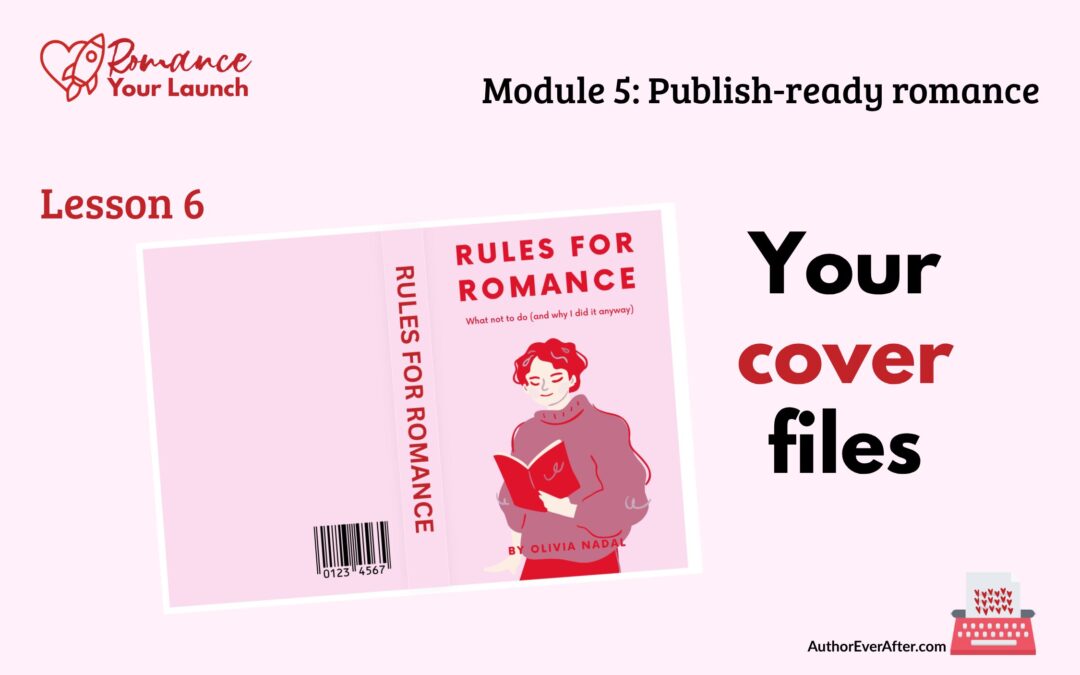
5.6 Book cover file specs for self-publishing authors
Book cover file specs for self-publishing authors Your cover designer has delivered your files. They're beautiful. You love them. You're ready to upload and get this book into the world. Understanding book cover file specs for self-publishing is the one thing standing...
5.5 Formatting check before you publish your romance novel
Your cover is beautiful. But a stunning cover file that fails a platform’s technical requirements can mean reprints, rejected uploads, or colours that shift dramatically between screen and print. Here’s how to get your book cover file specs right before anything goes live.
5.4 How to format a romance novel for self-publishing
Good formatting is invisible. Bad formatting costs you reviews you didn’t see coming. Here’s how to format a romance novel for self-publishing so your pages disappear and your readers stay in the story.
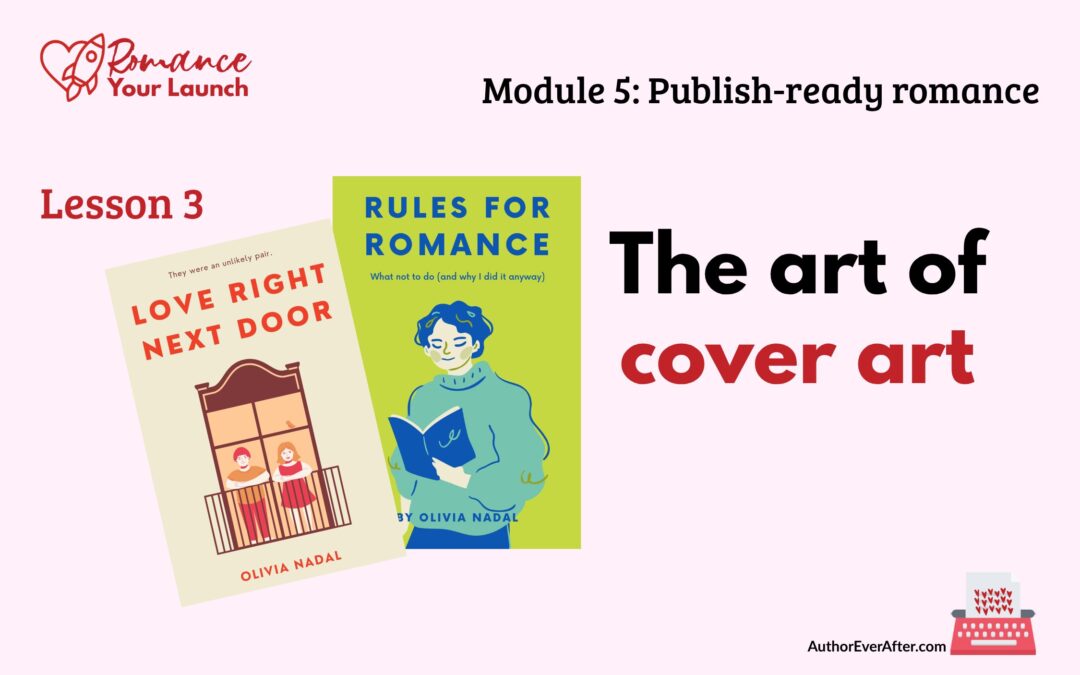
5.3 Romance book cover design guide for indie authors
Your feelings about what looks beautiful are almost beside the point. A romance cover is a signal, not self-expression. This romance book cover design guide shows you exactly what that signal needs to say and how to say it.

5.2 ISBNs for self-published authors: what you need to know
Before you upload your manuscript anywhere, you need to make one decision that affects every version of your book and every platform it lives on. Here’s what to know about ISBNs for self-published authors before you hit publish.

5.1 Romance novel metadata tips for self-published authors
Your book deserves to be found. But even a great romance novel stays invisible if your metadata isn’t doing its job. These romance novel metadata tips for self-published authors will help you get it right before you hit publish.
4.6 Final manuscript review before publishing your romance
“Almost there” is where a lot of authors stall out. In this lesson, you’ll walk through a final manuscript review before publishing so you can read like a reader, catch small issues that break immersion, and finally feel confident calling your romance done.

4.5 Line edit for a romance novel that feels polished
The line edit is where your romance stops feeling like a draft and starts feeling like a book. In this lesson, you’ll learn how to make your sentences clearer, sharper, and more intentional—without turning your voice into bland, beige prose.
4.4 Scene level edit for a romance novel that hits harder
Scene level edit for a romance novel that readers actually feel The structural edit asked whether your story works; the scene level edit for a romance novel asks whether your story feels. You've fixed the bones: the romance arc is present, the beats are in the right...

4.3 Structural edit for a romance novel that actually works
A structural edit is where you stop fussing over sentences and zoom all the way out to your romance as a whole. In this lesson, you’ll learn how to read your draft for structure, map the romance arc, and spot the big changes that will make everything you revise next actually worth the effort.

4.2 Beta readers for romance authors who want better books
Before you sink weeks into polishing sentences, you need to know if the story actually works for anyone who isn’t you. In this lesson, you’ll learn how to find and brief beta readers for romance authors so you get targeted, story-level feedback that makes revision easier instead of overwhelming.
4.1 Self-editing tips for romance authors who want readers
Self-editing is not a punishment for an imperfect draft; it’s how you give your romance a second life with a clearer head and a sharper eye. In this lesson, you’ll set yourself up with mindset, tools, and support so your edits actually help you reach more readers.
3.4 Simple romance author websites
Your author website doesn’t have to impress anyone. It has to exist and give readers one clear place to go. In this lesson, you’ll pick an easy platform, claim your URL, write your copy, and build a simple, on‑brand home that points straight to your books and your list.
Need to go back to a previous lesson?
Return to Module 3: Find your first readers to see all five lessons.
Or go back to the Romance Your Launch home page to see all the modules and links to their hub pages.
Want the next lesson in your inbox?
This post is part of the Romance Your Launch series—a lesson-by-lesson guide to self-publishing your romance novel, written for pre-published and early career romance authors.
.
—> Click this link, drop in your name and email address, and I’ll send you two to three lessons a week, starting with Lesson 1.
.
—> If you’d rather just pick up where the series is, join my regular email list from this link.