
Romance novel metadata tips for self-published authors
When I uploaded my first novel, I treated those metadata fields like an afterthought. I had a story I loved, a cover I was proud of, clean formatting… and then I just filled in the boxes as fast as I could and hit publish. Big mistake. These romance novel metadata tips for self-published authors exist because I learned the hard way that even a great book stays invisible when those fields are filled in carelessly, and this lesson belongs on your pre-launch checklist right alongside your cover reveal and your advance reader copies.
I know. Metadata is not a sexy topic. It doesn’t have the emotional weight of writing your black moment or the satisfaction of seeing your finished cover for the first time. But it is one of the most powerful publishing decisions you’ll make. It’s how Amazon, Kobo, Apple Books, and every other retailer decides which readers to show your book to. Get it right and the algorithm works with you. Get it wrong and you’re publishing into a void, hoping readers stumble across you by accident.
The good news? Metadata is learnable. And once you understand what you’re actually doing when you fill in those fields, it stops feeling like a bureaucratic chore and starts feeling like what it really is: the last step in connecting your book to the person it was written for.
What metadata actually is
Metadata is the information layer that wraps around your book: the title, subtitle, series name, author name, book description, keywords, and categories you enter when you upload your manuscript to a retailer. It’s what the retailer’s algorithm reads to understand what your book is and who to show it to. Book metadata for romance authors covers every one of those fields, and each one is a decision worth making deliberately.
Think of it this way. Your cover catches a reader’s eye. Your blurb earns her click. But your metadata is what determines whether she ever saw your cover in the first place. Romance book discoverability starts here, long before any marketing you do.
Every piece of metadata you enter is a signal you’re sending to the algorithm. Its job is to match books to readers who are likely to buy them, and it does that entirely based on the signals you give it. Strong, accurate, reader-focused metadata means the algorithm can do its job well. Vague or mismatched metadata means your book gets shown to the wrong people, earns poor click-through rates, and quietly disappears from search results over time.
Your title and subtitle
Your title is the first piece of metadata a reader encounters, and it carries more weight than most authors realise. In genre romance, your title has a job beyond sounding beautiful: it needs to signal the emotional tone and, in many sub-genres, hint at the tropes or the world your book lives in.
A title like The Road Back to You could be almost anything. A title like The Grumpy Billionaire’s Forbidden Nanny is doing hard, specific work. It’s telling the reader the tropes, the heat level, and the sub-genre before she’s read a single word of the blurb. Neither approach is universally right. But you need to know which one your specific sub-genre and reader base respond to, and that means looking at what the bestselling books in your corner of the market are actually called.
Subtitles tend to do one of two things: name a series and the book’s place in it (A Maple Creek Romance, Book 2), or add a keyword-rich descriptor that helps with search. Understanding how readers find romance books on Amazon means paying close attention to how those titles and subtitles are constructed in your sub-genre. If your corner of the market uses subtitles, use them. If it doesn’t, don’t force one.
Your book description
Your book description (the blurb) is both metadata and marketing copy, which makes it one of the hardest things you’ll write for your book. It needs to do two distinct jobs at once: convince the human reader to buy, and include the language the algorithm needs to categorise and surface your book correctly.
The blurb that works in romance is not a summary. It’s a seduction. It introduces your main characters with enough specificity to make them feel real, establishes the central conflict or tension, hints at the emotional stakes, and closes with something that makes a reader think I need to know how this ends. It should also read in the emotional register of the book itself. A cozy small-town romance and a dark mafia romance have very different blurb energies, and readers in those sub-genres have been trained to recognise the difference instantly.
Write for humans and the algorithm
What the algorithm needs from your blurb is slightly different. It’s scanning for the language your ideal reader actually uses when she searches: the tropes by name, the sub-genre identifiers, the emotional promises your book makes. This is where romance novel metadata tips get practical. You’re not stuffing your blurb with keywords until it reads like a grocery list. You’re writing a blurb that accurately describes your book in the specific vocabulary of your corner of the romance market. If you’re writing the right book for the right audience, that should come naturally.
The worksheet for this lesson walks you through blurb structure in detail, including how to layer in keyword-rich language without losing the emotional pull. Don’t skip that work. A weak blurb is one of the single biggest reasons well-written romance novels underperform.
Categories and keywords
When you upload to Amazon KDP, you’ll choose categories and enter keywords. These two fields are where most first-time authors make their most consequential book metadata mistakes, either because they don’t understand how the system works or because they make choices based on what sounds right rather than what’s actually strategic.
Categories are the browsing pathways readers use to find books like yours.
Amazon allows you to choose three categories at upload, and you can request additional ones after publication. The instinct is to choose the broadest possible category (Romance, or Contemporary Romance) on the theory that more visibility is better. This is almost always the wrong call. A broad category means competing against tens of thousands of books from established authors with large backlists and advertising budgets. A narrow, well-chosen category means you’re a bigger fish in a smaller pond, with a real shot at the “bestseller” tag that builds social proof and triggers further algorithmic promotion.
The right category for your book is specific, accurately describes what you’ve written, and is one where the top hundred books look like books your reader would also enjoy. That last part matters. You want your book sitting next to its actual competition: the books your ideal reader is already buying.
Keywords work differently.
They’re not visible to readers. They’re signals sent directly to the algorithm, and Amazon gives you seven fields of up to fifty characters each. Strong keywords for romance authors tend to be phrase-based rather than single-word: not “romance” but “small town grumpy sunshine romance,” not “billionaire” but “billionaire forbidden romance series.” You’re trying to match the exact phrases real readers type into the search bar, which means doing actual research into how readers find romance books in your sub-genre, not just guessing at what sounds right.
The places to do that research (Amazon’s own search bar, the “Products related to this item” and “Customers also bought or read” carousels on comparable books (on Amazon), and tools like Publisher Rocket) are covered in detail in the worksheet, along with a process for building a keyword list you can test and refine over time. Because metadata isn’t a one-time decision. You can update it. And early in your book’s life, paying attention to what’s working and adjusting what isn’t is one of the highest-value things you can do for your sales.
Your author name and series information
Two more metadata fields deserve attention before you publish: your author name exactly as it appears on your cover, and your series name and number if this book is part of a series.
Your author name in your metadata must match your author name on your cover and in your author profile. Exactly. Not a different capitalisation, not a version with a middle initial that appears nowhere else. If you use initials, decide once (SP Neeson vs. S.P. Neeson) and use that version everywhere, consistently. That consistency is how retailers connect your books to each other, and how readers find romance books you’ve written after they finish one and immediately want more.
Series metadata is worth getting right from the beginning, even if you’re only publishing book one. Naming your series consistently in every metadata field (the subtitle, the series field, the book description) is what triggers the “also in this series” features on retail pages. That’s essentially free cross-promotion of your future books every time a new reader finds you. Set it up correctly once, and it keeps working.
Metadata is a living document
One of the most freeing things to understand about book metadata for romance authors is that almost all of it can be changed after publication. If your first keyword set isn’t driving traffic, swap it out. If your blurb isn’t converting browsers into buyers, rewrite it. If you discover a more targeted category after your book goes live, you can request a change.
This doesn’t mean publishing with careless metadata and fixing it later. Getting it as right as possible at launch matters, because the first weeks of a book’s life on Amazon are when the algorithm is most actively paying attention to it. But it does mean that metadata work doesn’t end on publication day. The authors who treat it as an ongoing practice tend to see steadily improving romance book discoverability over time, rather than the slow fade that follows a launch with no follow-up.
Your book deserves to be found by the reader it was written for. Metadata is how you make that possible.
Key takeaway
Metadata isn’t an administrative chore you complete after the real work is done. It’s the last step in connecting your book to the reader it was written for. Every field you fill in thoughtfully (your title, blurb, categories, keywords for romance authors, series information) is a signal working on your behalf: in search results, in category browsing, and in the algorithm’s understanding of what your book is and who should see it. Getting it right before you upload means you’re launching with your best foot forward rather than correcting course after the fact.
Join Author Ever After
You’ll get immediate and full access to the Romance Your Launch program (all 11 modules), a worksheet for every lesson, plus three weekly, small group support meetings to answer all your questions, and a freaking amazing community of pre-published and early career romance authors who are building their indie publishing careers alongside you.
Get more details about the community here.
Or, go straight to the application form.
Get every lesson in the Romance Your Launch course
—> Click this link and I’ll send you two to three lessons a week, starting with Lesson 1.
—>Or, join my regular email list if you’d rather just pick up from the current lesson.
This lesson is part of Module 5: Publish-ready romance in the Romance Your Launch program.
5.6 Book cover file specs for self-publishing authors
Book cover file specs for self-publishing authors Your cover designer has delivered your files. They're beautiful. You love them. You're ready to upload and get this book into the world. Understanding book cover file specs for self-publishing is the one thing standing...
5.5 Formatting check before you publish your romance novel
Your cover is beautiful. But a stunning cover file that fails a platform’s technical requirements can mean reprints, rejected uploads, or colours that shift dramatically between screen and print. Here’s how to get your book cover file specs right before anything goes live.
5.4 How to format a romance novel for self-publishing
Good formatting is invisible. Bad formatting costs you reviews you didn’t see coming. Here’s how to format a romance novel for self-publishing so your pages disappear and your readers stay in the story.
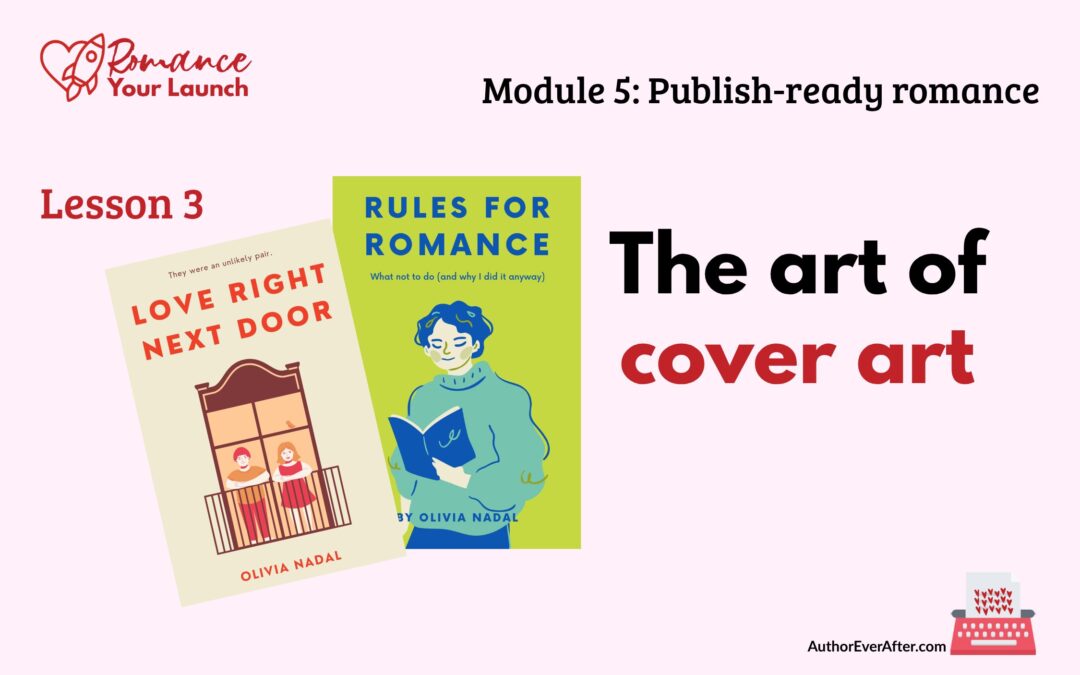
5.3 Romance book cover design guide for indie authors
Your feelings about what looks beautiful are almost beside the point. A romance cover is a signal, not self-expression. This romance book cover design guide shows you exactly what that signal needs to say and how to say it.

5.2 ISBNs for self-published authors: what you need to know
Before you upload your manuscript anywhere, you need to make one decision that affects every version of your book and every platform it lives on. Here’s what to know about ISBNs for self-published authors before you hit publish.
4.6 Final manuscript review before publishing your romance
“Almost there” is where a lot of authors stall out. In this lesson, you’ll walk through a final manuscript review before publishing so you can read like a reader, catch small issues that break immersion, and finally feel confident calling your romance done.

4.5 Line edit for a romance novel that feels polished
The line edit is where your romance stops feeling like a draft and starts feeling like a book. In this lesson, you’ll learn how to make your sentences clearer, sharper, and more intentional—without turning your voice into bland, beige prose.
4.4 Scene level edit for a romance novel that hits harder
Scene level edit for a romance novel that readers actually feel The structural edit asked whether your story works; the scene level edit for a romance novel asks whether your story feels. You've fixed the bones: the romance arc is present, the beats are in the right...

4.3 Structural edit for a romance novel that actually works
A structural edit is where you stop fussing over sentences and zoom all the way out to your romance as a whole. In this lesson, you’ll learn how to read your draft for structure, map the romance arc, and spot the big changes that will make everything you revise next actually worth the effort.

4.2 Beta readers for romance authors who want better books
Before you sink weeks into polishing sentences, you need to know if the story actually works for anyone who isn’t you. In this lesson, you’ll learn how to find and brief beta readers for romance authors so you get targeted, story-level feedback that makes revision easier instead of overwhelming.
4.1 Self-editing tips for romance authors who want readers
Self-editing is not a punishment for an imperfect draft; it’s how you give your romance a second life with a clearer head and a sharper eye. In this lesson, you’ll set yourself up with mindset, tools, and support so your edits actually help you reach more readers.
3.5 Social media strategy for romance authors
You do not need to be everywhere online to sell romance. In this lesson, you’ll choose one platform, decide what you actually want social media to do for your career, and build a sustainable posting rhythm that turns curiosity into clicks on your lead magnet.
3.4 Simple romance author websites
Your author website doesn’t have to impress anyone. It has to exist and give readers one clear place to go. In this lesson, you’ll pick an easy platform, claim your URL, write your copy, and build a simple, on‑brand home that points straight to your books and your list.
3.3 Email list setup for romance authors
Followers belong to the platform. Your list belongs to you. In this lesson, you’ll connect your lead magnet to a clean email setup and draft a four‑email welcome sequence so every new romance reader is welcomed, warmed up, and ready when you launch your book.
3.2 Romance lead magnet ideas to grow your email list
Your lead magnet is not a throwaway freebie. It is often the first story a new reader ever sees from you. In this lesson, you’ll choose the right format, length, and emotional promise for your romance lead magnet so it attracts the readers who will go on to buy your books.
Need to go back to a previous lesson?
Return to Module 5: Publish-ready romance to see all six lessons.
Or go back to the Romance Your Launch home page to see all the modules and links to their hub pages.
Want the next lesson in your inbox?
This post is part of the Romance Your Launch series—a lesson-by-lesson guide to self-publishing your romance novel, written for pre-published and early career romance authors.
.
—> Click this link, drop in your name and email address, and I’ll send you two to three lessons a week, starting with Lesson 1.
.
—> If you’d rather just pick up where the series is, join my regular email list from this link.