
ISBNs for self-published authors: what you need to know
Before you upload a single file to Amazon KDP or IngramSpark (my personal publishing nemesis, more on that another day), you need to make one decision that affects every version of your book, every platform it appears on, and your identity as a publisher for the life of your career. Understanding ISBNs for self-published authors is more consequential than most first-time romance authors realise, and getting it wrong is the kind of thing that’s messy to fix three books into your backlist.
That decision is what to do about your ISBNs.
It sounds technical, and it is, a little. But the underlying question is actually quite simple, and by the end of this lesson you’ll know exactly what you need, what your options are, and what to do next.
What an ISBN actually is
ISBN stands for International Standard Book Number. It’s a 13-digit identifier that is unique to a specific edition of a specific book. Your ebook, your paperback, and your hardcover are each a different edition, and each gets its own ISBN. Every significantly revised edition gets a new one too.
Think of an ISBN the way you’d think of a product barcode. The barcode on a can of soup tells every system in the supply chain exactly what that product is. An ISBN does the same thing for your book. It tells libraries, bookstores, distributors, retailers, and industry databases exactly which book they’re dealing with, and who published it. For romance authors specifically, getting your own ISBN is also the first step in establishing a publishing imprint for indie authors that looks professional in every catalogue and database your book lands in.
That last part is why the decision matters so much.
Every ISBN is assigned to a publisher. When a library catalogues your book, when a bookstore orders it, when a distributor lists it in their system, the ISBN tells them who the publisher is. If you use a free ISBN from Amazon KDP, the publisher of record is Amazon. If you use a free ISBN from IngramSpark, the publisher of record is IngramSpark. If you purchase your own ISBN through the official agency in your country, the publisher of record is you, or more specifically, whatever publishing imprint name you register (which can be your name or pen name, if you prefer).
This distinction matters more in some situations than others, and understanding it is what will help you choose the right path for your publishing goals.
Your three options
Option 1: use a free KDP-assigned ISBN
Amazon KDP offers a free ISBN for your paperback. If you use it, Amazon is the publisher of record and the ISBN is locked to KDP. You cannot use it to distribute your print book through IngramSpark or any other platform. This works fine if you’re publishing exclusively on Amazon with no plans for bookstore or library distribution. The limitation is that the ISBN is not portable. If you ever want to distribute your print book more widely, you’ll need a new ISBN and a new upload.
One important note: KDP does not assign ISBNs for ebooks. Amazon uses their own proprietary identifier (the ASIN) for Kindle ebooks instead. The ISBN vs ASIN question only becomes relevant for your print edition. Your ebook gets an ASIN automatically when it goes live, and you don’t need to do anything to make that happen.
Option 2: use a free IngramSpark-assigned ISBN
IngramSpark also offers a free ISBN if you publish through their platform. The same principle applies: IngramSpark becomes the publisher of record and the ISBN is tied to their system. This works well if IngramSpark is your primary print distributor and you want wider distribution than KDP alone provides. The same portability limitation applies. It’s locked to IngramSpark and cannot be used on KDP or any other retailer.
A note on using both platforms with their respective free ISBNs
Some authors try to solve the distribution problem by listing their paperback on both KDP (with a KDP ISBN) and IngramSpark (with an IngramSpark ISBN). This sounds logical but creates its own problems. Two different ISBNs for the same book can generate two separate product listings on Amazon and in industry databases, which splits your reviews across both pages and weakens your social proof. A book with 47 reviews looks significantly more credible than two listings with 23 and 24 reviews each. You also risk a distribution conflict if KDP expanded distribution and IngramSpark are both active simultaneously, with the same book being offered through Ingram by two different sources at potentially different prices. And in industry databases, the same book appearing under two different publishers of record (Amazon and IngramSpark) looks unprofessional to anyone who looks closely, including librarians and booksellers.
The cleaner solution is Option 3.
Option 3: purchase your own ISBNs
When you purchase your own ISBN through the official agency in your country, you register it under your publishing imprint name. That imprint becomes the publisher of record across every platform and every database, giving you a consistent publishing identity for indie authors, full portability across distributors, and maximum flexibility for your entire backlist. One ISBN assigned to both your KDP and IngramSpark editions means one clean listing, consolidated reviews, and no distribution conflicts. This is the path that makes the most sense for romance authors building a long-term career.
A side note on the cost of ISBNs
If you’re based in the US and the cost of buying your own ISBNs feels frustrating, there’s a reason for that, and it’s not how the system works everywhere.
The United States is one of the only countries in the world where ISBN assignment is handled by a private company (Bowker) rather than a government or national library. That’s why a single US ISBN costs $125 and a block of ten costs $295. It’s a privatised system, and authors pay the price for it.
In many other countries, ISBNs are issued free or at very low cost through national libraries or government agencies. Canada, New Zealand, South Africa, and Nigeria all offer free ISBNs to their authors. Several European countries offer free or heavily subsidised ISBNs as well. The United Kingdom, like the US, uses a private agency (Nielsen) and charges accordingly.
If you’re outside the US, it’s worth checking your country’s national ISBN agency before you assume you’ll need to pay. The International ISBN Agency maintains a full directory of national agencies at isbn-international.org/agencies, and a quick search may save you a meaningful amount of money.
If you’re a US-based author building a backlist, buying a block of one hundred ISBNs at $575 upfront is the most cost-effective path. It works out to $5.75 per ISBN, which is reasonable once you account for how many editions, formats, and future titles you’ll be assigning them to.
Where to get your ISBNs
ISBNs are assigned nationally, so where you get them depends on where you live.
🇺🇸 United States:
Through Bowker at myidentifiers.com.
As of April 2026, a single ISBN costs $125, a block of ten costs $295, and a block of one hundred costs $575. If you’re planning to publish a series with ebooks, paperbacks, audiobooks, special editions, boxsets, large print, and/or translations, buying a block of one hundred makes sense. Each format requires its own ISBN, and those add up faster than most first-time authors expect.
🇨🇦 Canada:
Completely free through Library and Archives Canada.
You register online, provide your publisher information, and receive your first block of ten ISBNs within two weeks. They list you or your imprint as publisher of record, not the retailer. If you’re a Canadian author asking whether do you need an ISBN to self-publish under your own name, the answer is yes, and there is no reason not to get one.
Important note in May 2026: The notice on Library and Archives Canada is warning:
We have recently received a large number of requests that require extra processing. It may take up to two months to process your request. We apologize for the inconvenience and thank you for your patience.
If you are requesting your first batch of ten ISBNs, do so now so you have them before you publish! Plan ahead.
🇬🇧 United Kingdom:
Through Nielsen at nielsenisbnstore.com.
🇦🇺 Australia:
Through Thorpe-Bowker at isbn.org.au.
🌍 Elsewhere:
The International ISBN Agency maintains a directory of all national agencies at isbn-international.org/agencies.
‼️ Important note on third-party resellers ‼️
Some resellers offer ISBNs in the US, UK, and elsewhere at slightly lower prices. Please don’t use them. ISBNs purchased through a third-party reseller often list that reseller as the publisher of record, not you. That defeats the entire point of buying your own. Always purchase directly from your country’s official ISBN agency.
How many ISBNs do you need?
Each distinct edition of your book requires its own ISBN. Here’s how that looks for a typical romance novel:
Publishing exclusively on Amazon KDP with a paperback
A minimum of one ISBN for the paperback. Your Kindle ebook gets an ASIN from Amazon automatically. The ISBN vs ASIN distinction here is simple: ISBNs are for print, ASINs are Amazon’s system for ebooks, and the two don’t overlap.
Publishing on both KDP and IngramSpark with wide ebook distribution
A minimum of two ISBNs, one for the ebook and one for the paperback. The best practice is to give your KDP and IngramSpark paperbacks distinct ISBNs, even though you can sometimes get away with a shared one if you set things up in the right order. IngramSpark and KDP often differ in paper quality, binding, or cover finish, and separate ISBNs allow bookstores to identify which printing house they’re ordering from. It also avoids a distribution conflict if expanded distribution is ever enabled on both platforms simultaneously.
Publishing a hardcover, large print edition, and audiobook
One additional ISBN for each format. Note that audiobook distribution has its own platform-specific considerations we’ll cover separately.
Revised editions
Revised editions get new ISBNs if the content changes significantly. A corrected reprint (fixing typos, updating back matter) does not require a new one as long as the book is substantively the same. Amazon’s own guideline: updates that result in a page count change of more than 10% must be published as a new edition with a new ISBN.
Setting up your imprint
If you’re purchasing your own ISBNs, you’ll register them under a publisher name. This is your publishing imprint as an indie author, and it’s worth a few minutes of thought before you type something in.
Your imprint name will appear as the publisher on your Amazon page, in library catalogues, on IngramSpark listings, and in the industry databases that booksellers and librarians use. It doesn’t need to be elaborate. It just needs to be something you’d be comfortable with on every book you publish, something that doesn’t already belong to an existing publisher (please do a search before you commit), and something that reads as an independent press rather than a personal name alone.
Common approaches romance authors use:
- Something evocative that fits their brand (Midnight Bloom Press, Ember House Books)
- Something simple and location-adjacent (Pacific Rim Publishing, Ridgeline Press)
- Their own name with “Publishing” or “Press” appended
Keep it simple. You can always create additional imprints later if your publishing life expands into significantly different genres. One imprint you’re comfortable with and proud of is enough for now.
Once you have your imprint name and your ISBNs, register your title information in your country’s publishing database. In the US, this is done through Books In Print via myidentifiers.com at the same time you purchase. In Canada, title registration is handled separately through ISBN Canada after publication. This registration is what puts your book in the database that booksellers, librarians, and distributors use to look up and order titles. It’s a small step with a real payoff for any romance author with ambitions beyond Amazon-only distribution.
A note on ASINs
An ASIN is an Amazon Standard Identification Number, a unique identifier that Amazon automatically assigns to every product in its catalogue, including books. The ISBN vs ASIN question comes up a lot for first-time self-published romance authors, and the simplest answer is this: they serve different purposes and live in different systems. ISBNs belong to the wider publishing world. ASINs belong to Amazon.
For Kindle ebooks, your ASIN will always start with the letter B followed by nine alphanumeric characters (for example, B087F4TTHW). For print books, Amazon uses the book’s ISBN-10 as the ASIN, so your paperback’s ASIN will look like a 10-digit number rather than starting with B. If you published your paperback without your own ISBN and used a KDP-assigned identifier instead, it will get a B-starting ASIN like a digital product.
Your ASIN is worth knowing because it’s embedded in your Amazon product link and you’ll use it if you run ads. Some promo sites will ask for it. And some of the reporting tools you’ll use to track your book’s performance willalso require you share it. But it’s not something you need to manage or apply for. Amazon creates it when your book goes live, it stays attached to that listing permanently, and you’ll find it in your title’s URL and as the first entry in your product details.
Key takeaway
The ISBN decision is one you make once per book per edition, and it follows you. Using a free retailer-assigned ISBN is fine for a first book with no plans for wide distribution. But if you’re building a backlist, want bookstore or library access, or simply want to be the publisher of record on your own work, buying your own ISBNs under your own publishing imprint is the right call from the start. It costs more in some countries than others (nothing in Canada!), but the flexibility and professional identity it gives you are worth it.
Join Author Ever After
You’ll get immediate and full access to the Romance Your Launch program (all 11 modules), a worksheet for every lesson, plus three weekly, small group support meetings to answer all your questions, and a freaking amazing community of pre-published and early career romance authors who are building their indie publishing careers alongside you.
Get more details about the community here.
Or, go straight to the application form.
Get every lesson in the Romance Your Launch course
—> Click this link and I’ll send you two to three lessons a week, starting with Lesson 1.
—>Or, join my regular email list if you’d rather just pick up from the current lesson.
This lesson is part of Module 5: Publish-ready romance in the Romance Your Launch program.
5.6 Book cover file specs for self-publishing authors
Book cover file specs for self-publishing authors Your cover designer has delivered your files. They're beautiful. You love them. You're ready to upload and get this book into the world. Understanding book cover file specs for self-publishing is the one thing standing...
5.5 Formatting check before you publish your romance novel
Your cover is beautiful. But a stunning cover file that fails a platform’s technical requirements can mean reprints, rejected uploads, or colours that shift dramatically between screen and print. Here’s how to get your book cover file specs right before anything goes live.
5.4 How to format a romance novel for self-publishing
Good formatting is invisible. Bad formatting costs you reviews you didn’t see coming. Here’s how to format a romance novel for self-publishing so your pages disappear and your readers stay in the story.
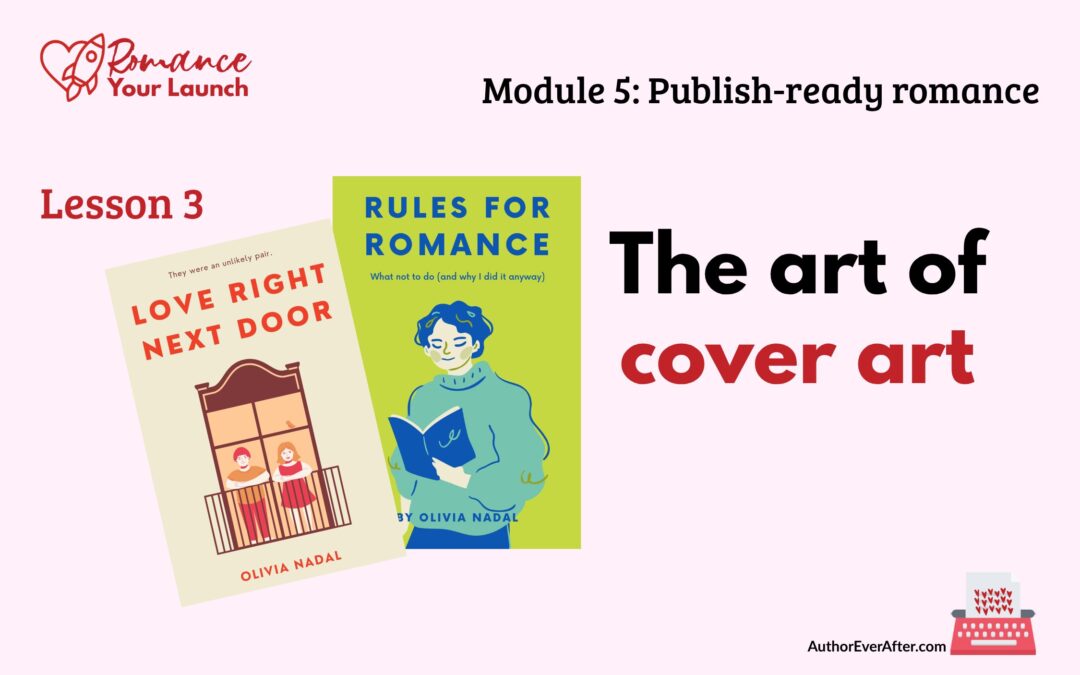
5.3 Romance book cover design guide for indie authors
Your feelings about what looks beautiful are almost beside the point. A romance cover is a signal, not self-expression. This romance book cover design guide shows you exactly what that signal needs to say and how to say it.

5.1 Romance novel metadata tips for self-published authors
Your book deserves to be found. But even a great romance novel stays invisible if your metadata isn’t doing its job. These romance novel metadata tips for self-published authors will help you get it right before you hit publish.
4.6 Final manuscript review before publishing your romance
“Almost there” is where a lot of authors stall out. In this lesson, you’ll walk through a final manuscript review before publishing so you can read like a reader, catch small issues that break immersion, and finally feel confident calling your romance done.

4.5 Line edit for a romance novel that feels polished
The line edit is where your romance stops feeling like a draft and starts feeling like a book. In this lesson, you’ll learn how to make your sentences clearer, sharper, and more intentional—without turning your voice into bland, beige prose.
4.4 Scene level edit for a romance novel that hits harder
Scene level edit for a romance novel that readers actually feel The structural edit asked whether your story works; the scene level edit for a romance novel asks whether your story feels. You've fixed the bones: the romance arc is present, the beats are in the right...

4.3 Structural edit for a romance novel that actually works
A structural edit is where you stop fussing over sentences and zoom all the way out to your romance as a whole. In this lesson, you’ll learn how to read your draft for structure, map the romance arc, and spot the big changes that will make everything you revise next actually worth the effort.

4.2 Beta readers for romance authors who want better books
Before you sink weeks into polishing sentences, you need to know if the story actually works for anyone who isn’t you. In this lesson, you’ll learn how to find and brief beta readers for romance authors so you get targeted, story-level feedback that makes revision easier instead of overwhelming.
4.1 Self-editing tips for romance authors who want readers
Self-editing is not a punishment for an imperfect draft; it’s how you give your romance a second life with a clearer head and a sharper eye. In this lesson, you’ll set yourself up with mindset, tools, and support so your edits actually help you reach more readers.
3.5 Social media strategy for romance authors
You do not need to be everywhere online to sell romance. In this lesson, you’ll choose one platform, decide what you actually want social media to do for your career, and build a sustainable posting rhythm that turns curiosity into clicks on your lead magnet.
3.4 Simple romance author websites
Your author website doesn’t have to impress anyone. It has to exist and give readers one clear place to go. In this lesson, you’ll pick an easy platform, claim your URL, write your copy, and build a simple, on‑brand home that points straight to your books and your list.
3.3 Email list setup for romance authors
Followers belong to the platform. Your list belongs to you. In this lesson, you’ll connect your lead magnet to a clean email setup and draft a four‑email welcome sequence so every new romance reader is welcomed, warmed up, and ready when you launch your book.
3.2 Romance lead magnet ideas to grow your email list
Your lead magnet is not a throwaway freebie. It is often the first story a new reader ever sees from you. In this lesson, you’ll choose the right format, length, and emotional promise for your romance lead magnet so it attracts the readers who will go on to buy your books.
Need to go back to a previous lesson?
Return to Module 5: Publish-ready romance to see all six lessons.
Or go back to the Romance Your Launch home page to see all the modules and links to their hub pages.
Want the next lesson in your inbox?
This post is part of the Romance Your Launch series—a lesson-by-lesson guide to self-publishing your romance novel, written for pre-published and early career romance authors.
.
—> Click this link, drop in your name and email address, and I’ll send you two to three lessons a week, starting with Lesson 1.
.
—> If you’d rather just pick up where the series is, join my regular email list from this link.