
Self‑publishing romance novels: your real opportunities
If you’re self-publishing romance novels, you picked a smart, generous genre to build a business in or to create a fun, fulfilling writing life that fits inside your very real responsibilities. Romance is still the top performing adult fiction category in the English-speaking market. Indie romance authors are not begging for leftovers from traditional publishing, they’re leading many of the conversations and trends that shape the genre.
None of that means this is easy. Recent changes to store algorithms, especially around Kindle Unlimited, have made discoverability bumpier and harder to predict than it was a few years ago. The surge of low-quality and AI-generated titles has makes it even more important for actual romance writers to stand out with clear branding, consistent quality, and reader trust. Even established romance authors talk about income wobbling when they rely on past strategies that no longer work the way they used to.
You do not need to panic. You do need to orient yourself. The opportunity is real and ongoing. It just tends to reward authors who take a long view: series instead of one-off books, relationship-building instead of one big launch, and deliberate choices instead of throwing everything at the wall and hoping something sticks.
In this lesson, you’ll get a bird’s-eye view of the market you’re stepping into so you can make decisions that support your future self, not just your first book.
How big is the romance market, really?
Romance has sat at or near the top of adult fiction sales for a long time, both in traditional and self-publishing.
Industry reports, retailer charts, and bestseller lists consistently show romance shoulder-to-shoulder with, or ahead of, other popular genres like mystery, thrillers, and fantasy. Readers are buying a lot of love stories, and they are not slowing down.
You may see lots of statistics about the romance genre, and while much of it may be accurate (given the sample size, which should always be looked at), the most recent verifiable data is from 2021-2023 and where the oft-cited
“Romance novels generate over $1.44 billion in revenue, making romance the highest-earning genre of fiction”
comes from. That data is from WordsRated.com.
A few other sites to find solid data include:
- Book Riot’s Fascinating Romance Novel Trends In 2023
- PublishDrive’s How To Write A Romance Novel: Tips For Getting A Romance Novel Published
- The Circana BookScan report, Another Year of Romance, with a Dark Twist (from 2025)
The upshot? Romance readers, in particular, buy and read many books a year, often multiple books a month. They binge series, auto-buy favourite authors, and treat romance as both entertainment and emotional self-care. They’re not casual browsers who pick up one book a summer. They are active, engaged, and very clear about what they like. That steady appetite is your opportunity: there is an ongoing, repeat demand for quality new stories.
These readers also talk. They run book clubs, post on social media, recommend books to friends, and leave detailed reviews when a story hits them in the feels. That kind of community behaviour means one book can have a much longer life if it finds the right pocket of readers who are excited to push it into other people’s hands.
Kindle Unlimited as a romance ecosystem
One of the biggest structural realities in our genre is that romance leads most other categories in ebook sales. Digital reading became normal in romance earlier than in many genres, and a huge portion of romance revenue still comes from ebooks and digital-first platforms. If you’ve felt “late” to digital, you’re not. You’re entering a space that already understands and embraces it.
Kindle Unlimited (KU) is Amazon’s subscription reading program. Readers pay a monthly fee, then borrow and read as many enrolled books as their heart’s desire without paying per title.
Authors get paid from a global fund based on how many pages readers actually read of their books, according to Amazon’s KDP terms.
For romance readers who burn through multiple books a week, KU feels like an all-you-can-read buffet, which is why so many of them use it.
Many romance readers search specifically within KU, filter for KU titles, and will take a chance on new-to-them authors because there is no extra cost to trying a book that looks interesting. That behaviour can create real discoverability for indie romance authors who choose to publish exclusively on Amazon through KDP Select to access KU. At the same time, KU has drawbacks: payout rates shift, visibility can change overnight with algorithm tweaks, and exclusivity means you can’t have that book on other major stores like Kobo, Apple Books, or Nook while it’s enrolled.
You don’t need to decide your KU versus wide strategy right now, but you do want to understand that this is a foundational business decision. It affects your launch timelines, your pricing, your marketing plans, and who can easily access your books. We’ll unpack the details in a later lesson so you can choose what fits your goals and your bandwidth.
Who is the romance reader?
Understanding who actually buys romance novels is one of the most useful pieces of market research you can do, especially when you’re self-publishing romance novels and making your own decisions about covers, blurbs, and marketing. Not so you can stereotype, but so you can picture the person on the other side of the “Buy now” button.
Surveys over many years show that romance readers are predominantly women, often spread across a wide age range from young adults through midlife and beyond. Many are juggling work, caregiving, health, and the daily grind, and they turn to romance for escape, hope, and emotional satisfaction. They are also community builders. They write reviews, gush in DMs, post shelfies, run buddy reads, and gently peer-pressure friends into reading the books they love.
Social platforms matter because that is where a lot of this discovery happens. TikTok’s romance corner (often called BookTok) has pushed plenty of titles onto major bestseller lists and introduced waves of new readers to the genre. Instagram’s Bookstagram community remains strong, especially for eye-catching covers.
In 2024, Canada’s national media outlet (kind of like NPR) spoke to several romance authors in a piece called How social media is influencing the romance novel genre—and wider trends in fiction. It’s worth a read.
Goodreads is still a main hub where many readers track their reading and reviews, while alternatives like The StoryGraph are growing and offer different ways to log and discover books.
All of this means that discoverability in romance is not just about “the algorithm.” It’s about readers finding books through other readers, in ecosystems that reward emotional resonance and community chatter as much as ad spend. As you start thinking about your author identity and how you’ll talk about your books, remember that you are not shouting into a void. You’re joining conversations that already exist.
Why self-published romance authors have an edge
There’s a reality in the industry that a lot of traditional publishing folks do not love to say out loud: in digital storefronts where most romance is sold, indie authors often chart very well, sometimes ahead of big traditionally published names. That’s not an accident. It reflects how well the self-publishing model fits the way romance readers read.
Self-published romance authors can release books on their own schedule, often multiple titles a year, which suits binge readers who want the next book in a series sooner rather than later. They can price flexibly, experimenting with free series starters, sale pricing, and retailer-specific promotions to bring new readers into their worlds. They can respond quickly to reader interest in particular tropes or subgenres instead of waiting years for a traditional publishing pipeline to catch up.
On the business side, indie authors keep a higher percentage of each sale, which means you may not need massive sales numbers to see meaningful income over time. You also retain control of your covers, blurbs, metadata, formats, and rights. That control lets you keep aligning your packaging and positioning with the readers you want to reach, instead of hoping someone else gets it right on your behalf.
Traditional publishing is not “wrong” or “bad.” It is one path. (And if that’s a path you’d like to explore, I compiled a list of all the romance publishers who take submissions without an agent. Download your editable spreadsheet here.)
Self-publishing romance novels is another path that has become more respected and proven over the last decade, especially inside our genre. The old stigma around self-publishing has softened considerably as more readers discover and fall in love with indie books without even realizing who published them.
Your opportunity in this market
Everything in this lesson leads to one simple truth: there is room for you. Not someday “when the market calms down.” Now. Readers are not asking for fewer romance novels. They are asking for more books that hit their favourite tropes, more representation, more settings, more banter, more emotional payoffs that feel like they were written by someone who understands what they are carrying in their real lives.
What the market tends to reward, more and more, is authors who give readers a world to return to. A single standalone title can absolutely find readers, but Book 1 in a compelling series or shared world gives both readers and algorithms a clear next step. Authors who are growing sustainable income in self-publishing romance novels are usually doing it by writing series, showing up consistently over time, and building a relationship with the readers who love what they do.
Your job, over the rest of this program, is not to become a marketing machine overnight. It’s to learn how to put your first book, and the books that follow, in front of the right readers in ways that feel professional, strategic, and as enjoyable as possible for you. This is romance. You’re allowed to want some joy in how you build your business too.
How to use this market overview as a new romance author
If you’re pre‑published or early in your career, here’s how I’d use this data in a practical way:
- Treat the big romance revenue numbers as proof there is a market for what you want to write, not as pressure to chase trends.
- Pay attention to which sub‑genres are over‑served and which are still hungry, then choose where your voice and capacity actually fit.
- Decide early whether you’re aiming for KU‑heavy strategy or wide distribution, because that choice affects covers, tropes, and release pace.
This is the same process I walk my Romance Your Launch students through when we map their first series plan.
xo
Danika
PS: The places authors most often get stuck are not talent or ideas. They’re courage, clarity, and trying to wing an entire career alone. You’re already doing something different by learning the business side with support instead of hoping it somehow “just works.”
PPS: A couple of writers replied to the email version of this blog poast and asked…
“Can you make money self-publishing romance novels?”
Yes, you can. Self-published romance authors at the higher-earning end often have multiple series, a strong backlist, sell more than just their book (and audiobooks, and translations) and consistent release schedules.
Many midlist indie romance authors build meaningful part-time income by publishing several books over a few years and learning to launch strategically, even without massive social media followings.
If you want a real-world example of what’s possible, this case study from BookBub Insights walks through how romance author Willow Winters built a six-figure income over time.
This lesson is part of Module 1: Understanding the romance market in the Romance Your Launch program.

4.3 Structural edit for a romance novel that actually works
A structural edit is where you stop fussing over sentences and zoom all the way out to your romance as a whole. In this lesson, you’ll learn how to read your draft for structure, map the romance arc, and spot the big changes that will make everything you revise next actually worth the effort.

4.2 Beta readers for romance authors who want better books
Before you sink weeks into polishing sentences, you need to know if the story actually works for anyone who isn’t you. In this lesson, you’ll learn how to find and brief beta readers for romance authors so you get targeted, story-level feedback that makes revision easier instead of overwhelming.
4.1 Self-editing tips for romance authors who want readers
Self-editing is not a punishment for an imperfect draft; it’s how you give your romance a second life with a clearer head and a sharper eye. In this lesson, you’ll set yourself up with mindset, tools, and support so your edits actually help you reach more readers.
3.5 Social media strategy for romance authors
You do not need to be everywhere online to sell romance. In this lesson, you’ll choose one platform, decide what you actually want social media to do for your career, and build a sustainable posting rhythm that turns curiosity into clicks on your lead magnet.
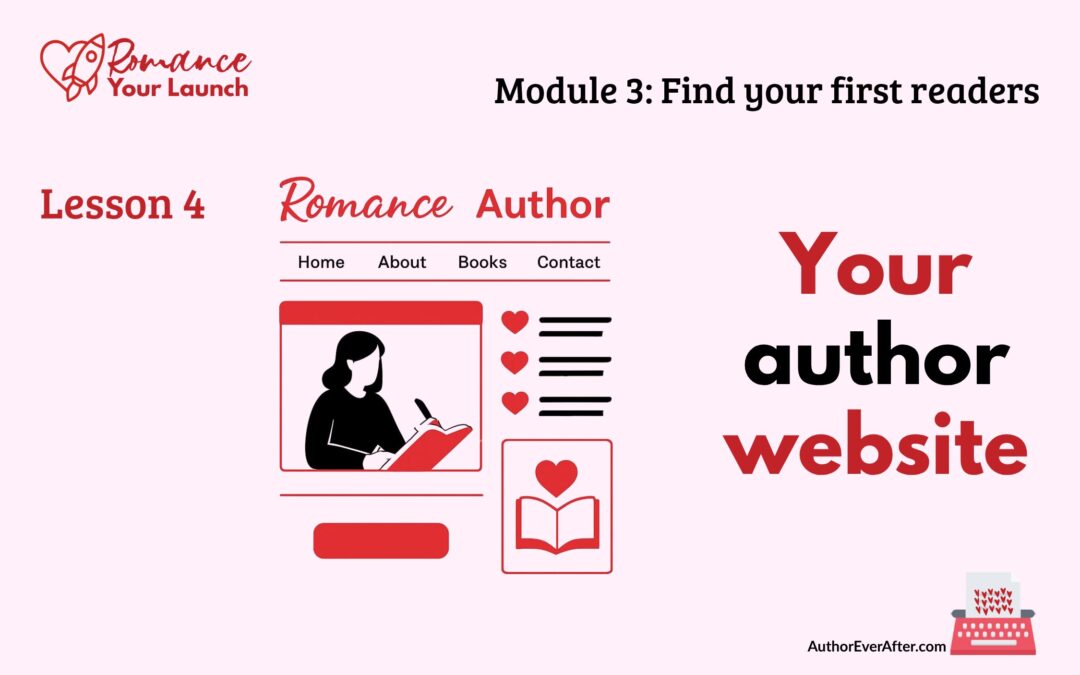
3.4 Simple romance author websites
Your author website doesn’t have to impress anyone. It has to exist and give readers one clear place to go. In this lesson, you’ll pick an easy platform, claim your URL, write your copy, and build a simple, on‑brand home that points straight to your books and your list.
Get every lesson in the Romance Your Launch course
—> Click this link and I’ll send you two to three lessons a week, starting with Lesson 1.
—>Or, join my regular email list if you’d rather just pick up from the current lesson.
All lessons in this module
1.1 Self‑publishing romance novels: your real opportunities
1.2 Popular romance sub-genres and the readers who love them
1.3 Identify your romance author niche and target audience
1.4 Romance reader expectations and market trends in 2026
1.5 Self‑publishing vs traditional publishing in the romance genre
Ready for the next module?
Go back to the Romance Your Launch home page to see all the modules and links to their hub pages.
Want the next lesson in your inbox?
This post is part of the Romance Your Launch series—a lesson-by-lesson guide to self-publishing your romance novel, written for pre-published and early career romance authors.
.
—> Click this link, drop in your name and email address, and I’ll send you two to three lessons a week, starting with Lesson 1.
.
—> If you’d rather just pick up where the series is, join my regular email list from this link.
** If you join from both links, you’ll get duplicate emails. If that happens and you’d like to stop one of them, hit reply to my email and tell me which delivery schedule you’d like to stay on so I can remove you from the other one. If you unsubscribe yourself, you’ll actually be removed from my entire list and won’t get any emails from me at all. ☹️