3.5 Social media strategy for romance authors

3.5 Social media strategy for romance authors

Social media strategy for romance authors

Social media should serve your writing, not smother it. This lesson helps you build a focused social media strategy for romance authors: you’ll choose one platform, sharpen a hook that actually attracts your ideal reader, and use simple content pillars to send the right people from every post straight to your free story and your email list.

Let me start by saying the thing most social media marketing advice refuses to say.

You do not need social media to build a successful indie romance author career.

Books sell through algorithms, email lists, reader communities, word of mouth, and the compounding effect of publishing more books. Authors with no social presence at all have built sustainable incomes. Authors who post daily on three platforms have burned out and quit before their second book. Having a TikTok account does not guarantee anything. Not having one does not doom you.

So why are we talking about it?

Because when you use social media intentionally, with a clear purpose, a realistic commitment, and a direct line to your email list, it can speed up the path between you and the readers who would love your books. The authors who use it well are not the ones posting the most. They’re the ones who know exactly what they’re trying to accomplish and do just enough to accomplish it.

That’s what this lesson is about.

Why you need a reason before you need a platform


The most common social media mistake romance authors make is starting with the wrong question. They ask,

“Which platform should I be on?” before they’ve asked,

“What do I actually want social media to do for me?”

Those two questions have very different answers.

If your goal right now is to attract readers into your lead magnet and onto your email list, your social strategy will look one way. If your goal is to connect with comp authors for future cross-promotion, it will look quite different. If your goal is to test how readers respond to your hook and tropes before your book is live, that’s different again, and honestly, it’s one of the most valuable and underused things a pre-published author can do with a social account.

Before you think about content, platforms, or posting schedules, sit with this question:

What do I want this time to do for my author career?

A clear answer is the foundation of a social strategy that actually works. Without it, you’re posting into the void and wondering why nothing happens.

For most authors at this stage, the most useful answer is some version of this: I want social media to bring the right readers to my lead magnet and onto my email list.

That answer shapes everything, including which platform you choose, what you post, how often you post, and how you’ll know whether it’s working.

One platform. Genuinely.

I know you’ve heard this before, and I know there’s probably a voice in your head insisting you should really be on at least three platforms to maximize reach. That voice is wrong, and I say that with love.

But I do have one caveat: claim all the social media platforms with your name, whether you eventually plan to use them or not. You don’t want some fakey-fake person using your name to take it and confuse your future readers when they land on the feed of a death metal singer when they were looking for some small town love stories.

Spreading yourself across multiple platforms at this stage does not maximize reach. It maximizes exhaustion while diluting the quality of what you’re making everywhere. The authors building genuine audiences right now are doing it by going deep on one platform, not skimming across five.

Here’s how to choose yours.

You did reader research in Lesson 1. You know roughly where your ideal reader spends her time online. Use that.

If you’re writing contemporary romance, romantasy, dark romance, or anything trope-heavy that lends itself to enthusiastic, community-driven discovery, TikTok and Instagram Reels can be genuinely powerful. And you do not need to dance, lip-sync, or do anything that makes you want to close the app and never come back. A talking-to-camera video, a text-on-screen clip, or a simple slideshow Reel with a strong hook can perform just as well, sometimes better.

If your books skew cozier, such as small-town romance, sweet romance, or later-in-life love stories, or if your readers tend to gather in communities rather than scroll feeds, Facebook groups may be more effective than they get credit for. Your readers may be in a small-town romance Facebook group rather than on TikTok at all.

If you’re writing for a niche or fandom-adjacent readership, such as paranormal romance, dark romance, or fantasy romance, there may be specific communities on Discord, Reddit, or other dedicated spaces where your readers are intensely present in a way that general social media cannot replicate.

Choose the one place where your specific reader is most likely to see you. Commit to it for six months before you even consider adding a second. Write it down and stop reconsidering.

The decision you make now is not permanent. You can change platforms if yours is not working. But you cannot fairly evaluate whether something is working if you’re constantly second-guessing whether you should be somewhere else.

Your hook is your most valuable piece of content

If social media has one highest-value job for you at this stage, it’s this: testing and refining your hook in public before your book is live.

Your hook is the shorthand description that makes a reader instantly understand whether your book is for her. The formula that often works best, borrowed from film and television pitching and adapted beautifully for romance, is the comp formula: X meets Y in this adjective, adjective, sub-genre.

Here’s what that can look like in practice:

  • Virgin River meets Schitt’s Creek in this steamy, small-town romcom.
  • Sons of Anarchy meets Hades and Persephone in this dark, high-heat mafia romance.
  • Legends & Lattes meets Practical Magic in this cozy, queer romantasy.
  • Swoony, slightly spicy fantasy romance with Little Mermaid vibes and a protective hero (this is how Anthea Sharpe describes her special edition of Crown of Sea and Storm).

Notice what’s happening in each example. The comp titles do two jobs at once. They tell the reader the emotional tone and the world, and they signal the reader community she belongs to. Someone who lights up at Legends & Lattes meets Practical Magic knows almost immediately whether that’s her book, without reading a single line of the blurb.

Write a version with trope language. And a third that focuses on the emotional promise of your book.

Draft two or three versions of each hook and then do something most authors skip: post them.

Put each version out on your social platform several times. Early on, your audience will probably be too small to make a confident judgement from a single post. Watch what gets saved, shared, and commented on, and let readers tell you which version lands. This is some of the most direct market research available to you, and it costs nothing.

Once you have a hook that’s working, use it everywhere and use it often. Put it in your bio, in the text overlay on your videos, in your captions, on your website, in your email signature, and on your lead magnet landing page.

Repetition is not a failure of creativity. It’s how a hook becomes a brand signal.

If you need one more reason to come up with your killer hook that links your book to other titles, know that readers are turning more and more to their favourite AI, like ChatGPT, Gemini, and Claude, to tell them what they might enjoy as their next read. They’re typing in requests like, “Give me something like ACOTAR but with a grumpy sunshine hero and zero love triangle,” or “I want a small‑town romcom that feels like Book X, only sapphic.” The more clearly your hooks talk in the language of an answer to a reader recommendation question, the easier it is for those tools to surface your book instead of skipping past you.

What to actually post

The most useful framework for not staring at a blank content calendar is content pillars: three or four recurring themes your posts rotate through.

Pillars give you guardrails so you’re not starting from scratch every time you open the app, and they keep your content coherent enough that a new follower can scroll your feed and immediately understand what you’re about.

For a pre-published romance author, four pillars tend to work well.

1. Book and world teasers

This can include snippets from your work in progress or your lead magnet, such as lines, short passages, out-of-context quotes, or trope teasers.

“Grumpy single dad plus loud-mouthed nanny plus one-bed snowstorm” is a post. A three-line excerpt that captures your voice is a post. A mood-board image with a quote from your opening chapter is a post.

These are the posts that attract exactly the readers who are already looking for what you write.

2. Reader-facing value

This includes trope recommendations, sub-genre lists, and “if you loved X, try Y” content.

This positions you as someone who genuinely knows and loves this genre, which matters, because readers follow authors they trust to point them toward good books, not just authors who promote their own work.

3. Behind the scenes and author identity

This is where you share why you write what you write, what your writing life actually looks like, the playlist you’re listening to for this book, the detail you cannot stop putting in every story, or the moment you realized you were a romance author.

These posts do the relationship-building work. They’re where readers start to feel like they know you, and that is what makes them care whether your book comes out.

4. Lead magnet invitation

These are the most direct posts you’ll write. Here’s the free story, here’s who it’s for, and here’s where to get it.

You do not need to post these constantly, but you do need to post them regularly, because your audience is always changing. The person who followed you last week has not seen the lead magnet post you shared in January.

Consistency over intensity, every single time

Social media rewards regularity far more than brilliance once in a while. An algorithm does not care that your last post was extraordinary if your account has been quiet for three weeks.

The most important number in your social media strategy is not your follower count. It’s the posting frequency you can sustain when life is full, your writing is hard, and you’d rather do almost anything else than film a video.

That number is different for every author. Whatever it is for you, that’s your baseline. And your baseline is worth far more than any burst of intense activity followed by two months of silence.

To make this easier:

  • Batch your ideas in one sitting.
  • Create multiple pieces of content from a single source. A chapter excerpt can become a quote post, a Reel, a story slide, and a caption.
  • Pay attention to which formats and topics consistently perform well for you.

Your audience is telling you what to make more of. Let them.

Social media is the beginning of the conversation, not the end

Everything you post on social media should have a next step, and that next step should almost always be your lead magnet.

The path you’re building looks like this: a post creates curiosity, curiosity sends a reader to your bio, your bio sends her to your lead magnet, she downloads it, she enters your welcome sequence, she joins your email list, and she hears from you on launch day.

Social media is the top of that funnel, not the destination. Followers who never click through to your list become harder to reach every time an algorithm changes. Readers on your email list are yours.

Every post you make should quietly and consistently point toward that next step. Not in a pushy or transactional way. In the way a generous, enthusiastic author naturally says: if you liked this, there’s more where that came from, and it’s free.

Before you open your notes app

Sit with three things before you start building your social strategy:

  1. What specifically do you want social media to do for your author career right now?
  2. Which one platform is most likely to put you in front of your actual reader?
  3. What can you genuinely and sustainably commit to, not on your best day, but on a random Tuesday in a hard week?

Your answers to those three questions are your strategy. The worksheet is where you build it out.

Key takeaway

A social media strategy that works is not the most ambitious one. It’s the most sustainable one.

One platform, one clear goal, a hook you’ve actually tested, and a posting rhythm you can keep when life is busy. That’s it.

Every post you make should point toward your lead magnet and your email list, because the followers you have on any platform are always one algorithm change away from becoming harder to reach. The readers on your list are yours.

Join Author Ever After

You’ll get immediate and full access to the Romance Your Launch program (all 11 modules), a worksheet for every lesson, plus three weekly, small group support meetings to answer all your questions, and a freaking amazing community of pre-published and early career romance authors who are building their indie publishing careers alongside you.

Get more details about the community here.

Or, go straight to the application form.

Get every lesson in the Romance Your Launch course

—> Click this link and I’ll send you two to three lessons a week, starting with Lesson 1.

—>Or, join my regular email list if you’d rather just pick up from the current lesson.

This lesson is part of Module 3: Find your first readers in the Romance Your Launch program.
Romance Your Launch: coming May 8!

Romance Your Launch: coming May 8!

Get every lesson from Romance Your Launch—my premium self-publishing program for romance authors—directly to your inbox. For free.
Need to go back to a previous lesson?

Return to Module 3: Find your first readers to see all five lessons. 

Or go back to the Romance Your Launch home page to see all the modules and links to their hub pages.

Want the next lesson in your inbox?

This post is part of the Romance Your Launch series—a lesson-by-lesson guide to self-publishing your romance novel, written for pre-published and early career romance authors. 

.

—> Click this link, drop in your name and email address, and I’ll send you two to three lessons a week, starting with Lesson 1.

.

—> If you’d rather just pick up where the series is, join my regular email list from this link. 
3.4 Simple romance author websites

3.4 Simple romance author websites

How to build a simple romance author website

You do not need a fancy, custom site to look like a real author. In this lesson, you’ll learn how to build a simple romance author website that matches your brand, highlights your books or lead magnet, and gives readers an obvious path to join your email list without getting lost in tech decisions.

A simple home that works

Let me start with the thing I wish someone had said to me early on: your author website does not need to be impressive. It needs to exist. (I was the new author who paid a web designer $$ to have her first author website made … it was pretty, sure, but I never recouped that investment).

That’s it. That’s the bar for version one is that you need to have a spot on the internet that people who search your name will find. And a place to send people to when they ask about your book, which they will once you say, “I write romance novels” to the person you just met at an extended family gathering.

I say this because I’ve watched more authors than I can count delay building a site, or abandon one halfway through, because they got tangled up in decisions about platforms, page structure, colour hex codes, and whether their font was giving the right energy.

Meanwhile, readers who found them on social media had nowhere to go. The link in their bio was a dead end. And every week without a site was another week of reader relationships that couldn’t start.

So before we go any further: your first author website can be a single page. It can be built on a free plan. It can have a placeholder cover and three paragraphs of copy. What it cannot be is nonexistent, because a website you haven’t built yet isn’t doing any of the jobs it needs to do.

What your website actually needs to do

For a romance author at this stage, a basic site has four jobs, and only four jobs.

  1. It tells readers you exist and what you write.
  2. It points them to your books, or your lead magnet while your first book is still in progress.
  3. It points them to your email list.
  4. And it points them to your socials, if you’re actually active somewhere.

That’s it. Everything else, including a blog, a store, a media kit, Easter eggs for superfans, or a page of character art, is optional and can come later. Much later. None of it belongs on your list of things to figure out right now.

Even a simple, rarely updated site does things a social media profile can’t. It’s a professional home you actually own and control, with no algorithm deciding whether readers see it and no random ads sitting next to your book covers. It’s a place you can send readers from any platform, any promo swap, or any newsletter mention. It gives you credibility with other authors, reviewers, and potential collaborators who will look you up before they work with you. And it’s the foundation for direct sales later on, if and when you decide you want that.

The tech doesn’t have to be scary or expensive

You do not need to build a custom WordPress site. You do not need a developer. You do not need to spend more than about $20 to get started, and depending on the tools you choose, you might spend nothing at all (beyond the cost to purchase your URL).

There are several services built specifically to make author sites almost plug and play, and they’re genuinely good.

BookBub’s author pages and website builder give you a clean, book-centric presence that’s easy to configure. Multi-published hybrid author Jennifer Sommersby, who also writes as Eliza Gordon, recently moved her author site to BookBub and it looks great.

CrewFiction offers a simple author page that works well even if you only have a lead magnet at this point. E.J. Campbell, a new author, is a good example of how to use it to signal dark romance clearly.

MailerLite includes basic website and landing page templates as part of its free plan. Author Ever After member Jillian Beane has used MailerLite as her website home for her two series. She’s even included a page of pronunciations for her fantasy romance and book club questions on a page she calls Fun Tidbits. Simple, functional, and completely her. (And if you notice the URL is something funky, don’t worry about that. You give people your normal web address—like JillianBeane.com—and set it up to redirect to MailerLite. easy-peasy).

Carrd builds clean single-page sites for free, and the Pro plan, which gives you more customization, is only $19 a year. Author Ever After member Tami Winbush built her site in Carrd, putting her brand feeling onto one of the hundreds of templates it offers.

If tech makes your shoulders crawl up around your ears, pick one of these and don’t look back. The goal for version one is simple: claim your URL before someone else does, and put something real at that address.

Your URL: claim it now

Think of your URL as your bookstore’s street address. You want it to match your author name or imprint, be as simple and memorable as possible, and ideally end in .com. Readers still default to that, though .author, .books, or your country domain can work if .com is already taken.

You’ll pay somewhere around $10 to $20 USD per year for a .com domain. You can buy it through a hosting provider like DreamHost or Bluehost, or through a registrar like Namecheap or Domain.com and then point it to wherever your site lives.

One thing a lot of new authors don’t know to do is turn on Whois privacy when you register. When you register a domain, your personal information, including your real name, actual address, and primary email, is collected and can end up in a public database called Whois. Most registrars now include privacy protection free or for a small fee. Turn it on. It keeps your home address off public directory searches, reduces spam, and adds a layer of safety that genuinely matters when you’re building a public presence.

Let your Module 2 work do the heavy lifting

Here’s the good news: you’ve already done most of the hard thinking. In Module 2, you identified your brand values and traits, chose your colours, fonts, and imagery styles, and described your author voice. Your website doesn’t require you to make new decisions. It just requires you to apply the ones you already made.

That means using your author photo or logo consistently, ideally the same image on your website, socials, and email header. It means applying your colour palette to buttons, links, headings, and accent blocks. It means choosing fonts in your site builder that are as close as possible to your chosen trio. You may not be able to match them exactly, and that’s fine. Just get as close to the feeling you want as the builder allows. And it means selecting imagery that matches your brand mood: soft and romantic, dark and mysterious, bold and playful, small-town cozy, whatever your books are promising.

You’re not building a design portfolio. You’re making your site look like the same author who’s been showing up in your bio, your branding, and your socials. Coherence is the goal.

What (pages) you actually need

A full author site can eventually include a lot. Right now, you need very little.

Your home page is the front door. A quick snapshot of who you are and what you write, a feature on your latest book or lead magnet, and a clear visible link to join your email list. That’s all it needs to be.

Your About page is where readers get to know you beyond your books. Your short bio, your author photo, and a few on-brand details that support your persona belong here. Focus less on your rĂ©sumĂ© and more on what’s in it for the reader: the emotional experience you offer.

Your Books page is the heart of the site. Include a cover, a short description, key tropes, heat level, and buy links or a coming-soon note for each title. If you only have one book, or none yet, a simple feature section is fine. You can absolutely link to your lead magnet as your first book. Just make sure you do it so that you capture those email addresses!

A Contact page gives readers a way to send fan mail and gives bloggers, podcasters, and event organizers a way to reach you. Set expectations here too. “I read everything but may not be able to respond to every message” is honest, kind, and saves you guilt later. BUT—make replying to readers a high priority. And with the caveat that you may not reply underlaying your reply, your reader will feel very special. (And she is!).

And you need some kind of newsletter sign-up, whether that’s a dedicated page, a section on your home page, or an embedded form in your header or footer. This part is non-negotiable. Getting people to your site without giving them a way onto your list is like opening a shop with no till. Use your lead magnet here!

Worth noting: these five things do not need to be five separate pages. On a simple site, they can all be sections on one landing page. That’s a completely legitimate version-one website, and it’s what a lot of authors use until their backlist grows enough to need more.

Steal like an artist (my fave thing to do!)

You do not have to invent any of this from scratch. One of the most useful things you can do before you build anything is spend an hour or two looking at newer author websites you genuinely like, especially authors in your sub-genre.

Visit three to five sites and pay attention to what makes you feel welcome the moment you land on the home page. Look at how they present their books, where they put their newsletter sign-up, and what their About page actually says. Notice their navigation, which pages they’ve included, and the order they appear in. Pay attention to the tone of their copy too: playful, cozy, intense, wry.

You’re not copying. You’re noticing what works and translating it into your voice, your colours, your fonts, and your priorities. Austin Kleon calls it “steal like an artist.” I call it doing your research before you do your work. Either way, it turns a blank page into a starting point, and that’s the job.

Build your site from a document, not a blank screen

The single best thing you can do before you open your site builder is write your copy first, somewhere else. In a Google doc. In Notion. On paper if that’s your thing. Anywhere but directly in the site builder.

Trying to write and design at the same time is a special kind of hell, and I do not recommend it.

When you already have your copy written, your welcome paragraph, your about blurb, your book descriptions, your newsletter invitation, building the site becomes a copy-and-paste job. It takes a fraction of the time and produces a much cleaner result.

Before you open any platform, draft:

  • Your author business name. Are you “Danika Bloom,” “Danika Bloom Romance,” or “Fire Lily Press”?
  • An optional tagline, such as “Small-town steamy romance with heart and humour.”
  • Your home page welcome.
  • Your About page copy adapted from Lesson 2.
  • Your book descriptions with tropes and heat level.
  • A simple contact message with any expectations you want to set.

While you’re at it, gather your visuals in one folder:

  • Your author photo or logo.
  • A favicon, the tiny image that shows in the browser tab. Leave this out and you get a generic brown box, which is on-brand for exactly nobody.
  • Your book covers or placeholders.
  • Two or three on-brand images for your home page.

Author Ever After members can use the DepositPhotos offer mentioned in the worksheet to source on-brand images for their site and socials.

Having all of this ready before you start building is the difference between a site that takes an afternoon and a site that takes three weeks of open browser tabs.

Key takeaway

Reserve your URL. Choose the simplest platform that works for you. Use the branding decisions you already made in Module 2. Write your copy before you build. Then build the thing.

Your first site does not need to be impressive. It needs to exist, feel like you, and give readers one clear place to go. Everything you add after that is a bonus.

The worksheet walks you through the decisions and drafts in order: tool choice, URL registration, copy, visuals, and a community share so you can get eyes on it before it goes live.

The best place to gut-check your choices and get sub-genre-specific tool recommendations is in the Author Ever After community, from authors who’ve already been through exactly this.

Join Author Ever After

You’ll get immediate and full access to the Romance Your Launch program (all 11 modules), a worksheet for every lesson, plus three weekly, small group support meetings to answer all your questions, and a freaking amazing community of pre-published and early career romance authors who are building their indie publishing careers alongside you.

Get more details about the community here.

Or, go straight to the application form.

Get every lesson in the Romance Your Launch course

—> Click this link and I’ll send you two to three lessons a week, starting with Lesson 1.

—>Or, join my regular email list if you’d rather just pick up from the current lesson.

This lesson is part of Module 3: Find your first readers in the Romance Your Launch program.
1.1 Self‑Publishing Romance Novels: The Market in 2026

1.1 Self‑Publishing Romance Novels: The Market in 2026

Self-publishing romance novels is not a pipe dream or a shortcut. It is a real way to build a joyful, sustainable author career when you understand the market, the readers, and your options. This first lesson gives you the lay of the land so you can make informed choices.

Romance Your Launch: coming May 8!

Romance Your Launch: coming May 8!

Get every lesson from Romance Your Launch—my premium self-publishing program for romance authors—directly to your inbox. For free.

Ready for the next step in the module?

Return to Module 3: Find your first readers to see all five lessons. 

Or go back to the Romance Your Launch home page to see all the modules and links to their hub pages.

Want the next lesson in your inbox?

This post is part of the Romance Your Launch series—a lesson-by-lesson guide to self-publishing your romance novel, written for pre-published and early career romance authors. 

.

—> Click this link, drop in your name and email address, and I’ll send you two to three lessons a week, starting with Lesson 1.

.

—> If you’d rather just pick up where the series is, join my regular email list from this link. 
3.3 Email list setup for romance authors

3.3 Email list setup for romance authors

Email list setup for romance authors

An email list is the one part of your audience you actually own, and setting it up does not have to be complicated. In this lesson, you’ll walk through a simple email list setup for romance authors, connecting your lead magnet delivery to a clean subscriber list and a four‑email welcome sequence that introduces you like a pro.

Get your lead magnet into readers’ hands

Let’s keep this simple, because this topic can very quickly become the opposite of simple.

You have a lead magnet. Someone wants to download it. When they do, two things need to happen: they need to actually receive the file, and you need to capture their email address so you can stay in touch. Everything else, including sequences, segmentation, analytics, and list architecture, is covered in Module 8. This lesson is just about getting the mechanism in place so your lead magnet can do its job.

Two tools. One list. Four emails. That’s the whole task.

The two jobs your setup needs to do

Before you look at a single tool, it helps to understand what you’re actually trying to accomplish.

Job 1: Deliver the lead magnet.


When a reader clicks your download link, she needs to receive the file cleanly, formatted correctly for her device, and delivered in a way that feels professional and author-branded. This is not as simple as attaching a PDF to an email. Device compatibility, download reliability, and reader experience all matter, and a clunky delivery process undermines the goodwill your lead magnet is trying to build.

Job 2: Capture and store the email address.


When she downloads the file, you need her email address added to your list automatically so you can follow up with your welcome sequence. This is what turns a one-time download into the start of a reader relationship.

Some tools do both jobs in one place. Others split the work between two tools that talk to each other. Both approaches work. What matters is that you choose one and actually set it up.

Your options


Option A: SendFox


If you’re at the very beginning of your author career and you want a capable, clean email setup without a monthly subscription, SendFox is worth a look.

SendFox is available through AppSumo as a one-time payment of $49 for up to 5,000 subscribers, not a monthly fee and not an annual renewal. You pay once and it’s yours. For a new author who isn’t sure yet how quickly her list will grow or how long it will take to recoup any business investment, that’s genuinely different math from what most ESPs offer.

I used SendFox for my own list for five years. The deliverability is solid, the sign-up page is clean and professional, and the automations are straightforward to set up, which means your welcome sequence can do exactly what you need it to do at this stage. It’s not as feature-rich as MailerLite at the higher tiers, and the AppSumo deal is the main way to access it at that price point, so it’s worth checking whether the offer is still live when you’re reading this. But if it is, it’s one of the best-value options available for authors just getting started.

You can pair SendFox with StoryOrigin’s free plan for lead magnet delivery in the same way you would MailerLite. The integration works cleanly between the two.

Option B: MailerLite + StoryOrigin


This is the combination I’d point most on-a-budget writers toward in 2026, and it’s the setup I’d recommend you ask about first in the community.

MailerLite is your email service provider, or ESP. It’s the tool that stores your subscribers, sends your emails, and runs your welcome sequence. It’s well regarded for deliverability, has a clean and learnable interface, and is the ESP most commonly used by indie romance authors right now.

A few things to know before you sign up:

  • The free plan supports up to 500 subscribers and 12,000 emails per month. That’s enough to get started, but you’ll hit the limit faster than you might expect if your lead magnet performs well.
  • The free plan includes automation, landing pages, and forms, which are the things you actually need at this stage.
  • It includes MailerLite branding on your emails until you upgrade, and upgrades start at $10 a month for 500 subscribers.

StoryOrigin handles the delivery side. It gives your reader a clean professional download page, manages device compatibility, and integrates directly with MailerLite so that when someone downloads your lead magnet, their email address is automatically added to your list.

Pricing:

  • The free plan includes email service provider integration and unlimited file delivery, which means you can connect it to MailerLite and have the full delivery-to-list pipeline working at no cost.
  • The Standard plan at $10 a month or $100 a year adds group promotions, newsletter swaps, ARC management, and other list-building tools you’ll want eventually, but you don’t need them right now.

StoryOrigin is also BookFunnel’s main competitor, and many romance authors use it because the free plan includes the email integration that BookFunnel reserves for higher-tier plans.

Option C: MailerLite + BookFunnel


BookFunnel is the better-known delivery tool, and it’s excellent, but the pricing structure changed in early 2026 and it’s worth understanding before you commit.

The First-Time Author plan is $30 a year and covers basic book delivery. However, email integration, the feature that automatically adds a downloader’s address to your MailerLite list, is only available on the Mid-List Author plan at $20 a month or $200 a year.

That’s a meaningful cost difference at the start of your author career, especially compared with StoryOrigin’s free integration tier. If you already have a BookFunnel account from a previous promotion and you’re on a plan that includes integrations, use it. If you’re starting from scratch, StoryOrigin’s pricing is much more beginner-friendly for this specific use case.

Option D: CrewFiction


CrewFiction is an all-in-one platform built specifically for fiction authors that handles email list management, lead magnet delivery, and reader community features in a single tool. If the idea of managing two separate platforms and an integration between them creates genuine anxiety, it’s worth a look.

The trade-off is that it’s newer and less widely used than MailerLite, SendFox, StoryOrigin, or BookFunnel. That means a smaller community of indie romance authors who can answer your questions, fewer tutorials, and less accumulated peer knowledge about what works for romance-specific use cases.

It’s not the wrong choice, but it is the one that asks you to figure more out on your own. That said, I recently moved my romance list from SendFox and BookFunnel to CrewFiction and I’ve been very happy with the service.

Option E: Ask your community first


I’ve given you suggestions from my own expeirence and that of many early career romance I know and have worked with. There are literally dozens of other ESPs you could use that I haven’t mentioned but that romance authors use. FloDesk, Kit, and even Substack come to mind. I’ve looked at those three and none do as good a job (for that money) that my recs do. In my opinion! So do your own research! Before you spend a single dollar or sign up for anything, post this question in a romance author community:

“What are you using to deliver your lead magnet and send your welcome emails, and if you were starting from scratch today, would you choose the same thing?”

The answer you get from authors in your specific sub-genre will tell you more than any comparison chart I (or anyone else) can make. People who write what you write, for readers like yours, have already made these decisions and learned from them. Use that.

This is not a reason to delay setting things up. It’s a reason to spend twenty minutes asking before you spend twenty hours figuring it out alone.

What you actually need set up right now

Once you’ve chosen your tools, here’s the full scope of what needs to exist before your lead magnet goes live. Nothing more.

One list.

Name it something simple: your author name, “readers,” or “newsletter.” Don’t overthink it.

One sign-up form or landing page connected to that list, with clear copy about what the reader is getting, the lead magnet, and what they can expect from you going forward, including a rough sense of how often you’ll email and what kind of emails you send.

One welcome sequence, four emails, triggered automatically when someone signs up:

  • Email 1, sent immediately: deliver the lead magnet, say hello, set expectations, keep it short. Oh, and provide whitelist instructions to keep your email out of the dread Promotions tab on Gmail.
  • Email 2, sent two to three days later: who you are and what you write. This is the email where you earn the relationship. Share something true about why you write romance, in your actual voice. And ask them to reply. The readers who reply are gold. Start a conversation.
  • Email 3, sent three to four days later: what they can expect from your emails going forward, what you’ll send, roughly how often, and another invitation to reply and introduce themselves. I cannot express how valuable direct engagement with readers is. To many, you are a rock star because you’re a romance author. When you reply, it’s meaningful.
  • Email 4, sent four to seven days later: your “why romance” email, the deeper human story behind your writing.  Not marketing-speak. Just true. Please do not use a bot to write this email. Your human voice, even if it’s clunky, is far more valuable than a polished letter.

After Email 4, your subscribers roll into your regular list and start receiving whatever you send to everyone else. Module 8 goes deep on what that looks like. For now, you just need these four emails to exist and send automatically.

The one thing to resist:

Spending two weeks comparing tools instead of choosing one and starting.

MailerLite plus StoryOrigin on their free plans gives you a fully functional setup for zero dollars. Once you hit the 500 subscribers, if you’re still not ready to pay monthly, exporting your list and getting the $49 Sendfox account is super easy.

The best email setup is the one that exists before your lead magnet goes live. That’s the bar. You can optimize everything else later.

Key takeaway

Getting your email setup in place before your lead magnet goes live is one of the highest-value things you can do at this stage of your author career. The tools are more accessible and more affordable than they’ve ever been, and the four-email welcome sequence you build here will work quietly on your behalf every time a new reader downloads your story, introducing you, building trust, and turning a one-time download into a reader who’s genuinely looking forward to hearing from you again.

Join Author Ever After

You’ll get immediate and full access to the Romance Your Launch program (all 11 modules), a worksheet for every lesson, plus three weekly, small group support meetings to answer all your questions, and a freaking amazing community of pre-published and early career romance authors who are building their indie publishing careers alongside you.

Get more details about the community here.

Or, go straight to the application form.

Get every lesson in the Romance Your Launch course

—> Click this link and I’ll send you two to three lessons a week, starting with Lesson 1.

—>Or, join my regular email list if you’d rather just pick up from the current lesson.

This lesson is part of Module 3: Find your first readers in the Romance Your Launch program.
1.3 Finding Your Romance Author Niche and Target Reader

1.3 Finding Your Romance Author Niche and Target Reader

Your sub‑genre tells readers what you write. Your romance author niche tells them why your book is the one they’ve been waiting for. In this lesson, you’ll define your niche and target audience so every decision you make about branding, blurbs, and marketing points straight at your ideal reader.

1.1 Self‑Publishing Romance Novels: The Market in 2026

1.1 Self‑Publishing Romance Novels: The Market in 2026

Self-publishing romance novels is not a pipe dream or a shortcut. It is a real way to build a joyful, sustainable author career when you understand the market, the readers, and your options. This first lesson gives you the lay of the land so you can make informed choices.

Romance Your Launch: coming May 8!

Romance Your Launch: coming May 8!

Get every lesson from Romance Your Launch—my premium self-publishing program for romance authors—directly to your inbox. For free.

Ready for the next step in the module?

Return to Module 3: Find your first readers to see all five lessons. 

Or go back to the Romance Your Launch home page to see all the modules and links to their hub pages.

Want the next lesson in your inbox?

This post is part of the Romance Your Launch series—a lesson-by-lesson guide to self-publishing your romance novel, written for pre-published and early career romance authors. 

.

—> Click this link, drop in your name and email address, and I’ll send you two to three lessons a week, starting with Lesson 1.

.

—> If you’d rather just pick up where the series is, join my regular email list from this link. 
3.2 Romance lead magnet ideas to grow your email list

3.2 Romance lead magnet ideas to grow your email list

Romance lead magnet ideas to grow your email list

Your email list needs more than a half‑hearted sample to grow. This lesson walks you through proven romance lead magnet ideas so you can choose a short story, prequel, side‑character bonus, or strong sample that delivers your signature emotional hit and makes new readers eager to join your email list.

Give them a reason to say yes

When I published my first romance novel, nobody told me I should be building an email list before my book was live. Nobody told me a lot of things, which is part of why this course exists. So when I finally decided I wanted a list, I used the first three chapters of the novel I’d just published as my sign-up incentive.

It worked well enough. A few hundred people signed up. Some of them probably bought the book.

But here’s the problem: those three chapters weren’t designed to do the job a lead magnet needs to do. They didn’t introduce a cold reader to my world on her terms. They dropped her into a story without a satisfying payoff, because the payoff was in the book she hadn’t bought yet. It wasn’t a gift. It was a sample. Lots of romance readers will react badly to this “bait and switch” when they expect an HEA and are left being asked to pay to see it. That’s a terrible first impression for readers.

I’ve learned a lot about lead magnets since then. This lesson is what I wish someone had handed me before I hit publish.

Why your email list matters most

Before we get into the what and how of lead magnets, let’s get clear on why this matters. “Build an email list” is advice that gets thrown around constantly in indie publishing circles, often without much explanation of why it’s worth your time.

Here it is: your email list is the only reader relationship you actually own.

Your TikTok following? The platform owns it. One algorithm change, one account suspension, one company acquisition, and you could wake up tomorrow with no reliable way to reach the readers you spent two years gathering. The same is true for Instagram, Facebook, Substack, any of it. You’re renting attention on someone else’s platform, and the terms can change at any time.

Your email list is different. Those readers gave you their address directly. The relationship lives in your account, not on a platform. When you have a new book live, a cover reveal to share, a sale running, or just a story you want to tell your readers, you can reach them directly. No algorithm decides whether your content gets seen. No ad spend is required. No hoping they happen to scroll past at the right moment.

Romance readers are also genuinely enthusiastic email subscribers. They follow their favourite authors. They want to know when the next book is coming. They pre-order. They leave reviews. They tell their reader friends. The readers on your list aren’t passive. They’re the most engaged and the most likely to buy. The relationship you build with them through consistent, honest, enjoyable emails is what turns a one-time reader into someone who pre-orders every book you write without needing to be convinced.

That’s why we’re talking about this in Module 5, before your book is live. The authors who launch to crickets are usually the ones who started building their list after publication. The authors who launch to real, warm readers started earlier and used a lead magnet to do it.

So what is a lead magnet?

A lead magnet is something valuable you offer for free in exchange for a reader’s email address. It’s the answer to the question every cold reader is quietly asking before she subscribes: what do I get out of this?

For romance authors, the most effective answer is almost always the same: a story.

Not a PDF of tips. Not a checklist. Not a quiz. A story. A short, complete piece of fiction that delivers the same emotional experience your full-length books deliver, in miniature. Something a reader can start and finish in one sitting and put down thinking, I want more of this.

Here’s the distinction to keep in mind as we go through this lesson.


A lead magnet is content for a cold audience: readers who haven’t read your books yet and found you through social media, a blog post, a newsletter swap, or a recommendation. They don’t know you. They’re curious about you. Your lead magnet is your first real introduction to those readers, and its job is to give them enough of your world, your voice, your heat level, and your emotional tone that they decide they want to stay in it.

A reader cookie is content for readers who have just finished one of your books. These are warm readers who already love you and want more of the specific couple they just met. A reader cookie, typically a bonus epilogue, invites those readers onto your list from the back matter of your book. Same list-building goal. Completely different audience. Completely different content. We’ll cover strategies for reader cookies in a later module.

This lesson is about lead magnets, which means we’re designing for the stranger. The woman who found your Instagram last week, thought your vibe looked interesting, and clicked the link in your bio. She’s on the fence. She’s not handing over her email address for nothing. What are you going to give her?

What makes a romance lead magnet work

The lead magnets that convert, meaning readers actually sign up, actually download, actually read, and actually feel something, have three things in common.

They deliver your emotional promise.

Your lead magnet isn’t just content. It’s a sample of the experience readers can expect from your full-length books. If you write slow-burn with aching tension and a guaranteed emotional payoff, your lead magnet should feel like that. If you write chaotic, bantery romantic comedy with chemistry that crackles off the page, your lead magnet should feel like that. A reader who signs up, reads your free story, and thinks this is exactly my kind of book is a reader who will one-click your debut the moment it’s live.

They’re complete.

A lead magnet that ends on a cliffhanger or cuts off mid-arc and effectively demands the reader buy your book to get resolution feels like a bait and switch. Readers notice. They feel manipulated, even if they can’t quite name why. Your lead magnet should tell a complete story. Small, contained, satisfying. The reader closes it and thinks, I want more of this, not, I can’t believe that just ended.

They’re the right length for the job.

This is not the place to prove how much you can write. A cold reader who picked up your lead magnet on a whim is not committing to a novel. She’s sampling. Keep it lean. Between 3,000 and 10,000 words is the sweet spot for most romance lead magnets: long enough to deliver a real emotional experience, short enough that she actually reads it before she forgets why she signed up.

Four lead magnet types that work

There’s no single right answer here, but there are a handful of formats that consistently work well. Pick the one that fits your book and your bandwidth.

The prequel short story.


A short complete story set before your main book begins, featuring your main couple or a key secondary character. This works beautifully when there’s meaningful backstory that didn’t make it into the book: the moment before the meet-cute, the first encounter years earlier, the event that set everything in motion. Readers get context that deepens their experience of the full-length book, and they get it in a satisfying complete story. Aim for 4,000 to 8,000 words.

The side-character story.


A short complete story centred on a secondary character from your main book or your series who gets their own arc and HEA. This is especially effective if you’re writing a series. It gives readers a taste of your world and plants the seed of a character they’ll root for in a future book (preferably the next book),  strong on emotional payoff, and it tends to convert well because it functions as a standalone while also deepening the world readers are about to enter. Aim for 7,500 to 10,000 words.

The tropey one-shot.


A short self-contained story, not directly connected to your main book, that delivers the core trope or emotional experience your books are (or will be) known for. Forced proximity. A grumpy-sunshine pairing. Fake relationship. A second-chance reunion. This option works well if  you don’t have secondary characters to draw from, or if your main book’s world is complex enough that a prequel requires too much setup. Aim for 3,000 to 6,000 words.

The generous sample.


The first chapter or two of your actual book, packaged and delivered as a standalone reading experience, not just a “look inside,” but something that stands on its own as an introduction. This works best when your opening chapters are genuinely strong and leave readers wanting more in a way that feels exciting rather than frustrating. It’s also the lowest-writing-time option, which matters if you’re already deep in revisions. Honest caveat: a complete original story will usually outperform a sample. But a strong sample beats nothing, and it beats a weak original story too. Just make 100% sure the page that the reader uses to download the sample makes it extremely clear that the sample does not end in an HEA and that the full story will need to be purchased.

Understand the job your lead magnet is doing

Your reader snapshot from Lesson 1 is your compass here. Pull it out.

The lead magnet that works for a reader who’s hiring your books for comfort and cozy familiarity is not the same lead magnet that works for a reader hiring them for catharsis and emotional wreckage. One wants warmth and a soft landing. The other wants to feel something big.

Think the difference between a light Jennifer Crusie rom-com and a gutting Colleen Hoover story.

Ask yourself: what is my reader hoping to feel when she picks up a free story from an author she’s considering? Then make sure your lead magnet delivers exactly that, completely and in miniature.

A few examples to get your brain storming:

If you write small-town contemporary with grumpy-sunshine energy and medium heat, a prequel short story featuring your main couple’s first awkward encounter several years earlier, complete with banter, tension, and a moment that hints at something bigger, is doing exactly the right job. It’s warm, it shows your tone and heat level without overselling, and it ends with the reader smiling and wanting more.

If you write dark romance with morally grey heroes and high heat, a tropey one-shot that goes somewhere intense and delivers a complicated emotional payoff does the job. It signals clearly: this is what you’re getting from me. It self-selects for the reader who wants exactly that and filters out the reader who would leave you a one-star review for content she wasn’t prepared for.

If you write sapphic historical romance with slow burn and lush prose, a side-character story set in your world, with the same period detail and a complete arc for a character your reader will meet in the main book, tells your ideal reader you can hold a world together and make her feel things before she’s committed to the full novel.

Scope it so it doesn’t eat your writing life

Your lead magnet should not take three months to write.

You’re a pre-published author with a manuscript to finish, revise, and publish. Your lead magnet matters. It also matters less than your book. If the lead magnet you’ve chosen leads you to spend six weeks writing an 25,000-word prequel novella while your debut novel is still waiting for your line edit, you’ve made the wrong call.

The right lead magnet is the one you can complete in a few focused writing sessions, a week or two at most, without derailing the work that’s actually getting you to publication. That usually means shorter is better, the format should be one you’re comfortable in, and the story shouldn’t require you to invent entirely new characters, worldbuilding, or backstory from scratch.

If your tropey one-shot idea keeps expanding, scope it back down. If your prequel short story refuses to resolve in under 10,000 words, something in the concept is too big for the format. A tight, satisfying 5,000-word story that readers actually finish is worth far more than a sprawling 25,000-word novella that half your subscribers abandon before the end.

You want that reader to get the emotional pay-off of reading to the end.

Key takeaway

Your lead magnet is not a marketing asset. It’s a story, the first one many of your readers will ever read from you. Its job is to deliver your emotional promise in miniature to someone who doesn’t know you yet and is deciding whether she wants to stay.

Your email list is where those readers live once they sign up. It’s the asset that will support every book launch you ever do, and keeps your backlist alive between launches. Building it before your book is live, with a lead magnet designed for the right reader, is one of the most valuable things you can do right now.

Choose a format that fits your book and your bandwidth. Scope it so it supports your writing life rather than competing with it. And when you sit down to write it, write it the same way you’d write any story: for a reader who deserves something real.

The one-sentence concept you’re building toward:

My lead magnet is a [format], featuring [who it’s about], that delivers [trope or emotional experience], and is approximately [word count] words long.

That sentence is your brief. The worksheet takes you through everything you need to get there.

Join Author Ever After

You’ll get immediate and full access to the Romance Your Launch program (all 11 modules), a worksheet for every lesson, plus three weekly, small group support meetings to answer all your questions, and a freaking amazing community of pre-published and early career romance authors who are building their indie publishing careers alongside you.

Get more details about the community here.

Or, go straight to the application form.

Get every lesson in the Romance Your Launch course

—> Click this link and I’ll send you two to three lessons a week, starting with Lesson 1.

—>Or, join my regular email list if you’d rather just pick up from the current lesson.

This lesson is part of Module 3: Find your first readers in the Romance Your Launch program.
2.1 The power of a name: how to choose your romance author pen name

2.1 The power of a name: how to choose your romance author pen name

Your author name goes on every cover and every reader interaction you’ll have. Lesson 1 walks you through the real‑name vs pen‑name decision and gives you a step‑by‑step process for choosing a romance author pen name you’re excited to build a career around.

1.3 Finding Your Romance Author Niche and Target Reader

1.3 Finding Your Romance Author Niche and Target Reader

Your sub‑genre tells readers what you write. Your romance author niche tells them why your book is the one they’ve been waiting for. In this lesson, you’ll define your niche and target audience so every decision you make about branding, blurbs, and marketing points straight at your ideal reader.

1.1 Self‑Publishing Romance Novels: The Market in 2026

1.1 Self‑Publishing Romance Novels: The Market in 2026

Self-publishing romance novels is not a pipe dream or a shortcut. It is a real way to build a joyful, sustainable author career when you understand the market, the readers, and your options. This first lesson gives you the lay of the land so you can make informed choices.

Romance Your Launch: coming May 8!

Romance Your Launch: coming May 8!

Get every lesson from Romance Your Launch—my premium self-publishing program for romance authors—directly to your inbox. For free.

Ready for the next step in the module?

Return to Module 3: Find your first readers to see all five lessons. 

Or go back to the Romance Your Launch home page to see all the modules and links to their hub pages.

Want the next lesson in your inbox?

This post is part of the Romance Your Launch series—a lesson-by-lesson guide to self-publishing your romance novel, written for pre-published and early career romance authors. 

.

—> Click this link, drop in your name and email address, and I’ll send you two to three lessons a week, starting with Lesson 1.

.

—> If you’d rather just pick up where the series is, join my regular email list from this link. 
3.1 How to define your romance reader avatar

3.1 How to define your romance reader avatar

How to define your romance reader avatar

Before you can sell a single book, you need to know exactly who you’re talking to. In this lesson, you’ll define a clear romance reader avatar so you stop trying to please “everyone” and start writing, branding, and marketing for the specific reader who will love your tropes, heat level, and emotional tone.

This lesson helps you answer that question in a way you can actually use.

Think of the module as five building blocks, each using the one before it:

  • Your ideal reader, a clear picture of who you’re writing for and where she hangs out.
  • Your lead magnet, a small strategic gift that gives those readers a reason to raise their hand.
  • Your email setup, the automated system that delivers your magnet and starts the relationship.
  • Your website, a simple welcoming home that makes signing up the obvious next step.
  • Your social presence, the amplifier that sends the right readers toward everything you’ve built.

We start with the reader because the reader has to come first. Everything else is built around her.

Here’s the trap I see romance authors fall into over and over again at this stage:

they try to write for every romance reader.

They think the bigger the net, the more fish. I understand the impulse. You’ve worked hard on this book, you want as many people as possible to read it, and narrowing down can feel like leaving readers out.

But here’s what actually happens when you try to speak to all romance readers at once: you end up speaking clearly to none of them. Your blurb gets generic. Your cover sends mixed signals. Your social content is all over the place. And the readers who would have loved your book can’t quite tell it’s for them.

Getting specific about your reader isn’t about limiting your readership. It’s about making it easy for the right readers, the ones already inclined to love what you write, to recognize themselves in your covers, your bio, your blurbs, and your posts. That recognition builds trust quickly. And trust is what turns a first-time reader into someone who pre-orders your next book before she’s finished your first.

The many flavours of romance readers

Romance readers sort themselves, consciously or not, along a few key axes. Understanding those axes is the first step toward locating your corner of the readership.

Sub-genre

contemporary, small town, romcom, dark, romantic suspense, historical, romantasy, paranormal, sports, LGBTQ+, sapphic, MM, and more.

Heat level

closed door or sweet, low heat, medium or steamy, high or explicit, erotic.

Emotional tone

cozy, light, bantery, angsty, intense, dark, twisty, heart-wrenching but hopeful, uplifting, cathartic.

Tropes

enemies to lovers, grumpy/sunshine, second chance, forced proximity, single dad, fake dating, friends to lovers, fated mates, and so on.

Life stage and identity

age range such as new adult, midlife, or later in life; queer identities; cultural backgrounds; faith elements; disability and neurodivergence representation.

Most romance readers have a few home bases within those axes. Your goal isn’t to create a corporate marketing profile. It’s to answer one question honestly:

What kind of reader will feel at home with my books?

Start from your stories, not the market

Don’t reverse-engineer your ideal reader from trend lists. Start with what you actually write. Your stories already know who they’re for. Your job is to listen to them.

For your current work in progress or series, answer these:

Sub-genre

What shelf would this book sit on in a bookstore? Be as specific as you can. Not just “contemporary romance,” but “small-town steamy romcom,” “dark mafia romance with a slow-burn core,” or “cozy sapphic historical with low heat.”

Heat level

Using reader language, is it sweet or closed door, low, medium or steamy, spicy or explicit?

Emotional tone

Which three to five words best describe how this book feels? Cozy, chaotic, angsty, funny, dark, hopeful, cathartic, swoony, comforting?

Tropes

Which two to four major tropes does this book deliver? Not every beat, just the key selling points readers actually search for.

Core themes

What’s going on under the romance? Found family, grief and healing, class tension, mental health, body image, faith?

Once you have those answers, you’re not looking for “readers who like romance.” You’re looking for readers who enjoy your sub-genre, your heat level, your tone, and your core tropes or themes. That’s a real person you can actually find.

Build your reader snapshot

Now translate all of that into a simple reader snapshot. Not a demographic profile with age brackets and income ranges, just a clear sense of whose hands you want this book in.

You might not know her exact job or where she lives. But you can usually say what she reaches for when she needs comfort, what kind of emotional ride she’s up for on a random weeknight, and what she avoids. The avoids matter. A reader who hates heavy grief storylines and stumbles into yours because your blurb didn’t signal it is a one-star review waiting to happen.

Three examples to help you get your brain storming:

  • “My ideal reader binges small-town series on KU, loves grumpy/sunshine and found family, wants on-page heat but not a ton of angst, and prefers to cry happy tears, not ugly sobs.”
  • “My ideal reader hangs out in dark romance Facebook groups, loves morally grey anti-heroes, doesn’t mind content warnings, and wants to be emotionally wrecked and then rebuilt.”
  • “My ideal reader is hungry for sapphic historicals with real stakes but insists on a solid HEA, loves lush prose, and wants to feel both rage at the constraints and satisfaction at the win.”

Notice what’s in each of these: what they binge, what they avoid, and what emotional promise they’re hoping you can keep. That’s your target. Everything in this module points back to it.

What job are your readers hiring your book to do?

When a romance reader chooses her next book, she’s hiring it for a job, whether she thinks about it that way or not. To comfort her. To distract her during a stressful week. To give her cathartic tears. To give her heat without a lot of emotional labour. To let her live out a darker fantasy in a safe container. To give her hope that love like this exists.

Ask yourself: what job is my book best suited for? What kind of reader is actively looking for that job to be done?

  • Cozy, trope-forward, series-based books are hired for comfort and familiarity.
  • High-angst, trauma-healing, dark-but-hopeful books are hired for catharsis.
  • High-heat, bantery, escapist books are hired for fun and fantasy.

Knowing this helps you describe your book to the right reader and, just as importantly, helps you avoid attracting readers who will be disappointed by what they find. Disappointed readers leave reviews. You want the reader who is delighted by exactly what you wrote.

Key takeaway

You’re not trying to attract every romance reader. You’re trying to make it unmistakably easy for the right readers, the ones already inclined to love what you write, to recognize themselves in everything you create.

The reader snapshot you’ve built here isn’t a cage. It’s a compass. Every decision in Module 3 points back to it.

Join Author Ever After

You’ll get immediate and full access to the Romance Your Launch program (all 11 modules), a worksheet for every lesson, plus three weekly, small group support meetings to answer all your questions, and a freaking amazing community of pre-published and early career romance authors who are building their indie publishing careers alongside you.

Get more details about the community here.

Or, go straight to the application form.

Get every lesson in the Romance Your Launch course

—> Click this link and I’ll send you two to three lessons a week, starting with Lesson 1.

—>Or, join my regular email list if you’d rather just pick up from the current lesson.

This lesson is part of Module 3: Find your first readers in the Romance Your Launch program.
2.3 Romance author brand style guide: your brand made visible

2.3 Romance author brand style guide: your brand made visible

You’ve done the inner work. Now you make it visible. Lesson 3 walks you through every visual decision—from your colour palette and font trio to your mood board and romance author brand style guide—so your identity looks as specific and intentional as it actually is.

2.1 The power of a name: how to choose your romance author pen name

2.1 The power of a name: how to choose your romance author pen name

Your author name goes on every cover and every reader interaction you’ll have. Lesson 1 walks you through the real‑name vs pen‑name decision and gives you a step‑by‑step process for choosing a romance author pen name you’re excited to build a career around.

1.3 Finding Your Romance Author Niche and Target Reader

1.3 Finding Your Romance Author Niche and Target Reader

Your sub‑genre tells readers what you write. Your romance author niche tells them why your book is the one they’ve been waiting for. In this lesson, you’ll define your niche and target audience so every decision you make about branding, blurbs, and marketing points straight at your ideal reader.

1.1 Self‑Publishing Romance Novels: The Market in 2026

1.1 Self‑Publishing Romance Novels: The Market in 2026

Self-publishing romance novels is not a pipe dream or a shortcut. It is a real way to build a joyful, sustainable author career when you understand the market, the readers, and your options. This first lesson gives you the lay of the land so you can make informed choices.

Romance Your Launch: coming May 8!

Romance Your Launch: coming May 8!

Get every lesson from Romance Your Launch—my premium self-publishing program for romance authors—directly to your inbox. For free.

Ready for the next step in the module?

Return to Module 3: Find your first readers to see all five lessons. 

Or go back to the Romance Your Launch home page to see all the modules and links to their hub pages.

Want the next lesson in your inbox?

This post is part of the Romance Your Launch series—a lesson-by-lesson guide to self-publishing your romance novel, written for pre-published and early career romance authors. 

.

—> Click this link, drop in your name and email address, and I’ll send you two to three lessons a week, starting with Lesson 1.

.

—> If you’d rather just pick up where the series is, join my regular email list from this link. 
2.4 How to write your romance author bio

2.4 How to write your romance author bio

All the bios fit to print: write romance author bios readers want to follow

Before we get into your romance author bio, I want to make a distinction that will save you a lot of confusion later: your bio and your About page are not the same thing, and they don’t do the same job.

Your About page versus your author bios

When someone visits your website and clicks through to your About page, they’ve already cleared a significant hurdle. They liked something they saw… your cover, your blurb, a post… enough to go looking for more. That’s a warm lead. Your About page has the space and the job to answer the question every potential reader is quietly asking before they open their wallet: what’s in it for me?

For a romance reader, what’s “in it” is an emotional experience. Specific tropes, a particular heat level, a guaranteed HEA, and a tone that matches what they’re in the mood for. Your About page (which we’ll cover in module 3) is where you get to make that case at length. It should be several hundred words, voice-forward, and specific enough about what you write that the right reader feels seen and the wrong reader self-selects out. That’s not a problem. That’s the system working.

Your social bios are a different animal entirely. Where your About page can breathe, your bios need to be sharp, fast, and precise. They’re not selling your book. They’re selling the follow. Their only job is to pique enough interest that a reader clicks through to find out more… or decides they want to stick around and see what you post next.

Why one bio doesn’t fit everywhere

Think of each platform as a different kind of party. You wouldn’t show up to a wedding in the same outfit you’d wear to a beach barbecue. You’d introduce yourself differently to your head office colleagues than you would to your cousin’s new partner at a family dinner. Same principle applies here.

There are two good reasons to write platform-specific romance author bios rather than copy-pasting one version everywhere.

First, each platform has a different audience with different expectations. On Goodreads, readers are interested in you as a reader… mentioning your favourite books and the authors who influence your writing lands differently there than anywhere else. On BookBub, where people are actively looking for deals, a bio that mentions your free reader magnet does real work. On TikTok, personality and specificity win. On LinkedIn, you probably just want people to know you exist without accidentally ending up in someone’s professional network newsletter.

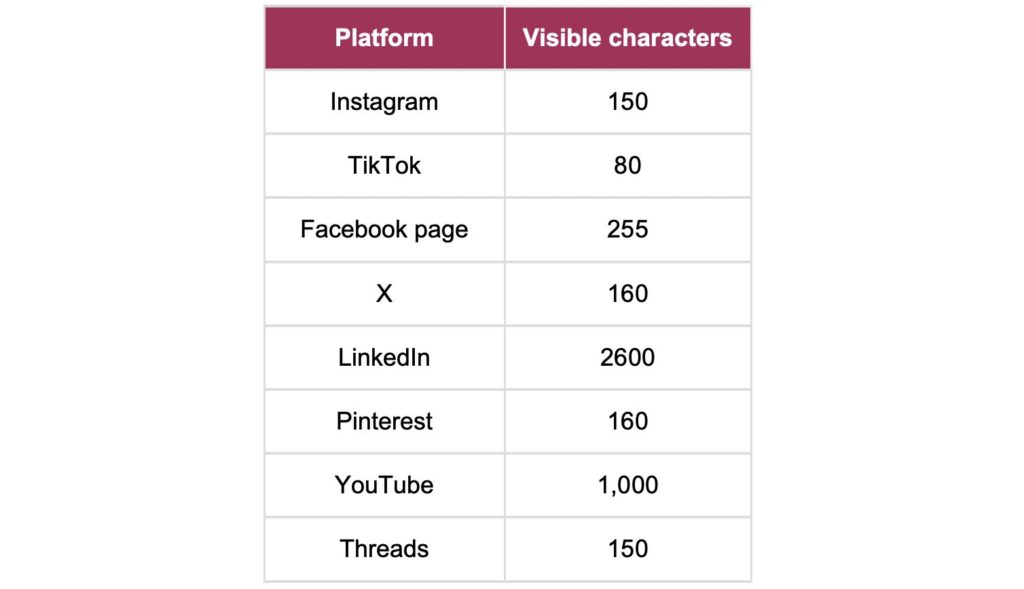
Second, character limits shape how much you can say. As of early 2026:

Table showing visible character limits for romance author bios across eight social media platforms including Instagram, TikTok, Facebook, X, Pinterest, YouTube, and Threads

Your goal is either to keep your author bio within the visible character count, or to let it cut off on a deliberate mini-cliffhanger… something interesting enough that a reader taps see more. What you never want is a bio that trails off mid-sentence because you ran out of room without noticing.

One more thing worth saying: some of your most engaged readers will eventually find you on multiple platforms and notice that your bios are slightly different. For them, it becomes a bit of an easter egg. That’s a lovely bonus and a great reason not to copy-paste.

A five-step approach to writing your romance author bios

You can write a full set of platform bios in under an hour. I mean it. Give yourself a firm time limit, do a dirty draft, share it with the community for quick feedback, and call it good for now. The beauty of social media is how easy it is to update. Done and working is better than perfect and sitting in a draft folder.

Here’s the framework.

Step 1: Start with your name

Use the author name you chose in Lesson 1. That’s the easy part.

Step 2: State what you write

Be specific about your sub-genre and, where it makes sense for the platform, your heat level. Vague is the enemy of a good bio. “Danika Bloom, USA Today bestselling author of steamy romantic comedy” (as simple as that is) does more work than “author of romance novels.”

The level of specificity can flex by platform… “contemporary romance” on LinkedIn, “steamy small-town grumpy/sunshine romance” on Instagram… but your sub-genre should appear in every single bio you write, always.

Step 3: Brainstorm your weird and wonderful

Set a 10-minute timer and make a no-filter list of everything that makes you specifically and memorably you. Think:

  • Quirks (afraid to fly, obsessed with spreadsheets, emotionally attached to houseplants)
  • Identities (single mom, retired paramedic, librarian, teacher, recovering accountant)
  • Delights (dark chocolate, K-dramas, gin, the Great Lakes, second-hand bookshops)
  • Obsessions (men in kilts, fuzzy blankets, petting dog’s ears, purple ink pens)

This is not the place to be professional. This is the place to be specific and human. Readers don’t follow authors they admire from a distance. They follow authors they feel like they know.

Step 4: Connect your details to what you write

Scan your list and circle anything that deepens or echoes the emotional promise of your books. If you write humorous romance and you’re terrified of flying, that’s a perfect bio detail. If you write dark romance and eighty percent of your wardrobe is black readers who love dark romance will feel seen. The details that belong in your bios are the ones that say yes, this is the author who writes those books.

Step 5: Draft bios for at least three platforms

Using your name, your sub-genre, and your best two or three personal details, write:

  • One short, punchy bio for a character-limited platform (Instagram, TikTok, or X)
  • One medium-length bio for Facebook
  • One complete bio for Amazon, Goodreads, BookBub, and your website

Even if you’re not active on every platform yet, claiming your name and posting a simple bio with a link to where you are active is an easy win you’ll thank yourself for later.

What good looks like: 2 real examples

You don’t have to invent this from scratch. Looking at how established authors handle their bios across platforms is clarifying in a way that no amount of general advice can match. (These are from 2024)

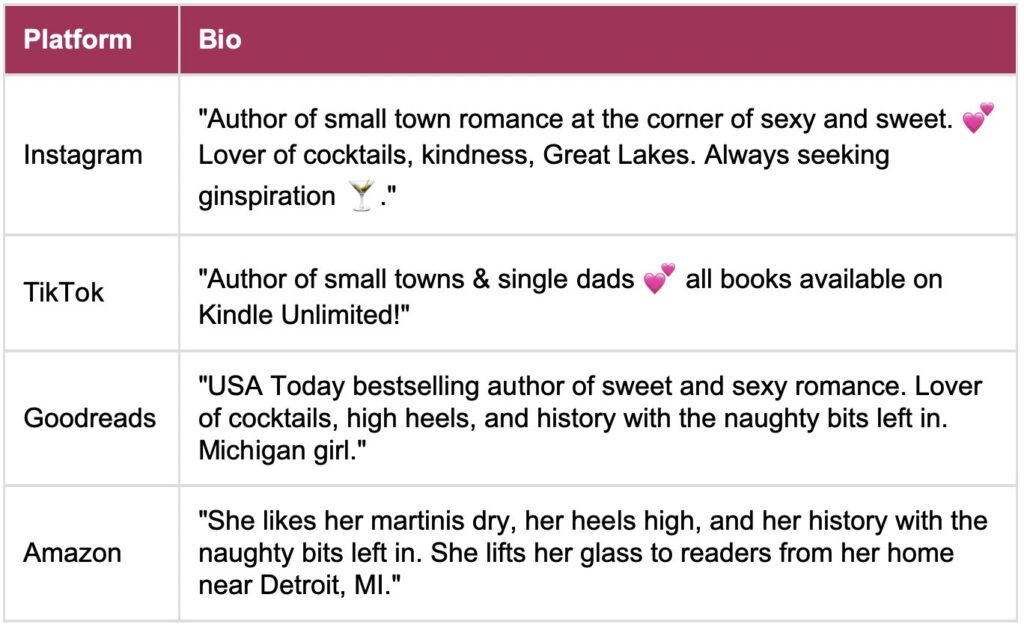
Melanie Harlow

Romance author bio examples from Melanie Harlow across Instagram, TikTok, Goodreads, and Amazon, showing platform-specific bio writing for indie authors

Notice: “sweet and sexy/sweet and spicy” appears everywhere—readers never have to guess. Her love of cocktails and “ginspiration” creates a cohesive, memorable persona across every platform without ever feeling copy-pasted.

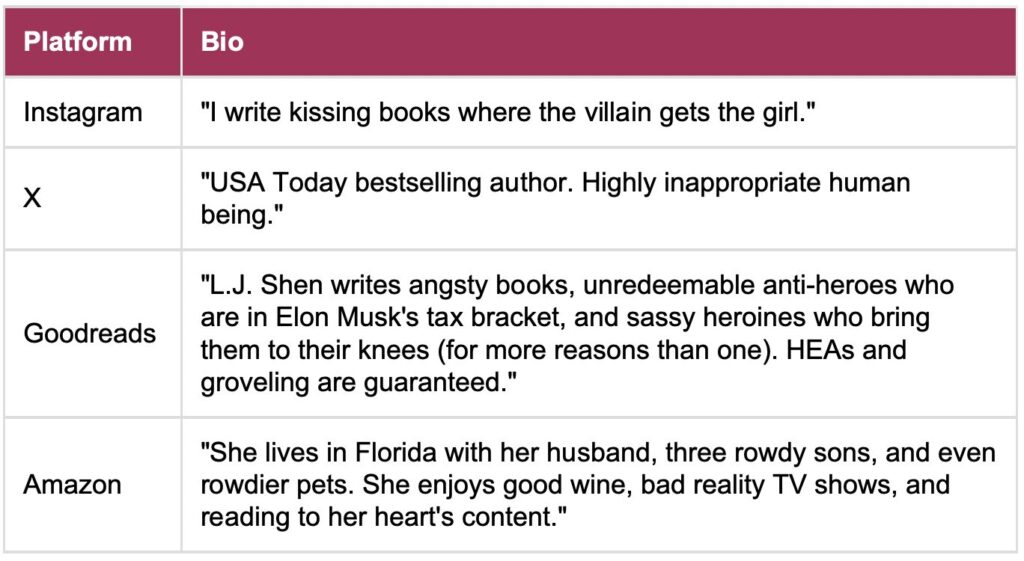
LJ Shen

Romance author bio examples from L.J. Shen across Instagram, X, Goodreads, and Amazon, showing how bios are tailored by platform

What both authors do well is commit. They’re not hedging or being vague in hopes of appealing to everyone. They know exactly who their reader is, and their bios speak directly to that person.

Key takeaway

A great author bio doesn’t try to impress everyone. It tries to delight the right reader and give everyone else a clear, kind exit. You’re not writing for maximum reach. You’re writing for the person who is already going to love your books, and making sure they recognize you when they find you.

Join Author Ever After

You’ll get immediate and full access to the Romance Your Launch program (all 11 modules), a worksheet for every lesson, plus three weekly, small group support meetings to answer all your questions, and a freaking amazing community of pre-published and early career romance authors who are building their indie publishing careers alongside you.

Get more details about the community here.

Or, go straight to the application form.

Get every lesson in the Romance Your Launch course

—> Click this link and I’ll send you two to three lessons a week, starting with Lesson 1.

—>Or, join my regular email list if you’d rather just pick up from the current lesson.

This lesson is part of Module 2: Your romance author identity in the Romance Your Launch program.
3.1 How to define your romance reader avatar

3.1 How to define your romance reader avatar

Most romance authors try to write for everyone and end up connecting clearly with no one. In this lesson, you’ll define a specific romance reader avatar so your blurb, lead magnet, website, and social posts all point at the same reader and make it obvious your books are for her.

2.4 How to write your romance author bio

2.4 How to write your romance author bio

One bio copied and pasted everywhere isn’t doing the job. This lesson gives you a five‑step framework for writing platform‑specific romance author bios that sell the follow, signal your sub‑genre, and make the right readers feel like they’ve already found their person.

2.3 Romance author brand style guide: your brand made visible

2.3 Romance author brand style guide: your brand made visible

You’ve done the inner work. Now you make it visible. Lesson 3 walks you through every visual decision—from your colour palette and font trio to your mood board and romance author brand style guide—so your identity looks as specific and intentional as it actually is.

2.1 The power of a name: how to choose your romance author pen name

2.1 The power of a name: how to choose your romance author pen name

Your author name goes on every cover and every reader interaction you’ll have. Lesson 1 walks you through the real‑name vs pen‑name decision and gives you a step‑by‑step process for choosing a romance author pen name you’re excited to build a career around.

1.3 Finding Your Romance Author Niche and Target Reader

1.3 Finding Your Romance Author Niche and Target Reader

Your sub‑genre tells readers what you write. Your romance author niche tells them why your book is the one they’ve been waiting for. In this lesson, you’ll define your niche and target audience so every decision you make about branding, blurbs, and marketing points straight at your ideal reader.

Ready for the next module?

Go back to the Romance Your Launch home page to see all the modules and links to their hub pages.

Want the next lesson in your inbox?

This post is part of the Romance Your Launch series—a lesson-by-lesson guide to self-publishing your romance novel, written for pre-published and early career romance authors. 

.

—> Click this link, drop in your name and email address, and I’ll send you two to three lessons a week, starting with Lesson 1.

.

—> If you’d rather just pick up where the series is, join my regular email list from this link.Â