No Results Found
The page you requested could not be found. Try refining your search, or use the navigation above to locate the post.
Your email list needs more than a half‑hearted sample to grow. This lesson walks you through proven romance lead magnet ideas so you can choose a short story, prequel, side‑character bonus, or strong sample that delivers your signature emotional hit and makes new readers eager to join your email list.
When I published my first romance novel, nobody told me I should be building an email list before my book was live. Nobody told me a lot of things, which is part of why this course exists. So when I finally decided I wanted a list, I used the first three chapters of the novel I’d just published as my sign-up incentive.
It worked well enough. A few hundred people signed up. Some of them probably bought the book.
But here’s the problem: those three chapters weren’t designed to do the job a lead magnet needs to do. They didn’t introduce a cold reader to my world on her terms. They dropped her into a story without a satisfying payoff, because the payoff was in the book she hadn’t bought yet. It wasn’t a gift. It was a sample. Lots of romance readers will react badly to this “bait and switch” when they expect an HEA and are left being asked to pay to see it. That’s a terrible first impression for readers.
I’ve learned a lot about lead magnets since then. This lesson is what I wish someone had handed me before I hit publish.
Before we get into the what and how of lead magnets, let’s get clear on why this matters. “Build an email list” is advice that gets thrown around constantly in indie publishing circles, often without much explanation of why it’s worth your time.
Here it is: your email list is the only reader relationship you actually own.
Your TikTok following? The platform owns it. One algorithm change, one account suspension, one company acquisition, and you could wake up tomorrow with no reliable way to reach the readers you spent two years gathering. The same is true for Instagram, Facebook, Substack, any of it. You’re renting attention on someone else’s platform, and the terms can change at any time.
Your email list is different. Those readers gave you their address directly. The relationship lives in your account, not on a platform. When you have a new book live, a cover reveal to share, a sale running, or just a story you want to tell your readers, you can reach them directly. No algorithm decides whether your content gets seen. No ad spend is required. No hoping they happen to scroll past at the right moment.
Romance readers are also genuinely enthusiastic email subscribers. They follow their favourite authors. They want to know when the next book is coming. They pre-order. They leave reviews. They tell their reader friends. The readers on your list aren’t passive. They’re the most engaged and the most likely to buy. The relationship you build with them through consistent, honest, enjoyable emails is what turns a one-time reader into someone who pre-orders every book you write without needing to be convinced.
That’s why we’re talking about this in Module 5, before your book is live. The authors who launch to crickets are usually the ones who started building their list after publication. The authors who launch to real, warm readers started earlier and used a lead magnet to do it.
A lead magnet is something valuable you offer for free in exchange for a reader’s email address. It’s the answer to the question every cold reader is quietly asking before she subscribes: what do I get out of this?
For romance authors, the most effective answer is almost always the same: a story.
Not a PDF of tips. Not a checklist. Not a quiz. A story. A short, complete piece of fiction that delivers the same emotional experience your full-length books deliver, in miniature. Something a reader can start and finish in one sitting and put down thinking, I want more of this.
A lead magnet is content for a cold audience: readers who haven’t read your books yet and found you through social media, a blog post, a newsletter swap, or a recommendation. They don’t know you. They’re curious about you. Your lead magnet is your first real introduction to those readers, and its job is to give them enough of your world, your voice, your heat level, and your emotional tone that they decide they want to stay in it.
A reader cookie is content for readers who have just finished one of your books. These are warm readers who already love you and want more of the specific couple they just met. A reader cookie, typically a bonus epilogue, invites those readers onto your list from the back matter of your book. Same list-building goal. Completely different audience. Completely different content. We’ll cover strategies for reader cookies in a later module.
This lesson is about lead magnets, which means we’re designing for the stranger. The woman who found your Instagram last week, thought your vibe looked interesting, and clicked the link in your bio. She’s on the fence. She’s not handing over her email address for nothing. What are you going to give her?
The lead magnets that convert, meaning readers actually sign up, actually download, actually read, and actually feel something, have three things in common.
They deliver your emotional promise.
Your lead magnet isn’t just content. It’s a sample of the experience readers can expect from your full-length books. If you write slow-burn with aching tension and a guaranteed emotional payoff, your lead magnet should feel like that. If you write chaotic, bantery romantic comedy with chemistry that crackles off the page, your lead magnet should feel like that. A reader who signs up, reads your free story, and thinks this is exactly my kind of book is a reader who will one-click your debut the moment it’s live.
They’re complete.
A lead magnet that ends on a cliffhanger or cuts off mid-arc and effectively demands the reader buy your book to get resolution feels like a bait and switch. Readers notice. They feel manipulated, even if they can’t quite name why. Your lead magnet should tell a complete story. Small, contained, satisfying. The reader closes it and thinks, I want more of this, not, I can’t believe that just ended.
They’re the right length for the job.
This is not the place to prove how much you can write. A cold reader who picked up your lead magnet on a whim is not committing to a novel. She’s sampling. Keep it lean. Between 3,000 and 10,000 words is the sweet spot for most romance lead magnets: long enough to deliver a real emotional experience, short enough that she actually reads it before she forgets why she signed up.
There’s no single right answer here, but there are a handful of formats that consistently work well. Pick the one that fits your book and your bandwidth.
A short complete story set before your main book begins, featuring your main couple or a key secondary character. This works beautifully when there’s meaningful backstory that didn’t make it into the book: the moment before the meet-cute, the first encounter years earlier, the event that set everything in motion. Readers get context that deepens their experience of the full-length book, and they get it in a satisfying complete story. Aim for 4,000 to 8,000 words.
A short complete story centred on a secondary character from your main book or your series who gets their own arc and HEA. This is especially effective if you’re writing a series. It gives readers a taste of your world and plants the seed of a character they’ll root for in a future book (preferably the next book), strong on emotional payoff, and it tends to convert well because it functions as a standalone while also deepening the world readers are about to enter. Aim for 7,500 to 10,000 words.
A short self-contained story, not directly connected to your main book, that delivers the core trope or emotional experience your books are (or will be) known for. Forced proximity. A grumpy-sunshine pairing. Fake relationship. A second-chance reunion. This option works well if you don’t have secondary characters to draw from, or if your main book’s world is complex enough that a prequel requires too much setup. Aim for 3,000 to 6,000 words.
The first chapter or two of your actual book, packaged and delivered as a standalone reading experience, not just a “look inside,” but something that stands on its own as an introduction. This works best when your opening chapters are genuinely strong and leave readers wanting more in a way that feels exciting rather than frustrating. It’s also the lowest-writing-time option, which matters if you’re already deep in revisions. Honest caveat: a complete original story will usually outperform a sample. But a strong sample beats nothing, and it beats a weak original story too. Just make 100% sure the page that the reader uses to download the sample makes it extremely clear that the sample does not end in an HEA and that the full story will need to be purchased.
Your reader snapshot from Lesson 1 is your compass here. Pull it out.
The lead magnet that works for a reader who’s hiring your books for comfort and cozy familiarity is not the same lead magnet that works for a reader hiring them for catharsis and emotional wreckage. One wants warmth and a soft landing. The other wants to feel something big.
Think the difference between a light Jennifer Crusie rom-com and a gutting Colleen Hoover story.
Ask yourself: what is my reader hoping to feel when she picks up a free story from an author she’s considering? Then make sure your lead magnet delivers exactly that, completely and in miniature.
A few examples to get your brain storming:
If you write small-town contemporary with grumpy-sunshine energy and medium heat, a prequel short story featuring your main couple’s first awkward encounter several years earlier, complete with banter, tension, and a moment that hints at something bigger, is doing exactly the right job. It’s warm, it shows your tone and heat level without overselling, and it ends with the reader smiling and wanting more.
If you write dark romance with morally grey heroes and high heat, a tropey one-shot that goes somewhere intense and delivers a complicated emotional payoff does the job. It signals clearly: this is what you’re getting from me. It self-selects for the reader who wants exactly that and filters out the reader who would leave you a one-star review for content she wasn’t prepared for.
If you write sapphic historical romance with slow burn and lush prose, a side-character story set in your world, with the same period detail and a complete arc for a character your reader will meet in the main book, tells your ideal reader you can hold a world together and make her feel things before she’s committed to the full novel.
Your lead magnet should not take three months to write.
You’re a pre-published author with a manuscript to finish, revise, and publish. Your lead magnet matters. It also matters less than your book. If the lead magnet you’ve chosen leads you to spend six weeks writing an 25,000-word prequel novella while your debut novel is still waiting for your line edit, you’ve made the wrong call.
The right lead magnet is the one you can complete in a few focused writing sessions, a week or two at most, without derailing the work that’s actually getting you to publication. That usually means shorter is better, the format should be one you’re comfortable in, and the story shouldn’t require you to invent entirely new characters, worldbuilding, or backstory from scratch.
If your tropey one-shot idea keeps expanding, scope it back down. If your prequel short story refuses to resolve in under 10,000 words, something in the concept is too big for the format. A tight, satisfying 5,000-word story that readers actually finish is worth far more than a sprawling 25,000-word novella that half your subscribers abandon before the end.
You want that reader to get the emotional pay-off of reading to the end.
Your lead magnet is not a marketing asset. It’s a story, the first one many of your readers will ever read from you. Its job is to deliver your emotional promise in miniature to someone who doesn’t know you yet and is deciding whether she wants to stay.
Your email list is where those readers live once they sign up. It’s the asset that will support every book launch you ever do, and keeps your backlist alive between launches. Building it before your book is live, with a lead magnet designed for the right reader, is one of the most valuable things you can do right now.
Choose a format that fits your book and your bandwidth. Scope it so it supports your writing life rather than competing with it. And when you sit down to write it, write it the same way you’d write any story: for a reader who deserves something real.
The one-sentence concept you’re building toward:
My lead magnet is a [format], featuring [who it’s about], that delivers [trope or emotional experience], and is approximately [word count] words long.
That sentence is your brief. The worksheet takes you through everything you need to get there.
You’ll get immediate and full access to the Romance Your Launch program (all 11 modules), a worksheet for every lesson, plus three weekly, small group support meetings to answer all your questions, and a freaking amazing community of pre-published and early career romance authors who are building their indie publishing careers alongside you.
Get more details about the community here.
Or, go straight to the application form.
—> Click this link and I’ll send you two to three lessons a week, starting with Lesson 1.
—>Or, join my regular email list if you’d rather just pick up from the current lesson.
Ready for the next step in the module?
Return to Module 3: Find your first readers to see all five lessons.
Or go back to the Romance Your Launch home page to see all the modules and links to their hub pages.
Want the next lesson in your inbox?
This post is part of the Romance Your Launch series—a lesson-by-lesson guide to self-publishing your romance novel, written for pre-published and early career romance authors.
.
—> Click this link, drop in your name and email address, and I’ll send you two to three lessons a week, starting with Lesson 1.
.
—> If you’d rather just pick up where the series is, join my regular email list from this link.
Before you can sell a single book, you need to know exactly who you’re talking to. In this lesson, you’ll define a clear romance reader avatar so you stop trying to please “everyone” and start writing, branding, and marketing for the specific reader who will love your tropes, heat level, and emotional tone.
This lesson helps you answer that question in a way you can actually use.
Think of the module as five building blocks, each using the one before it:
We start with the reader because the reader has to come first. Everything else is built around her.
Here’s the trap I see romance authors fall into over and over again at this stage:
they try to write for every romance reader.
They think the bigger the net, the more fish. I understand the impulse. You’ve worked hard on this book, you want as many people as possible to read it, and narrowing down can feel like leaving readers out.
But here’s what actually happens when you try to speak to all romance readers at once: you end up speaking clearly to none of them. Your blurb gets generic. Your cover sends mixed signals. Your social content is all over the place. And the readers who would have loved your book can’t quite tell it’s for them.
Getting specific about your reader isn’t about limiting your readership. It’s about making it easy for the right readers, the ones already inclined to love what you write, to recognize themselves in your covers, your bio, your blurbs, and your posts. That recognition builds trust quickly. And trust is what turns a first-time reader into someone who pre-orders your next book before she’s finished your first.
Romance readers sort themselves, consciously or not, along a few key axes. Understanding those axes is the first step toward locating your corner of the readership.
contemporary, small town, romcom, dark, romantic suspense, historical, romantasy, paranormal, sports, LGBTQ+, sapphic, MM, and more.
closed door or sweet, low heat, medium or steamy, high or explicit, erotic.
cozy, light, bantery, angsty, intense, dark, twisty, heart-wrenching but hopeful, uplifting, cathartic.
enemies to lovers, grumpy/sunshine, second chance, forced proximity, single dad, fake dating, friends to lovers, fated mates, and so on.
age range such as new adult, midlife, or later in life; queer identities; cultural backgrounds; faith elements; disability and neurodivergence representation.
Most romance readers have a few home bases within those axes. Your goal isn’t to create a corporate marketing profile. It’s to answer one question honestly:
What kind of reader will feel at home with my books?
Don’t reverse-engineer your ideal reader from trend lists. Start with what you actually write. Your stories already know who they’re for. Your job is to listen to them.
For your current work in progress or series, answer these:
What shelf would this book sit on in a bookstore? Be as specific as you can. Not just “contemporary romance,” but “small-town steamy romcom,” “dark mafia romance with a slow-burn core,” or “cozy sapphic historical with low heat.”
Using reader language, is it sweet or closed door, low, medium or steamy, spicy or explicit?
Which three to five words best describe how this book feels? Cozy, chaotic, angsty, funny, dark, hopeful, cathartic, swoony, comforting?
Which two to four major tropes does this book deliver? Not every beat, just the key selling points readers actually search for.
What’s going on under the romance? Found family, grief and healing, class tension, mental health, body image, faith?
Once you have those answers, you’re not looking for “readers who like romance.” You’re looking for readers who enjoy your sub-genre, your heat level, your tone, and your core tropes or themes. That’s a real person you can actually find.
Now translate all of that into a simple reader snapshot. Not a demographic profile with age brackets and income ranges, just a clear sense of whose hands you want this book in.
You might not know her exact job or where she lives. But you can usually say what she reaches for when she needs comfort, what kind of emotional ride she’s up for on a random weeknight, and what she avoids. The avoids matter. A reader who hates heavy grief storylines and stumbles into yours because your blurb didn’t signal it is a one-star review waiting to happen.
Three examples to help you get your brain storming:
Notice what’s in each of these: what they binge, what they avoid, and what emotional promise they’re hoping you can keep. That’s your target. Everything in this module points back to it.
When a romance reader chooses her next book, she’s hiring it for a job, whether she thinks about it that way or not. To comfort her. To distract her during a stressful week. To give her cathartic tears. To give her heat without a lot of emotional labour. To let her live out a darker fantasy in a safe container. To give her hope that love like this exists.
Ask yourself: what job is my book best suited for? What kind of reader is actively looking for that job to be done?
Knowing this helps you describe your book to the right reader and, just as importantly, helps you avoid attracting readers who will be disappointed by what they find. Disappointed readers leave reviews. You want the reader who is delighted by exactly what you wrote.
You’re not trying to attract every romance reader. You’re trying to make it unmistakably easy for the right readers, the ones already inclined to love what you write, to recognize themselves in everything you create.
The reader snapshot you’ve built here isn’t a cage. It’s a compass. Every decision in Module 3 points back to it.
You’ll get immediate and full access to the Romance Your Launch program (all 11 modules), a worksheet for every lesson, plus three weekly, small group support meetings to answer all your questions, and a freaking amazing community of pre-published and early career romance authors who are building their indie publishing careers alongside you.
Get more details about the community here.
Or, go straight to the application form.
—> Click this link and I’ll send you two to three lessons a week, starting with Lesson 1.
—>Or, join my regular email list if you’d rather just pick up from the current lesson.
Ready for the next step in the module?
Return to Module 3: Find your first readers to see all five lessons.
Or go back to the Romance Your Launch home page to see all the modules and links to their hub pages.
Want the next lesson in your inbox?
This post is part of the Romance Your Launch series—a lesson-by-lesson guide to self-publishing your romance novel, written for pre-published and early career romance authors.
.
—> Click this link, drop in your name and email address, and I’ll send you two to three lessons a week, starting with Lesson 1.
.
—> If you’d rather just pick up where the series is, join my regular email list from this link.
Before we get into your romance author bio, I want to make a distinction that will save you a lot of confusion later: your bio and your About page are not the same thing, and they don’t do the same job.
When someone visits your website and clicks through to your About page, they’ve already cleared a significant hurdle. They liked something they saw… your cover, your blurb, a post… enough to go looking for more. That’s a warm lead. Your About page has the space and the job to answer the question every potential reader is quietly asking before they open their wallet: what’s in it for me?
For a romance reader, what’s “in it” is an emotional experience. Specific tropes, a particular heat level, a guaranteed HEA, and a tone that matches what they’re in the mood for. Your About page (which we’ll cover in module 3) is where you get to make that case at length. It should be several hundred words, voice-forward, and specific enough about what you write that the right reader feels seen and the wrong reader self-selects out. That’s not a problem. That’s the system working.
Your social bios are a different animal entirely. Where your About page can breathe, your bios need to be sharp, fast, and precise. They’re not selling your book. They’re selling the follow. Their only job is to pique enough interest that a reader clicks through to find out more… or decides they want to stick around and see what you post next.
Think of each platform as a different kind of party. You wouldn’t show up to a wedding in the same outfit you’d wear to a beach barbecue. You’d introduce yourself differently to your head office colleagues than you would to your cousin’s new partner at a family dinner. Same principle applies here.
There are two good reasons to write platform-specific romance author bios rather than copy-pasting one version everywhere.
First, each platform has a different audience with different expectations. On Goodreads, readers are interested in you as a reader… mentioning your favourite books and the authors who influence your writing lands differently there than anywhere else. On BookBub, where people are actively looking for deals, a bio that mentions your free reader magnet does real work. On TikTok, personality and specificity win. On LinkedIn, you probably just want people to know you exist without accidentally ending up in someone’s professional network newsletter.
Second, character limits shape how much you can say. As of early 2026:
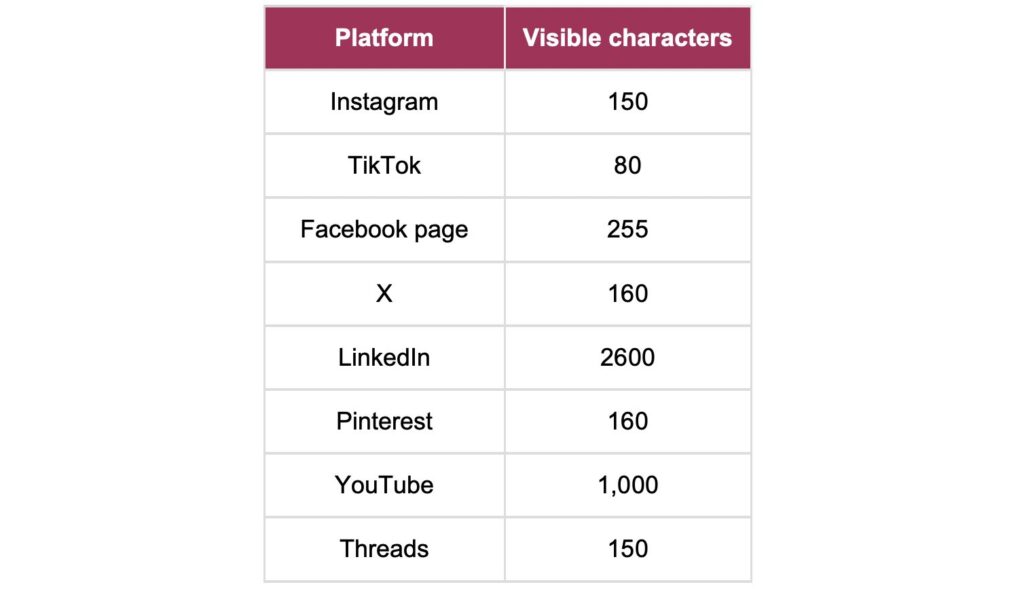
Your goal is either to keep your author bio within the visible character count, or to let it cut off on a deliberate mini-cliffhanger… something interesting enough that a reader taps see more. What you never want is a bio that trails off mid-sentence because you ran out of room without noticing.
One more thing worth saying: some of your most engaged readers will eventually find you on multiple platforms and notice that your bios are slightly different. For them, it becomes a bit of an easter egg. That’s a lovely bonus and a great reason not to copy-paste.
You can write a full set of platform bios in under an hour. I mean it. Give yourself a firm time limit, do a dirty draft, share it with the community for quick feedback, and call it good for now. The beauty of social media is how easy it is to update. Done and working is better than perfect and sitting in a draft folder.
Here’s the framework.
Use the author name you chose in Lesson 1. That’s the easy part.
Be specific about your sub-genre and, where it makes sense for the platform, your heat level. Vague is the enemy of a good bio. “Danika Bloom, USA Today bestselling author of steamy romantic comedy” (as simple as that is) does more work than “author of romance novels.”
The level of specificity can flex by platform… “contemporary romance” on LinkedIn, “steamy small-town grumpy/sunshine romance” on Instagram… but your sub-genre should appear in every single bio you write, always.
Set a 10-minute timer and make a no-filter list of everything that makes you specifically and memorably you. Think:
This is not the place to be professional. This is the place to be specific and human. Readers don’t follow authors they admire from a distance. They follow authors they feel like they know.
Scan your list and circle anything that deepens or echoes the emotional promise of your books. If you write humorous romance and you’re terrified of flying, that’s a perfect bio detail. If you write dark romance and eighty percent of your wardrobe is black readers who love dark romance will feel seen. The details that belong in your bios are the ones that say yes, this is the author who writes those books.
Using your name, your sub-genre, and your best two or three personal details, write:
Even if you’re not active on every platform yet, claiming your name and posting a simple bio with a link to where you are active is an easy win you’ll thank yourself for later.
You don’t have to invent this from scratch. Looking at how established authors handle their bios across platforms is clarifying in a way that no amount of general advice can match. (These are from 2024)
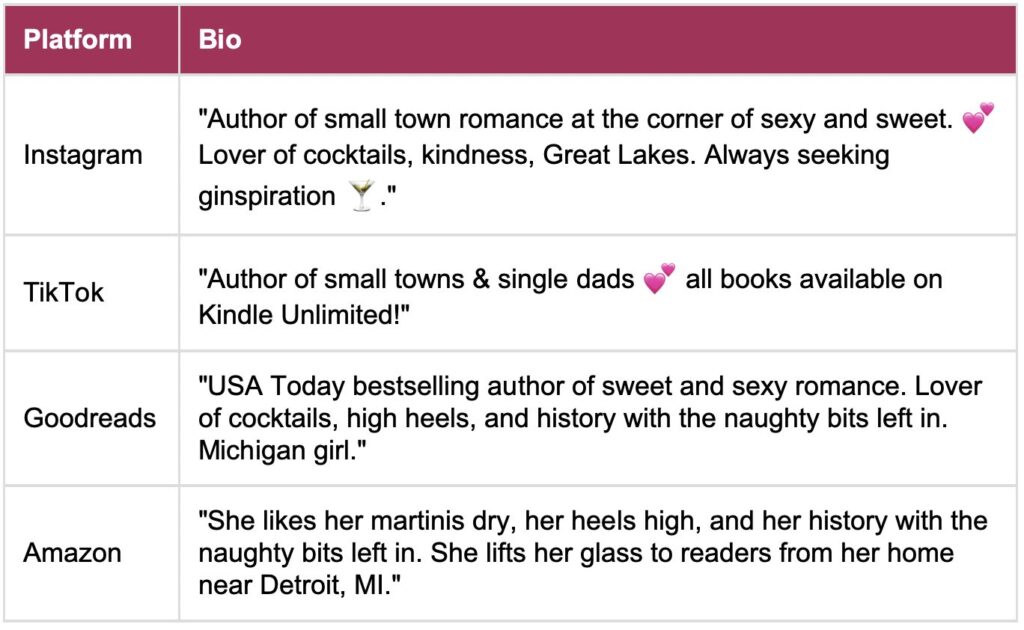
Notice: “sweet and sexy/sweet and spicy” appears everywhere—readers never have to guess. Her love of cocktails and “ginspiration” creates a cohesive, memorable persona across every platform without ever feeling copy-pasted.
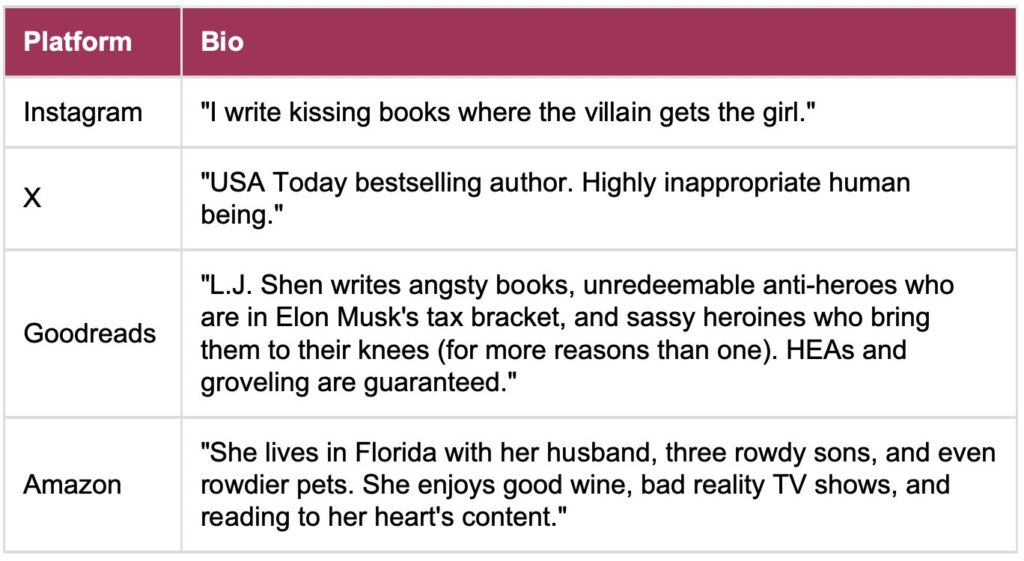
What both authors do well is commit. They’re not hedging or being vague in hopes of appealing to everyone. They know exactly who their reader is, and their bios speak directly to that person.
A great author bio doesn’t try to impress everyone. It tries to delight the right reader and give everyone else a clear, kind exit. You’re not writing for maximum reach. You’re writing for the person who is already going to love your books, and making sure they recognize you when they find you.
You’ll get immediate and full access to the Romance Your Launch program (all 11 modules), a worksheet for every lesson, plus three weekly, small group support meetings to answer all your questions, and a freaking amazing community of pre-published and early career romance authors who are building their indie publishing careers alongside you.
Get more details about the community here.
Or, go straight to the application form.
—> Click this link and I’ll send you two to three lessons a week, starting with Lesson 1.
—>Or, join my regular email list if you’d rather just pick up from the current lesson.
Readers don’t search “romance.” They search for grumpy small-town cowboy or dark mafia anti-hero. Here’s how to find your book’s address in the market.
Self-publishing romance novels is not a pipe dream or a shortcut. It is a real way to build a joyful, sustainable author career when you understand the market, the readers, and your options. This first lesson gives you the lay of the land so you can make informed choices.
Get every lesson from Romance Your Launch—my premium self-publishing program for romance authors—directly to your inbox. For free.
Ready for the next module?
Go back to the Romance Your Launch home page to see all the modules and links to their hub pages.
Want the next lesson in your inbox?
This post is part of the Romance Your Launch series—a lesson-by-lesson guide to self-publishing your romance novel, written for pre-published and early career romance authors.
.
—> Click this link, drop in your name and email address, and I’ll send you two to three lessons a week, starting with Lesson 1.
.
—> If you’d rather just pick up where the series is, join my regular email list from this link.
In Lesson 2, you did the inner work: values, traits, and the author persona that sits at the emotional core of everything you create. That work was the foundation. Now we build on it.
This lesson is about translating all of that internal clarity into the visual and verbal decisions readers will actually see: your photo or logo, your colours, your fonts, your imagery, and the way you sound when you show up online. By the end of the worksheet, you’ll have a starter romance author brand style guide you can bring into every creative and marketing decision that follows.
A brand style guide sounds fancier than it needs to be. For our purposes, it’s just a short document where you capture a handful of decisions… your primary visual, your colours, your fonts, your imagery style, your voice, and where you’ll show up on social media. That’s it. One document. Five to ten decisions.
Here’s why it’s worth doing before you design a single thing:
When your visuals are consistent, readers start to recognize your posts, emails, and covers at a glance. Recognition builds trust, and trust builds readers.
A cohesive look signals that you take your author business seriously, before someone has even read a word you’ve written. It’s a probably mostly subconscious signal that is especially important in the age of AI.
When you already know your colours and fonts, and how you want to make readers feel, creating graphics or briefing a cover designer takes a fraction of the time.
The right visuals amplify the feelings you want readers to have. A cozy small-town romcom should look and feel completely different from a dark mafia romance, and your brand should do some of that work before anyone reads your webpage or a single social media post.
In a genre as competitive as romance, a distinct look and feel is one of the fastest ways to stop the scroll.
None of this locks you in forever. You’re building a solid starting point you can and will evolve over time. Think of it as giving your author identity a coherent outfit to wear… not a uniform.
Readers connect with people more than logos. For most romance authors, your face is your most effective brand visual, because people buy from people they feel they know, and a photo does that work faster than any logo or signature ever will.
That said, you get to decide what you’re comfortable with. Your primary visual could be:
Once you’ve chosen, you’ll also want to decide where each version will live: social media profiles, your website header, your email footer. The same photo doesn’t have to be cropped identically everywhere, but it should be recognizably, consistently you.
Don’t overcomplicate this. Pick something you’re comfortable with that feels aligned with the persona you named in Lesson 2, and move on. You can update your photo if or when the one you pick starts to feel “off”. For now, consistency matters more than perfection.
Colours are emotion in shorthand. Before a reader reads a single word on your website or social feed, they’ve already had a feeling… and your colour palette is doing a lot of that work.
Think about what passionate reds and rich jewel tones say versus soft pastels and gentle neutrals. Dark, moody palettes with gold accents tell a completely different story than clean, modern monochrome with one bold pop of colour. None of these are better or worse, but they need to match what your books are actually promising.
For your brand palette, you’re aiming for:
Two tools that are genuinely useful here: Coolors.com for building and experimenting with palettes (watch their tutorial before you start. It will save you considerable frustration), and Color-Hex.org for exploring complementary colours once you have one you love.
You’re not designing a book cover. You’re choosing a palette you’ll reuse on your website, your social graphics, and possibly in your cover briefs. Keep it tight. Three core colours is plenty.
Fonts are another way your brand speaks before anyone reads a word.
Look at the covers in your sub-genre and you’ll start to see patterns almost immediately. Historical romance reaches for flowing scripts and elegant serifs. Dark romance leans into bold, angular, or condensed type. Small-town and cozy contemporary tends toward softer, friendlier typefaces. Your fonts don’t have to match your sub-genre exactly, but they shouldn’t contradict it either.
Aim for three:
You won’t use all three in every context. But knowing the general vibe… curvy and romantic, clean and modern, bold and gritty… keeps your visuals cohesive even when you’re working quickly in Canva at 10pm.
For font pairing resources, Google “font pairing websites” and you’ll find dozens of free tools. Google Fonts are a solid place to start since they’re free, widely available, and render well online.
There are dozens of imagery styles you could lean into. You only need the two or three that actually support your brand… the ones that, when you look at them, make you think yes, that’s my world.
A few of the most common styles in romance author branding:
Sepia tones, lace patterns, historical imagery. Works beautifully for historical and Regency romance.
Simple, uncluttered design for a modern, sophisticated feel. Strong for contemporary and chick-lit.
Intense colours, strong contrasts, striking visuals. Great for romantic suspense, sports romance, dark romance.
Botanical motifs, natural landscapes, warmth and growth. Perfect for small-town and rural romance.
Pastel colours, soft lighting, tender visuals. Ideal for sweet romance and inspirational romance.
Darker palettes, enigmatic imagery, a sense of danger or seduction. Mafia, gothic, dark romance.
Wood textures, warm tones, comfort imagery. Made for small-town romance and western romance.
Passion and heat without necessarily being explicit. Steamy contemporary, erotic romance.
Playful, unconventional, full of personality. Romcom, young adult romance.
Magical, otherworldly, imaginative. Romantasy, paranormal, time travel.
Jewel tones, gold accents, ornate details. Billionaire romance.
Nostalgic fun, drawn from specific decades or pop culture moments. Romcom, light contemporary.
Pick the two or three that feel like a natural fit for both your sub-genre and the brand words you landed on in Lesson 2. If your brand keywords are “cozy, hopeful, small-town, found family”… you’re not reaching for dark and mysterious. Trust the alignment.
If you’re an Author Ever After member, you’re invited to find (and request for free) up to 10 images on DepositPhotos that match your brand for use on your website, socials, or wherever else you need them.
Your visual branding needs to match your verbal branding… the way you sound in your emails, your social captions, and your back-cover copy. A dark, moody visual palette paired with a warm, breezy, self-deprecating email voice sends a mixed signal. Readers notice that dissonance even when they can’t name it.
In the worksheet, you’ll describe your author voice in a few sentences. Not your book’s voice. Your author voice. The one readers encounter in your newsletter and your Instagram captions.
Be honest, not aspirational.
You’ll also think about:
And you’ll pull forward the brand keywords from Lesson 2 as messaging anchors. These are the words and ideas you want coming through again and again in everything you write that isn’t a novel.
This is the step people either love immediately or resist with their whole body. Do it anyway. It works.
A mood board is a visual shorthand for this is what my brand feels like. It’s not a marketing asset. It’s a reference tool… something you look at when you’re writing a social caption or briefing a cover designer and need to quickly recalibrate.
Aim for around 30 images that capture:
Pinterest is the easiest tool for this. Create a secret board and pin without overthinking. If you search for [your mood] mood board, you’ll find hundreds of results to spark ideas. Canva also has a brand board template if you prefer to work there.
Don’t aim for perfection. Aim for this feels like me and my books. You can always delete an image later. Trust your gut when something makes you stop scrolling. That’s usually the right call.
Your brand look and feel doesn’t have to be perfect. It just has to be coherent enough that you feel like yourself when you use it, and readers can start to recognize your work at a glance. You can and will refine over time.
For now, you’ve given your stories an outfit that fits. That’s more than enough to move forward confidently into Module 3.
You’ll get immediate and full access to the Romance Your Launch program (all 11 modules), a worksheet for every lesson, plus three weekly, small group support meetings to answer all your questions, and a freaking amazing community of pre-published and early career romance authors who are building their indie publishing careers alongside you.
Get more details about the community here.
Or, go straight to the application form.
—> Click this link and I’ll send you two to three lessons a week, starting with Lesson 1.
—>Or, join my regular email list if you’d rather just pick up from the current lesson.
Both publishing paths have real trade‑offs. This lesson gives you an honest look at self‑publishing vs traditional publishing in romance and helps you choose the path that fits your book and your goals.
Reader expectations shift every year. Here’s what romance readers want in 2026 and how current romance market trends should influence the way you write, position, and launch.
Your sub‑genre tells readers what you write. Your romance author niche tells them why your book is the one they’ve been waiting for. In this lesson, you’ll define your niche and target audience so every decision you make about branding, blurbs, and marketing points straight at your ideal reader.
Readers don’t search “romance.” They search for grumpy small-town cowboy or dark mafia anti-hero. Here’s how to find your book’s address in the market.
Self-publishing romance novels is not a pipe dream or a shortcut. It is a real way to build a joyful, sustainable author career when you understand the market, the readers, and your options. This first lesson gives you the lay of the land so you can make informed choices.
Get every lesson from Romance Your Launch—my premium self-publishing program for romance authors—directly to your inbox. For free.
Ready for the next module?
Go back to the Romance Your Launch home page to see all the modules and links to their hub pages.
Want the next lesson in your inbox?
This post is part of the Romance Your Launch series—a lesson-by-lesson guide to self-publishing your romance novel, written for pre-published and early career romance authors.
.
—> Click this link, drop in your name and email address, and I’ll send you two to three lessons a week, starting with Lesson 1.
.
—> If you’d rather just pick up where the series is, join my regular email list from this link.
Let me tell you about the most common branding mistake romance authors make. They open Canva, spend three hours choosing between shades of mauve and dusty rose, pick a font that feels vaguely romantic, slap their name on it, and declare themselves branded.
Six months later, nothing feels cohesive. The font doesn’t match the tone of their books. The colour palette looks exactly like forty other romance authors’ palettes. And they’re redesigning everything from scratch while wondering why their social media presence feels like a costume they’re wearing rather than a skin they’re living in.
The problem isn’t Canva. The problem is starting with the visuals before doing the inner work that makes those visuals actually mean something. That inner work is the heart of romance author branding—and that’s what this lesson is for.
If you Google “author branding,” you will find approximately one thousand definitions, most of which are either so vague they’re useless or so corporate they belong in a quarterly earnings call rather than a conversation about romance novels.
So let’s clear the decks.
Here are the two definitions I come back to most often. S. Warren, author of The Bestselling Author Next Door, describes branding as
“positioning your book to reach readers. Your readers. New readers. Readers who are going to love your book.”
David Gaughran calls it
“the process of creating perceptions about our books through email, social media, and advertising.”
And he adds that it’s an ongoing process, not a fixed destination.
What I love about those two definitions together is that they place the reader at the centre. Your brand isn’t about you performing an identity. It’s about creating a consistent, recognizable signal so that the person who would love your books can find them… and trust them… before she’s read a single page.
You’ve experienced good author branding from the other side. There are authors whose name on a cover tells you exactly what you’re in for. The heat level, the emotional tone, the approximate level of chaos or calm, the flavour of the humour. You don’t need to read the blurb.
That’s branding working. Those authors have built such a consistent signal… through their covers, their blurbs, their social presence, their email voices, the feeling of their books… that readers have attached their reader identity to them. When a new title drops, existing readers pre-order without thinking. New readers discover them and immediately consume their backlist.
That’s what we’re building toward, deliberately, from the foundation up.
When your branding is working, it does five things that matter for your career. Your branding:
Here’s where the Canva-first approach goes wrong. Colours and fonts aren’t your brand. They’re the expression of your brand. And you can’t express something you haven’t yet identified.
Think about the authors whose visual identity feels completely right… where the colours, the fonts, the cover aesthetic, the Instagram grid all feel like the same person made them, and that person is clearly, specifically them. That coherence doesn’t come from picking pretty things. It comes from those visual choices being rooted in something true about who that author is and what her books feel like.
Melanie Harlow’s brand feels warm, witty, and a little bit chaotic in the most lovable way, because that’s what her books feel like. Talia Hibbert’s brand feels bold, intelligent, and radiantly herself, because that’s what her books feel like. The visual choices aren’t decorating a brand. They’re expressing one.
You can’t shortcut that sequence. Values and personality first. Visual identity second. Every time.
This is the part most authors find surprising.
You don’t have to invent your brand values. They’re already there. In the tropes you’re drawn to. In the emotional beats you find most satisfying to write. In the conflicts your characters keep having… not because you planned it, but because you keep writing them. In the way your characters treat each other when things get hard. In what you make your heroines fight for. For instance:
You’ve probably been writing your values into your books this whole time without naming them. This lesson is about naming them. Because once you have words for what your books stand for, everything else gets easier. You know what to post about. You know what your newsletter should feel like. You know whether a cover direction is right for your brand or just pretty. You know what to say when someone asks what your books are about and you want to say something better than “it’s a romance novel.”
Here’s a concrete example of how this works in practice.
Let’s say an author works through her values and lands on:
Immediately, that tells us something. Her books probably end with characters who have genuinely changed… not just found love, but found something in themselves. Her humour is probably warm rather than snarky. Her conflicts probably have emotional weight beneath the surface tension. Her reader probably wants to feel uplifted, not just entertained.
Now translate that into visual language. Joy and liberation read as colour… warm, saturated, alive. Resilience and chosen family read as warmth, images of connection, touch, togetherness. Not cold minimalism. Not dark and brooding. Those visual instincts come from the values, which means when she builds her Canva templates and briefs her cover designer and chooses her Instagram aesthetic, everything is pointing in the same direction.
Compare that to an author who lands on:
Different values. Completely different visual language. Darker palette, more negative space, a different kind of cover. A newsletter that sounds nothing like the first author’s newsletter. Both are legitimate. Both are specific. Neither is “smart and sexy romance.”
Two authors can share the same values… love, loyalty, found family, second chances… and produce completely different books. One writes snarky, banter-heavy, high-heat romcoms with chaotic heroines. The other writes slow-burn, introspective, emotionally devastating stories with measured, quiet tension. The values overlap. The personality is where they diverge.
Your personality traits are the flavour of your brand. They show up in how your characters talk to each other, in the rhythm of your prose, in your newsletter voice, in your social captions. Your tolerance for angst. Your appetite for humour. How dark you’re willing to go. The specific texture of the emotional experience you create for readers.
This is also where the gap between who you are and who you want to be known as can be revealing. If the traits you’d love readers to use to describe you-the-author look nothing like the traits that actually describe you as a person, that’s worth noticing. It might mean you’re chasing someone else’s brand instead of uncovering your own. It might mean your writing isn’t yet reflecting your aspirations. Either way, the gap is information.
The sweet spot is the overlap between the traits that are genuinely, authentically you and the traits you want readers to recognize in your books. That’s not something you manufacture. It’s something you find.
One thing I want to make clear before we get into the work: your brand is not a performance.
The authors who build the most loyal readerships aren’t the ones with the cleverest taglines or the most aesthetically consistent Instagram grids. They’re the ones who show up consistently as themselves… with the values that actually matter to them, in the voice that’s actually theirs, writing the stories that genuinely excite them. Readers are excellent at detecting inauthenticity. They’re even better at recognizing something real.
Your brand is not a persona you put on when you open the author laptop. It’s the true, specific, particular version of you that shows up in your books. Named, sharpened, and made consistent enough that readers can recognize it before they’ve even met you.
The work of this lesson is the work of uncovering that. Not inventing it. Uncovering it.
Before you open the worksheet for this lesson, sit with one question:
When a reader finishes one of my books and goes to tell a friend about it… not just the plot, but the feeling of it… what do I want her to say?
Not the marketing copy answer. The real one. The answer that would make you feel like you’d actually done what you set out to do.
Write it down somewhere. It doesn’t have to be polished. It just has to be honest. That answer is the seed of everything you’re about to build.
The Lesson 3 worksheet is where you do the actual excavation… working through your values, your traits, and pulling it all together into the brand foundation that Lesson 4’s visual work will build on. It’s inside Author Ever After, along with the support calls and community feedback that will make your answers sharper and more useful than anything you’d arrive at alone.
Because here’s the thing about brand work: a brand that only makes sense in your own head isn’t doing its job. It needs to land with other humans. And the best place to test it, refine it, and hear what it actually communicates to real readers?
That’s what the community is for.
Your author brand is not something you invent from scratch. It is something you uncover by naming the values you already care about, the traits that already show up in your work, and the emotional experience you are already trying to create for readers. You do not need to be profound. You do not need to be unique in every possible way. You just need to be specific, honest, and recognizably you.
You’ll get immediate and full access to the Romance Your Launch program (all 11 modules), a worksheet for every lesson, plus three weekly, small group support meetings to answer all your questions, and a freaking amazing community of pre-published and early career romance authors who are building their indie publishing careers alongside you.
Get more details about the community here.
Or, go straight to the application form.
—> Click this link and I’ll send you two to three lessons a week, starting with Lesson 1.
—>Or, join my regular email list if you’d rather just pick up from the current lesson.
This lesson is part of Module 2: Your romance author identity in the Romance Your Launch program.
You’ve done the inner work. Now you make it visible. Lesson 3 walks you through every visual decision—from your colour palette and font trio to your mood board and romance author brand style guide—so your identity looks as specific and intentional as it actually is.
Most romance authors start with colours and fonts. This lesson shows you why that’s the wrong order and walks you through the inner work of romance author branding that makes every visual decision actually mean something.
Your author name goes on every cover and every reader interaction you’ll have. Lesson 1 walks you through the real‑name vs pen‑name decision and gives you a step‑by‑step process for choosing a romance author pen name you’re excited to build a career around.
Both publishing paths have real trade‑offs. This lesson gives you an honest look at self‑publishing vs traditional publishing in romance and helps you choose the path that fits your book and your goals.
Reader expectations shift every year. Here’s what romance readers want in 2026 and how current romance market trends should influence the way you write, position, and launch.
Your sub‑genre tells readers what you write. Your romance author niche tells them why your book is the one they’ve been waiting for. In this lesson, you’ll define your niche and target audience so every decision you make about branding, blurbs, and marketing points straight at your ideal reader.
Ready for the next module?
Go back to the Romance Your Launch home page to see all the modules and links to their hub pages.
Want the next lesson in your inbox?
This post is part of the Romance Your Launch series—a lesson-by-lesson guide to self-publishing your romance novel, written for pre-published and early career romance authors.
.
—> Click this link, drop in your name and email address, and I’ll send you two to three lessons a week, starting with Lesson 1.
.
—> If you’d rather just pick up where the series is, join my regular email list from this link.
