No Results Found
The page you requested could not be found. Try refining your search, or use the navigation above to locate the post.

Here’s what happens to a lot of romance authors at the end of a first draft. You’ve written the whole thing, the characters are real to you, the emotional arc makes complete sense in your head, and you know exactly why the hero acts the way he does in that one messy chapter. Somewhere in your self-editing, a creeping doubt arrives: does this actually work for a reader who isn’t me.
That question is worth answering before you spend weeks polishing sentences in scenes that might need to be cut, or sharpening dialogue in a chapter a reader would skim. Beta readers for romance authors at this stage aren’t line editors; they’re test readers who show you whether the story experience you intended is the one they’re actually having.
Most authors think of beta readers as a final step, something you do when the book is almost done as a last check before proofreading. That’s a valid use, and you’ll come back to a later-stage beta in the publishing pipeline. This round is different. You’re bringing in readers when you have a complete but rough draft specifically to test the story experience.
You’re not asking for grammar notes, chapter‑break opinions, or whether they like your commas. You’re asking something much more basic: for a reader who picked up this book wanting this sub‑genre and these tropes, does the story feel like it delivers on that promise. Beta readers at this stage are the bridge between “I finished a draft” and “I know what to fix and why.”
Not all opinions are equally useful here, and the most common beta‑reader mistake is asking the wrong people. The person you want for this round is a reader who enjoys your specific sub‑genre and actively likes the tropes you’re using; if someone has complicated feelings about dark romance, she’s not the right beta for your dark romance, because her discomfort with the genre will show up as fake “craft” problems.
If a reader only reaches for sweet small‑town, her reaction to your steamy mafia romance will be shaped by expectations that have nothing to do with your actual audience. And the friend who can only say “I loved it” is lovely, genuinely, and also useless as a story‑level beta reader. You’re looking for people whose natural reading taste already matches the kind of romance you’re writing so their reactions map closely to the readers you want to reach. Fellow romance readers and writers in your sub-genre are often your best bet, including the folks who hang out with you in places like Author Ever After.
For this pass, two to four beta readers is plenty. Any fewer and you can’t spot patterns. Any more and you’ll drown in conflicting opinions before you’ve built the editorial stamina to sort through them. Your beta reader team should feel like a small, intentional panel at this stage, not a crowd.
You’re not sending a polished manuscript and pretending it’s almost done. You’re sending a complete story draft that you already know needs more work. Your job is to frame that clearly so your beta readers don’t pour their energy into typos when you need them tracking their emotional experience.
Start with a short context paragraph: three to five sentences that tell your beta what kind of romance this is—sub-genre, heat level, primary tropes. Think of it as the promise you’re making: this is the kind of romance this book wants to be. They need to read it against that promise, not against their own random assumptions.
Follow with a stage disclaimer, something along the lines of: “This is a complete draft that hasn’t been fully edited yet. I’m looking for your reactions to the story, characters, tropes, and pacing, not line edits or grammar fixes.” Without that, many well-meaning readers will spend the whole read hunting commas instead of noticing when the middle drags or the black moment doesn’t land.
Then give them specific questions. “What did you think” is vague and invites politeness. Try questions like:
Beta readers give you sharper feedback on your romance when your questions focus them on what it felt like to read the story, not on how they’d rewrite it themselves.
In other words, ask them questions that ask them to share their experience and not questions that lead them to offer their fixes.
The hardest part of beta feedback isn’t the criticism, it’s the noise: contradictions, taste dressed up as craft, intensely specific “fixes” that don’t match the book you’re trying to write. Learning to sort signal from noise is a core professional skill. Start by looking for patterns. If one beta isn’t into your grumpy hero and two others adore him, that’s taste; note it and move on.
If several readers independently mention that the middle sags, a subplot vanishes, or the emotional climax comes out of nowhere, that’s a revision target whether or not they describe it in the same words.
Patterns don’t lie.
Then check each note against the promise you made in your context paragraph. If you pitched this as a low-angst cozy and multiple readers tell you it got darker than they expected, that’s useful data. You can choose to adjust the story to match the promise, or adjust the eventual marketing copy to attract readers who want what the book actually is. Both are valid.
You get to decide which serves your career.
Finally, sort each piece of feedback into the revision stage where it belongs.
Structural issues—missing beats, muddled motivations, rushed endings, sagging middles—belong in Stage 1.
Scene-level issues—weak trope moments, flat emotional beats, a romance arc that doesn’t earn its resolution—belong in Stage 2.
Line-level issues wait for Stage 3. There’s no point polishing a scene you eventually may cut.
Beta readers are most powerful when their notes help you decide which pass each problem belongs in.
This round of beta reading is deliberately scoped around one big question: does this story deliver on its promise to the reader. You’re catching foundational problems now, when they’re still relatively easy to fix, so your structural, scene-level, and line edits are sharper and more targeted. Instead of wondering “what do I need to fix?” When you send your manuscript yo an editor, you’ll be asking “how do I fix these specific things that keep showing up in my manuscript?”
Later, near publication, you’ll bring in a different kind of beta reader: people looking for continuity errors, proofing misses, and formatting glitches. That final read is about polish. This one is about foundation. Getting the foundation right first is what keeps your future reviews from saying, “I wanted to love this, but something about the story just didn’t land.”
Beta readers at this stage aren’t here to validate your romance draft; they’re here to show you where the reading experience they had didn’t match the promise you made. Two to four aligned readers, briefed clearly and asked specific, story-focused questions, will give you more useful revision direction than endless self-editing in isolation—because they see what you’re too close to notice.
You’ll get immediate and full access to the Romance Your Launch program (all 11 modules), a worksheet for every lesson, plus three weekly, small group support meetings to answer all your questions, and a freaking amazing community of pre-published and early career romance authors who are building their indie publishing careers alongside you.
Get more details about the community here.
Or, go straight to the application form.
—> Click this link and I’ll send you two to three lessons a week, starting with Lesson 1.
—>Or, join my regular email list if you’d rather just pick up from the current lesson.
This lesson is part of Module 4: Revise & shine in the Romance Your Launch program.
Need to go back to a previous lesson?
Return to Module 4: Revise & Shine to see all six lessons.
Or go back to the Romance Your Launch home page to see all the modules and links to their hub pages.
Want the next lesson in your inbox?
This post is part of the Romance Your Launch series—a lesson-by-lesson guide to self-publishing your romance novel, written for pre-published and early career romance authors.
.
—> Click this link, drop in your name and email address, and I’ll send you two to three lessons a week, starting with Lesson 1.
.
—> If you’d rather just pick up where the series is, join my regular email list from this link.
Self-editing tips for romance authors are not about beating yourself up for an imperfect first draft; they’re about giving your love story a second life with a clearer head, a sharper eye, and a plan. When you approach self-editing with intention, you move from “I wrote a book” to “I wrote a book romance readers can actually sink into,” and that shift is what builds a career instead of a single title.
Self-editing is not a process designed to expose everything you did wrong, strip your voice from your writing, or make you wish you had never started the book. It’s not a referendum on your talent or an argument for why you should stop writing. self-editing is the stage where you decide you care enough about your future readers to make their experience inside your story as immersive and emotionally satisfying as you can.
This particular lesson is not about the detailed stages of editing; structural work, scene-level edits, and line editing all have their own place in the process. Here, you’re setting up the habits, tools, and mindset that will make those later stages calmer, faster, and more effective. Think of this as preparing your editing workspace and your writer brain before you dig into the manuscript itself.
When you’ve just finished a draft, your brain is still inside the story. It knows what you meant to write on every page, which means it will read what you meant instead of what is actually there. That is a great trait while you’re drafting and a real obstacle when you’re trying to edit like a reader who paid for the book and wants to be swept away.
The most effective self-editing tip for romance authors at this stage is simple: step away from the manuscript. A few days is the minimum; a couple or few weeks is better. During that time, read for pleasure in or near your sub-genre so your sense of how a satisfying romance reads stays fresh without being tangled up with your own story. Do non-writing activities that genuinely restore you, and resist the urge to “just peek” at your pages.
When you come back to the draft, change how the pages look so your brain cannot rely on memory. Adjust the font, bump up the size, or print a section out. Your brain is excellent at pattern matching familiar text; making the words look unfamiliar helps you see what is actually there. Then read a section without a pen in your hand. Notice where you get bored, feel confused, or feel something in your chest. That honest reaction is the compass you’ll use through the rest of your self-editing.
Editing tools can be useful companions when you self-edit, as long as you remember that none of them understands romance the way you do. Programs such as ProWritingAid, AutoCrit, or the checker in your word processor can highlight obvious typos, repeated words, and needlessly long or tangled sentences. They can surface habits you might not notice on your own, like leaning on “suddenly,” “just,” or overusing certain punctuation.
Text-to-speech is one of the most underrated self-editing tips for romance authors. Letting a synthetic voice read your chapter back to you will reveal missing words, clumsy rhythms, and emotional beats that don’t land; your eyes tend to glide right past those issues on the screen.
What these tools cannot do is understand romance beats, emotional nuance, pacing that serves tension, or the specific voice that makes your stories yours. They will mark your heroine’s internal monologue as passive and suggest that you cut a paragraph that carries the emotional heart of the scene because it contains a fragment. The tools are not wrong inside their own rules, but they are not qualified to tell you how to write romance. You are in charge. The tool is a flashlight you shine on the work, not the editor who makes decisions.
Even in a module about self-editing, you’re not meant to carry the entire quality control role by yourself. Trying to be the only set of eyes on your book from rough draft to publication is one of the most common and most expensive mistakes new romance authors make, especially if your goal is to find readers who will follow you from book to book.
We’ll dig into beta readers in more depth later, but for now, focus on finding one or two people who can give you early, big picture impressions of whether the story is working. Look for a critique partner who reads romance, a fellow author in your sub-genre, or a voracious romance reader who can tell you honestly where she got bored, confused, or emotionally disconnected from the central couple.
When you ask for feedback, ask specific questions instead of “What did you think.” Open-ended questions tend to produce polite but vague answers. Ask them to highlight the exact sentence where they felt confused, where they started to skim, and places where one of the main characters didn’t act in character or was not likable. Those questions give you feedback you can actually use inside your self-editing process.
Then treat feedback as information, not instruction. Notes from readers are data about their experience, not a list of orders you’re required to follow. If a suggestion clashes with the story you’re trying to tell, you are allowed to take it seriously and still decide not to act on it. That is not stubborn; that is you stepping into authorship.
Self-editing requires you to hold two truths at the same time: you wrote something worth improving and it is not yet as strong as it could be. That gap between the draft you have and the book you can see in your mind is uncomfortable. For many romance authors, this space is where the inner critic shows up and insists that the work proves you’re not cut out for this.
The existence of a gap is not evidence of failure; it is simply the nature of drafts. Every romance novel you love began as a messy first pass that needed attention. The distance between your rough draft and the book your readers will fall for is normal. The distance is the work.
This is where emotional resilience matters. You can acknowledge real issues in your manuscript while refusing to link them to your worth as a writer or a person. You can collect self-editing tips for romance authors, use them, and still write in your own voice. Your goal is not perfection. Your goal is to make the reading experience smoother, clearer, and more emotionally satisfying for the people who will meet your characters on the page.
Self-editing is not you “fixing” a failed draft; it’s you giving your romance a second life so readers can actually sink into the story you meant to tell. When you step away from the manuscript, use tools as support instead of a boss, invite targeted feedback, and protect your writer heart, you make the gap between messy draft and satisfying book smaller—and a lot more survivable.
You’ll get immediate and full access to the Romance Your Launch program (all 11 modules), a worksheet for every lesson, plus three weekly, small group support meetings to answer all your questions, and a freaking amazing community of pre-published and early career romance authors who are building their indie publishing careers alongside you.
Get more details about the community here.
Or, go straight to the application form.
—> Click this link and I’ll send you two to three lessons a week, starting with Lesson 1.
—>Or, join my regular email list if you’d rather just pick up from the current lesson.
This lesson is part of Module 4: Revise & shine in the Romance Your Launch program.
Need to go back to a previous lesson?
Return to Module 4: Revise & Shine to see all six lessons.
Or go back to the Romance Your Launch home page to see all the modules and links to their hub pages.
Want the next lesson in your inbox?
This post is part of the Romance Your Launch series—a lesson-by-lesson guide to self-publishing your romance novel, written for pre-published and early career romance authors.
.
—> Click this link, drop in your name and email address, and I’ll send you two to three lessons a week, starting with Lesson 1.
.
—> If you’d rather just pick up where the series is, join my regular email list from this link.
Social media should serve your writing, not smother it. This lesson helps you build a focused social media strategy for romance authors: you’ll choose one platform, sharpen a hook that actually attracts your ideal reader, and use simple content pillars to send the right people from every post straight to your free story and your email list.
Let me start by saying the thing most social media marketing advice refuses to say.
You do not need social media to build a successful indie romance author career.
Books sell through algorithms, email lists, reader communities, word of mouth, and the compounding effect of publishing more books. Authors with no social presence at all have built sustainable incomes. Authors who post daily on three platforms have burned out and quit before their second book. Having a TikTok account does not guarantee anything. Not having one does not doom you.
So why are we talking about it?
Because when you use social media intentionally, with a clear purpose, a realistic commitment, and a direct line to your email list, it can speed up the path between you and the readers who would love your books. The authors who use it well are not the ones posting the most. They’re the ones who know exactly what they’re trying to accomplish and do just enough to accomplish it.
That’s what this lesson is about.
The most common social media mistake romance authors make is starting with the wrong question. They ask,
“Which platform should I be on?” before they’ve asked,
“What do I actually want social media to do for me?”
Those two questions have very different answers.
If your goal right now is to attract readers into your lead magnet and onto your email list, your social strategy will look one way. If your goal is to connect with comp authors for future cross-promotion, it will look quite different. If your goal is to test how readers respond to your hook and tropes before your book is live, that’s different again, and honestly, it’s one of the most valuable and underused things a pre-published author can do with a social account.
Before you think about content, platforms, or posting schedules, sit with this question:
What do I want this time to do for my author career?
A clear answer is the foundation of a social strategy that actually works. Without it, you’re posting into the void and wondering why nothing happens.
For most authors at this stage, the most useful answer is some version of this: I want social media to bring the right readers to my lead magnet and onto my email list.
That answer shapes everything, including which platform you choose, what you post, how often you post, and how you’ll know whether it’s working.
I know you’ve heard this before, and I know there’s probably a voice in your head insisting you should really be on at least three platforms to maximize reach. That voice is wrong, and I say that with love.
But I do have one caveat: claim all the social media platforms with your name, whether you eventually plan to use them or not. You don’t want some fakey-fake person using your name to take it and confuse your future readers when they land on the feed of a death metal singer when they were looking for some small town love stories.
Spreading yourself across multiple platforms at this stage does not maximize reach. It maximizes exhaustion while diluting the quality of what you’re making everywhere. The authors building genuine audiences right now are doing it by going deep on one platform, not skimming across five.
Here’s how to choose yours.
You did reader research in Lesson 1. You know roughly where your ideal reader spends her time online. Use that.
If you’re writing contemporary romance, romantasy, dark romance, or anything trope-heavy that lends itself to enthusiastic, community-driven discovery, TikTok and Instagram Reels can be genuinely powerful. And you do not need to dance, lip-sync, or do anything that makes you want to close the app and never come back. A talking-to-camera video, a text-on-screen clip, or a simple slideshow Reel with a strong hook can perform just as well, sometimes better.
If your books skew cozier, such as small-town romance, sweet romance, or later-in-life love stories, or if your readers tend to gather in communities rather than scroll feeds, Facebook groups may be more effective than they get credit for. Your readers may be in a small-town romance Facebook group rather than on TikTok at all.
If you’re writing for a niche or fandom-adjacent readership, such as paranormal romance, dark romance, or fantasy romance, there may be specific communities on Discord, Reddit, or other dedicated spaces where your readers are intensely present in a way that general social media cannot replicate.
Choose the one place where your specific reader is most likely to see you. Commit to it for six months before you even consider adding a second. Write it down and stop reconsidering.
The decision you make now is not permanent. You can change platforms if yours is not working. But you cannot fairly evaluate whether something is working if you’re constantly second-guessing whether you should be somewhere else.
If social media has one highest-value job for you at this stage, it’s this: testing and refining your hook in public before your book is live.
Your hook is the shorthand description that makes a reader instantly understand whether your book is for her. The formula that often works best, borrowed from film and television pitching and adapted beautifully for romance, is the comp formula: X meets Y in this adjective, adjective, sub-genre.
Here’s what that can look like in practice:
Notice what’s happening in each example. The comp titles do two jobs at once. They tell the reader the emotional tone and the world, and they signal the reader community she belongs to. Someone who lights up at Legends & Lattes meets Practical Magic knows almost immediately whether that’s her book, without reading a single line of the blurb.
Write a version with trope language. And a third that focuses on the emotional promise of your book.
Draft two or three versions of each hook and then do something most authors skip: post them.
Put each version out on your social platform several times. Early on, your audience will probably be too small to make a confident judgement from a single post. Watch what gets saved, shared, and commented on, and let readers tell you which version lands. This is some of the most direct market research available to you, and it costs nothing.
Once you have a hook that’s working, use it everywhere and use it often. Put it in your bio, in the text overlay on your videos, in your captions, on your website, in your email signature, and on your lead magnet landing page.
Repetition is not a failure of creativity. It’s how a hook becomes a brand signal.
If you need one more reason to come up with your killer hook that links your book to other titles, know that readers are turning more and more to their favourite AI, like ChatGPT, Gemini, and Claude, to tell them what they might enjoy as their next read. They’re typing in requests like, “Give me something like ACOTAR but with a grumpy sunshine hero and zero love triangle,” or “I want a small‑town romcom that feels like Book X, only sapphic.” The more clearly your hooks talk in the language of an answer to a reader recommendation question, the easier it is for those tools to surface your book instead of skipping past you.
The most useful framework for not staring at a blank content calendar is content pillars: three or four recurring themes your posts rotate through.
Pillars give you guardrails so you’re not starting from scratch every time you open the app, and they keep your content coherent enough that a new follower can scroll your feed and immediately understand what you’re about.
For a pre-published romance author, four pillars tend to work well.
This can include snippets from your work in progress or your lead magnet, such as lines, short passages, out-of-context quotes, or trope teasers.
“Grumpy single dad plus loud-mouthed nanny plus one-bed snowstorm” is a post. A three-line excerpt that captures your voice is a post. A mood-board image with a quote from your opening chapter is a post.
These are the posts that attract exactly the readers who are already looking for what you write.
This includes trope recommendations, sub-genre lists, and “if you loved X, try Y” content.
This positions you as someone who genuinely knows and loves this genre, which matters, because readers follow authors they trust to point them toward good books, not just authors who promote their own work.
This is where you share why you write what you write, what your writing life actually looks like, the playlist you’re listening to for this book, the detail you cannot stop putting in every story, or the moment you realized you were a romance author.
These posts do the relationship-building work. They’re where readers start to feel like they know you, and that is what makes them care whether your book comes out.
These are the most direct posts you’ll write. Here’s the free story, here’s who it’s for, and here’s where to get it.
You do not need to post these constantly, but you do need to post them regularly, because your audience is always changing. The person who followed you last week has not seen the lead magnet post you shared in January.
Social media rewards regularity far more than brilliance once in a while. An algorithm does not care that your last post was extraordinary if your account has been quiet for three weeks.
The most important number in your social media strategy is not your follower count. It’s the posting frequency you can sustain when life is full, your writing is hard, and you’d rather do almost anything else than film a video.
That number is different for every author. Whatever it is for you, that’s your baseline. And your baseline is worth far more than any burst of intense activity followed by two months of silence.
To make this easier:
Your audience is telling you what to make more of. Let them.
Everything you post on social media should have a next step, and that next step should almost always be your lead magnet.
The path you’re building looks like this: a post creates curiosity, curiosity sends a reader to your bio, your bio sends her to your lead magnet, she downloads it, she enters your welcome sequence, she joins your email list, and she hears from you on launch day.
Social media is the top of that funnel, not the destination. Followers who never click through to your list become harder to reach every time an algorithm changes. Readers on your email list are yours.
Every post you make should quietly and consistently point toward that next step. Not in a pushy or transactional way. In the way a generous, enthusiastic author naturally says: if you liked this, there’s more where that came from, and it’s free.
Sit with three things before you start building your social strategy:
Your answers to those three questions are your strategy. The worksheet is where you build it out.
A social media strategy that works is not the most ambitious one. It’s the most sustainable one.
One platform, one clear goal, a hook you’ve actually tested, and a posting rhythm you can keep when life is busy. That’s it.
Every post you make should point toward your lead magnet and your email list, because the followers you have on any platform are always one algorithm change away from becoming harder to reach. The readers on your list are yours.
You’ll get immediate and full access to the Romance Your Launch program (all 11 modules), a worksheet for every lesson, plus three weekly, small group support meetings to answer all your questions, and a freaking amazing community of pre-published and early career romance authors who are building their indie publishing careers alongside you.
Get more details about the community here.
Or, go straight to the application form.
—> Click this link and I’ll send you two to three lessons a week, starting with Lesson 1.
—>Or, join my regular email list if you’d rather just pick up from the current lesson.
Get every lesson from Romance Your Launch—my premium self-publishing program for romance authors—directly to your inbox. For free.
Need to go back to a previous lesson?
Return to Module 3: Find your first readers to see all five lessons.
Or go back to the Romance Your Launch home page to see all the modules and links to their hub pages.
Want the next lesson in your inbox?
This post is part of the Romance Your Launch series—a lesson-by-lesson guide to self-publishing your romance novel, written for pre-published and early career romance authors.
.
—> Click this link, drop in your name and email address, and I’ll send you two to three lessons a week, starting with Lesson 1.
.
—> If you’d rather just pick up where the series is, join my regular email list from this link.
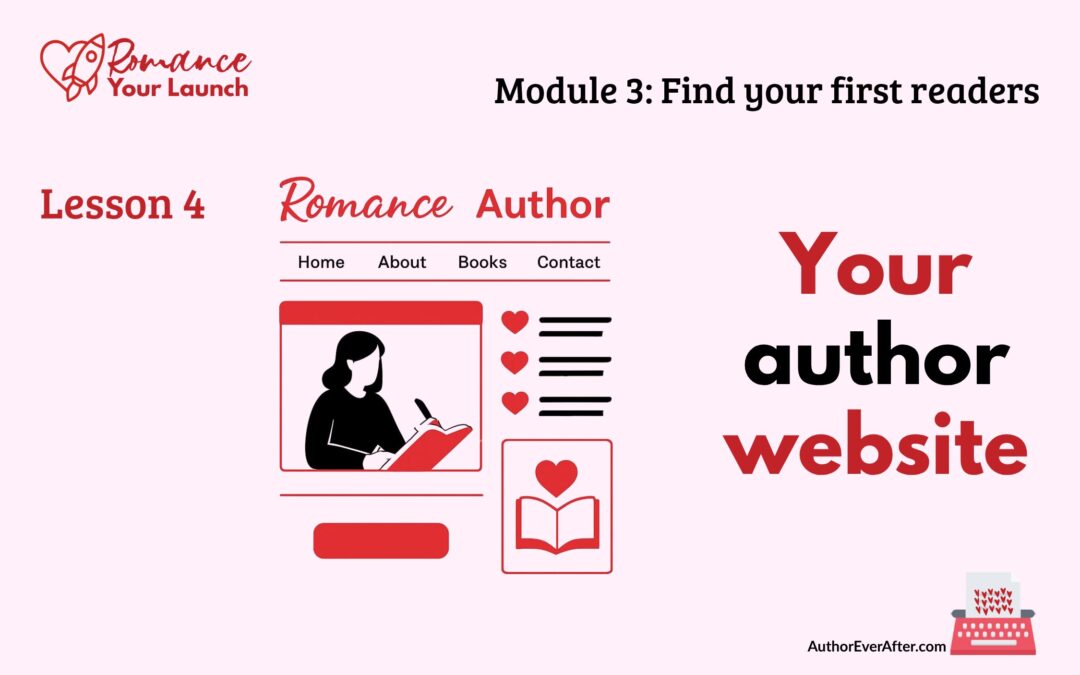
You do not need a fancy, custom site to look like a real author. In this lesson, you’ll learn how to build a simple romance author website that matches your brand, highlights your books or lead magnet, and gives readers an obvious path to join your email list without getting lost in tech decisions.
Let me start with the thing I wish someone had said to me early on: your author website does not need to be impressive. It needs to exist. (I was the new author who paid a web designer $$ to have her first author website made … it was pretty, sure, but I never recouped that investment).
That’s it. That’s the bar for version one is that you need to have a spot on the internet that people who search your name will find. And a place to send people to when they ask about your book, which they will once you say, “I write romance novels” to the person you just met at an extended family gathering.
I say this because I’ve watched more authors than I can count delay building a site, or abandon one halfway through, because they got tangled up in decisions about platforms, page structure, colour hex codes, and whether their font was giving the right energy.
Meanwhile, readers who found them on social media had nowhere to go. The link in their bio was a dead end. And every week without a site was another week of reader relationships that couldn’t start.
So before we go any further: your first author website can be a single page. It can be built on a free plan. It can have a placeholder cover and three paragraphs of copy. What it cannot be is nonexistent, because a website you haven’t built yet isn’t doing any of the jobs it needs to do.
For a romance author at this stage, a basic site has four jobs, and only four jobs.
That’s it. Everything else, including a blog, a store, a media kit, Easter eggs for superfans, or a page of character art, is optional and can come later. Much later. None of it belongs on your list of things to figure out right now.
Even a simple, rarely updated site does things a social media profile can’t. It’s a professional home you actually own and control, with no algorithm deciding whether readers see it and no random ads sitting next to your book covers. It’s a place you can send readers from any platform, any promo swap, or any newsletter mention. It gives you credibility with other authors, reviewers, and potential collaborators who will look you up before they work with you. And it’s the foundation for direct sales later on, if and when you decide you want that.
You do not need to build a custom WordPress site. You do not need a developer. You do not need to spend more than about $20 to get started, and depending on the tools you choose, you might spend nothing at all (beyond the cost to purchase your URL).
There are several services built specifically to make author sites almost plug and play, and they’re genuinely good.
BookBub’s author pages and website builder give you a clean, book-centric presence that’s easy to configure. Multi-published hybrid author Jennifer Sommersby, who also writes as Eliza Gordon, recently moved her author site to BookBub and it looks great.
CrewFiction offers a simple author page that works well even if you only have a lead magnet at this point. E.J. Campbell, a new author, is a good example of how to use it to signal dark romance clearly.
MailerLite includes basic website and landing page templates as part of its free plan. Author Ever After member Jillian Beane has used MailerLite as her website home for her two series. She’s even included a page of pronunciations for her fantasy romance and book club questions on a page she calls Fun Tidbits. Simple, functional, and completely her. (And if you notice the URL is something funky, don’t worry about that. You give people your normal web address—like JillianBeane.com—and set it up to redirect to MailerLite. easy-peasy).
Carrd builds clean single-page sites for free, and the Pro plan, which gives you more customization, is only $19 a year. Author Ever After member Tami Winbush built her site in Carrd, putting her brand feeling onto one of the hundreds of templates it offers.
If tech makes your shoulders crawl up around your ears, pick one of these and don’t look back. The goal for version one is simple: claim your URL before someone else does, and put something real at that address.
Think of your URL as your bookstore’s street address. You want it to match your author name or imprint, be as simple and memorable as possible, and ideally end in .com. Readers still default to that, though .author, .books, or your country domain can work if .com is already taken.
You’ll pay somewhere around $10 to $20 USD per year for a .com domain. You can buy it through a hosting provider like DreamHost or Bluehost, or through a registrar like Namecheap or Domain.com and then point it to wherever your site lives.
One thing a lot of new authors don’t know to do is turn on Whois privacy when you register. When you register a domain, your personal information, including your real name, actual address, and primary email, is collected and can end up in a public database called Whois. Most registrars now include privacy protection free or for a small fee. Turn it on. It keeps your home address off public directory searches, reduces spam, and adds a layer of safety that genuinely matters when you’re building a public presence.
Here’s the good news: you’ve already done most of the hard thinking. In Module 2, you identified your brand values and traits, chose your colours, fonts, and imagery styles, and described your author voice. Your website doesn’t require you to make new decisions. It just requires you to apply the ones you already made.
That means using your author photo or logo consistently, ideally the same image on your website, socials, and email header. It means applying your colour palette to buttons, links, headings, and accent blocks. It means choosing fonts in your site builder that are as close as possible to your chosen trio. You may not be able to match them exactly, and that’s fine. Just get as close to the feeling you want as the builder allows. And it means selecting imagery that matches your brand mood: soft and romantic, dark and mysterious, bold and playful, small-town cozy, whatever your books are promising.
You’re not building a design portfolio. You’re making your site look like the same author who’s been showing up in your bio, your branding, and your socials. Coherence is the goal.
A full author site can eventually include a lot. Right now, you need very little.
Your home page is the front door. A quick snapshot of who you are and what you write, a feature on your latest book or lead magnet, and a clear visible link to join your email list. That’s all it needs to be.
Your About page is where readers get to know you beyond your books. Your short bio, your author photo, and a few on-brand details that support your persona belong here. Focus less on your résumé and more on what’s in it for the reader: the emotional experience you offer.
Your Books page is the heart of the site. Include a cover, a short description, key tropes, heat level, and buy links or a coming-soon note for each title. If you only have one book, or none yet, a simple feature section is fine. You can absolutely link to your lead magnet as your first book. Just make sure you do it so that you capture those email addresses!
A Contact page gives readers a way to send fan mail and gives bloggers, podcasters, and event organizers a way to reach you. Set expectations here too. “I read everything but may not be able to respond to every message” is honest, kind, and saves you guilt later. BUT—make replying to readers a high priority. And with the caveat that you may not reply underlaying your reply, your reader will feel very special. (And she is!).
And you need some kind of newsletter sign-up, whether that’s a dedicated page, a section on your home page, or an embedded form in your header or footer. This part is non-negotiable. Getting people to your site without giving them a way onto your list is like opening a shop with no till. Use your lead magnet here!
Worth noting: these five things do not need to be five separate pages. On a simple site, they can all be sections on one landing page. That’s a completely legitimate version-one website, and it’s what a lot of authors use until their backlist grows enough to need more.
You do not have to invent any of this from scratch. One of the most useful things you can do before you build anything is spend an hour or two looking at newer author websites you genuinely like, especially authors in your sub-genre.
Visit three to five sites and pay attention to what makes you feel welcome the moment you land on the home page. Look at how they present their books, where they put their newsletter sign-up, and what their About page actually says. Notice their navigation, which pages they’ve included, and the order they appear in. Pay attention to the tone of their copy too: playful, cozy, intense, wry.
You’re not copying. You’re noticing what works and translating it into your voice, your colours, your fonts, and your priorities. Austin Kleon calls it “steal like an artist.” I call it doing your research before you do your work. Either way, it turns a blank page into a starting point, and that’s the job.
The single best thing you can do before you open your site builder is write your copy first, somewhere else. In a Google doc. In Notion. On paper if that’s your thing. Anywhere but directly in the site builder.
Trying to write and design at the same time is a special kind of hell, and I do not recommend it.
When you already have your copy written, your welcome paragraph, your about blurb, your book descriptions, your newsletter invitation, building the site becomes a copy-and-paste job. It takes a fraction of the time and produces a much cleaner result.
Before you open any platform, draft:
While you’re at it, gather your visuals in one folder:
Author Ever After members can use the DepositPhotos offer mentioned in the worksheet to source on-brand images for their site and socials.
Having all of this ready before you start building is the difference between a site that takes an afternoon and a site that takes three weeks of open browser tabs.
Reserve your URL. Choose the simplest platform that works for you. Use the branding decisions you already made in Module 2. Write your copy before you build. Then build the thing.
Your first site does not need to be impressive. It needs to exist, feel like you, and give readers one clear place to go. Everything you add after that is a bonus.
The worksheet walks you through the decisions and drafts in order: tool choice, URL registration, copy, visuals, and a community share so you can get eyes on it before it goes live.
The best place to gut-check your choices and get sub-genre-specific tool recommendations is in the Author Ever After community, from authors who’ve already been through exactly this.
You’ll get immediate and full access to the Romance Your Launch program (all 11 modules), a worksheet for every lesson, plus three weekly, small group support meetings to answer all your questions, and a freaking amazing community of pre-published and early career romance authors who are building their indie publishing careers alongside you.
Get more details about the community here.
Or, go straight to the application form.
—> Click this link and I’ll send you two to three lessons a week, starting with Lesson 1.
—>Or, join my regular email list if you’d rather just pick up from the current lesson.
Readers don’t search “romance.” They search for grumpy small-town cowboy or dark mafia anti-hero. Here’s how to find your book’s address in the market.
Self-publishing romance novels is not a pipe dream or a shortcut. It is a real way to build a joyful, sustainable author career when you understand the market, the readers, and your options. This first lesson gives you the lay of the land so you can make informed choices.
Get every lesson from Romance Your Launch—my premium self-publishing program for romance authors—directly to your inbox. For free.
Ready for the next step in the module?
Return to Module 3: Find your first readers to see all five lessons.
Or go back to the Romance Your Launch home page to see all the modules and links to their hub pages.
Want the next lesson in your inbox?
This post is part of the Romance Your Launch series—a lesson-by-lesson guide to self-publishing your romance novel, written for pre-published and early career romance authors.
.
—> Click this link, drop in your name and email address, and I’ll send you two to three lessons a week, starting with Lesson 1.
.
—> If you’d rather just pick up where the series is, join my regular email list from this link.
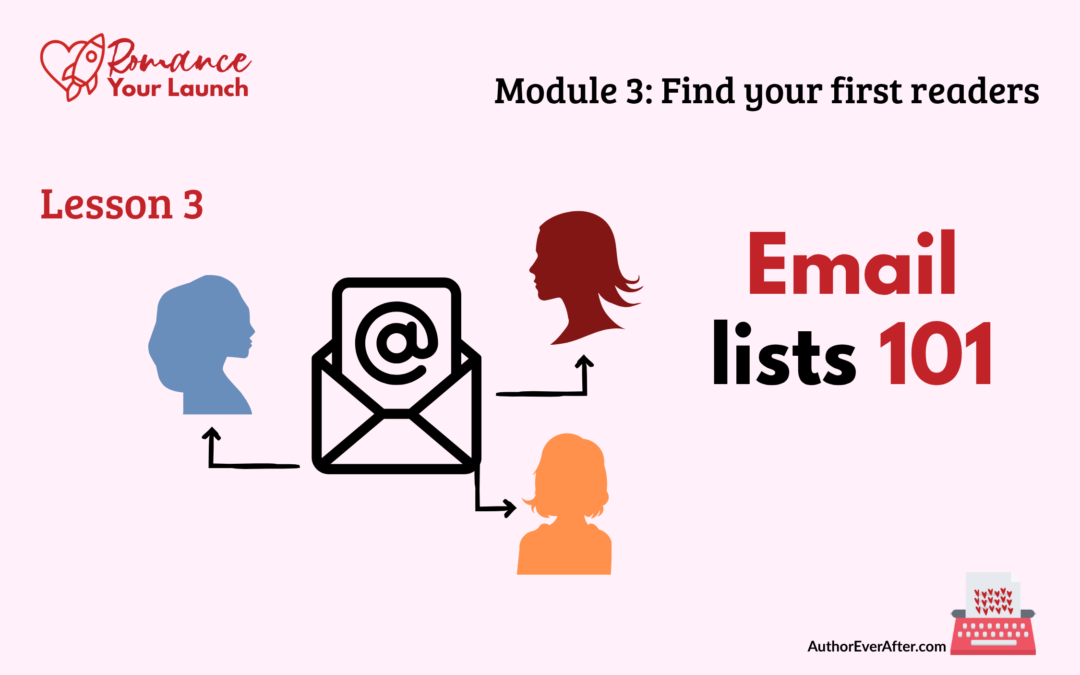
An email list is the one part of your audience you actually own, and setting it up does not have to be complicated. In this lesson, you’ll walk through a simple email list setup for romance authors, connecting your lead magnet delivery to a clean subscriber list and a four‑email welcome sequence that introduces you like a pro.
Let’s keep this simple, because this topic can very quickly become the opposite of simple.
You have a lead magnet. Someone wants to download it. When they do, two things need to happen: they need to actually receive the file, and you need to capture their email address so you can stay in touch. Everything else, including sequences, segmentation, analytics, and list architecture, is covered in Module 8. This lesson is just about getting the mechanism in place so your lead magnet can do its job.
Two tools. One list. Four emails. That’s the whole task.
Before you look at a single tool, it helps to understand what you’re actually trying to accomplish.
When a reader clicks your download link, she needs to receive the file cleanly, formatted correctly for her device, and delivered in a way that feels professional and author-branded. This is not as simple as attaching a PDF to an email. Device compatibility, download reliability, and reader experience all matter, and a clunky delivery process undermines the goodwill your lead magnet is trying to build.
When she downloads the file, you need her email address added to your list automatically so you can follow up with your welcome sequence. This is what turns a one-time download into the start of a reader relationship.
Some tools do both jobs in one place. Others split the work between two tools that talk to each other. Both approaches work. What matters is that you choose one and actually set it up.
If you’re at the very beginning of your author career and you want a capable, clean email setup without a monthly subscription, SendFox is worth a look.
SendFox is available through AppSumo as a one-time payment of $49 for up to 5,000 subscribers, not a monthly fee and not an annual renewal. You pay once and it’s yours. For a new author who isn’t sure yet how quickly her list will grow or how long it will take to recoup any business investment, that’s genuinely different math from what most ESPs offer.
I used SendFox for my own list for five years. The deliverability is solid, the sign-up page is clean and professional, and the automations are straightforward to set up, which means your welcome sequence can do exactly what you need it to do at this stage. It’s not as feature-rich as MailerLite at the higher tiers, and the AppSumo deal is the main way to access it at that price point, so it’s worth checking whether the offer is still live when you’re reading this. But if it is, it’s one of the best-value options available for authors just getting started.
You can pair SendFox with StoryOrigin’s free plan for lead magnet delivery in the same way you would MailerLite. The integration works cleanly between the two.
This is the combination I’d point most on-a-budget writers toward in 2026, and it’s the setup I’d recommend you ask about first in the community.
MailerLite is your email service provider, or ESP. It’s the tool that stores your subscribers, sends your emails, and runs your welcome sequence. It’s well regarded for deliverability, has a clean and learnable interface, and is the ESP most commonly used by indie romance authors right now.
A few things to know before you sign up:
StoryOrigin handles the delivery side. It gives your reader a clean professional download page, manages device compatibility, and integrates directly with MailerLite so that when someone downloads your lead magnet, their email address is automatically added to your list.
Pricing:
StoryOrigin is also BookFunnel’s main competitor, and many romance authors use it because the free plan includes the email integration that BookFunnel reserves for higher-tier plans.
BookFunnel is the better-known delivery tool, and it’s excellent, but the pricing structure changed in early 2026 and it’s worth understanding before you commit.
The First-Time Author plan is $30 a year and covers basic book delivery. However, email integration, the feature that automatically adds a downloader’s address to your MailerLite list, is only available on the Mid-List Author plan at $20 a month or $200 a year.
That’s a meaningful cost difference at the start of your author career, especially compared with StoryOrigin’s free integration tier. If you already have a BookFunnel account from a previous promotion and you’re on a plan that includes integrations, use it. If you’re starting from scratch, StoryOrigin’s pricing is much more beginner-friendly for this specific use case.
CrewFiction is an all-in-one platform built specifically for fiction authors that handles email list management, lead magnet delivery, and reader community features in a single tool. If the idea of managing two separate platforms and an integration between them creates genuine anxiety, it’s worth a look.
The trade-off is that it’s newer and less widely used than MailerLite, SendFox, StoryOrigin, or BookFunnel. That means a smaller community of indie romance authors who can answer your questions, fewer tutorials, and less accumulated peer knowledge about what works for romance-specific use cases.
It’s not the wrong choice, but it is the one that asks you to figure more out on your own. That said, I recently moved my romance list from SendFox and BookFunnel to CrewFiction and I’ve been very happy with the service.
I’ve given you suggestions from my own expeirence and that of many early career romance I know and have worked with. There are literally dozens of other ESPs you could use that I haven’t mentioned but that romance authors use. FloDesk, Kit, and even Substack come to mind. I’ve looked at those three and none do as good a job (for that money) that my recs do. In my opinion! So do your own research! Before you spend a single dollar or sign up for anything, post this question in a romance author community:
“What are you using to deliver your lead magnet and send your welcome emails, and if you were starting from scratch today, would you choose the same thing?”
The answer you get from authors in your specific sub-genre will tell you more than any comparison chart I (or anyone else) can make. People who write what you write, for readers like yours, have already made these decisions and learned from them. Use that.
This is not a reason to delay setting things up. It’s a reason to spend twenty minutes asking before you spend twenty hours figuring it out alone.
Once you’ve chosen your tools, here’s the full scope of what needs to exist before your lead magnet goes live. Nothing more.
One list.
Name it something simple: your author name, “readers,” or “newsletter.” Don’t overthink it.
One sign-up form or landing page connected to that list, with clear copy about what the reader is getting, the lead magnet, and what they can expect from you going forward, including a rough sense of how often you’ll email and what kind of emails you send.
One welcome sequence, four emails, triggered automatically when someone signs up:
After Email 4, your subscribers roll into your regular list and start receiving whatever you send to everyone else. Module 8 goes deep on what that looks like. For now, you just need these four emails to exist and send automatically.
Spending two weeks comparing tools instead of choosing one and starting.
MailerLite plus StoryOrigin on their free plans gives you a fully functional setup for zero dollars. Once you hit the 500 subscribers, if you’re still not ready to pay monthly, exporting your list and getting the $49 Sendfox account is super easy.
The best email setup is the one that exists before your lead magnet goes live. That’s the bar. You can optimize everything else later.
Getting your email setup in place before your lead magnet goes live is one of the highest-value things you can do at this stage of your author career. The tools are more accessible and more affordable than they’ve ever been, and the four-email welcome sequence you build here will work quietly on your behalf every time a new reader downloads your story, introducing you, building trust, and turning a one-time download into a reader who’s genuinely looking forward to hearing from you again.
You’ll get immediate and full access to the Romance Your Launch program (all 11 modules), a worksheet for every lesson, plus three weekly, small group support meetings to answer all your questions, and a freaking amazing community of pre-published and early career romance authors who are building their indie publishing careers alongside you.
Get more details about the community here.
Or, go straight to the application form.
—> Click this link and I’ll send you two to three lessons a week, starting with Lesson 1.
—>Or, join my regular email list if you’d rather just pick up from the current lesson.
Reader expectations shift every year. Here’s what romance readers want in 2026 and how current romance market trends should influence the way you write, position, and launch.
Your sub‑genre tells readers what you write. Your romance author niche tells them why your book is the one they’ve been waiting for. In this lesson, you’ll define your niche and target audience so every decision you make about branding, blurbs, and marketing points straight at your ideal reader.
Readers don’t search “romance.” They search for grumpy small-town cowboy or dark mafia anti-hero. Here’s how to find your book’s address in the market.
Self-publishing romance novels is not a pipe dream or a shortcut. It is a real way to build a joyful, sustainable author career when you understand the market, the readers, and your options. This first lesson gives you the lay of the land so you can make informed choices.
Get every lesson from Romance Your Launch—my premium self-publishing program for romance authors—directly to your inbox. For free.
Ready for the next step in the module?
Return to Module 3: Find your first readers to see all five lessons.
Or go back to the Romance Your Launch home page to see all the modules and links to their hub pages.
Want the next lesson in your inbox?
This post is part of the Romance Your Launch series—a lesson-by-lesson guide to self-publishing your romance novel, written for pre-published and early career romance authors.
.
—> Click this link, drop in your name and email address, and I’ll send you two to three lessons a week, starting with Lesson 1.
.
—> If you’d rather just pick up where the series is, join my regular email list from this link.
