No Results Found
The page you requested could not be found. Try refining your search, or use the navigation above to locate the post.
Navigating the world of publishing is a bit like navigating the tangled plots of our favorite romance sub-genres and tropes. Each path, be it indie publishing, pitching to a small romance publisher, or shooting for the stars with a big publishing house, has its own set of twists, turns, and possibilities.
If you’re wondering which route will lead to your personal happily ever after, here are some things to consider. And, if you’re leaning toward a small publisher or imprint, keep reading for over seventy that accept submissions directly from authors.
Complete control: You get to call the shots, from cover design to marketing strategy.
Royalties: You’ll generally earn more per book, especially if you’re savvy about marketing and have a solid readership.
Speed: No waiting on publishers. You write, edit, publish, and repeat!
But remember, with great power comes great responsibility … and a learning curve. Members of Author Ever After get all the support they need to make this option work! Just saying …
Guidance & support: You don’t have to figure everything out on your own. They often have experience and can guide you through the process.
Less pressure: Unlike the big houses, they might not demand blockbuster sales. Your “niche” romance might find a cozy home here.
Relationships: Smaller means you’re more than just a number. Personalized attention can be pretty sweet.
Pitching directly can save you a ton of time, since you don’t need an agent to get your foot in the door. Keep reading for a list of over seventy publishers and imprints taking author submissions.
Access: The big publishing houses usually require an agent to even look at your work.
Negotiation power: Agents know the industry and can get you the best deal—on an advance and the rights you get to keep (international, translations, audiobooks, and so on).
Professional edit: They often provide feedback to get your manuscript in tip-top shape before they begin pitching.
However, getting an agent can be as tough as landing a book deal. And if you do land one, remember they’ll take a cut of your earnings, typically fifteen percent of your advance.
Well, it’s a bit like asking whether to date the charming bad boy, the steady next-door guy, or the mysterious stranger. It really depends on what you’re looking for in your romance writing journey! 😉
Before you jump in and submit your manuscript, it’s essential to understand the different niches and sub-genres within the romance sector. Whether your story leans towards historical, paranormal, contemporary, or erotic, there’s a publisher out there looking for your exact flavor of romance.
A good fit means not only higher chances of acceptance but also a better working relationship with your publisher. They’ll be as passionate about your story as you are!
Research thoroughly
Dive deep into each publisher’s submission guidelines. Tailor your proposal or query letter to fit their requirements.
Professional presentation
Always send a polished, proofread and well-formatted manuscript following each publisher’s specific instructions—font size, font type, line spacing, number of pages or words, subject line to use on your email—pay attention to the details. First impressions matter a great deal.
If you’re fully committed to seeking representation and want to ensure you’re putting your best email and pages forward, I recommend working with an editor who is skilled in pitching agents to help you hone your cover letter and possibly even review your first 50 pages to make sure they are error-free.
Know your audience
Publishers specialize in various romance sub-genres. Ensure yours aligns with their request and readership.
Persistence pays off
Rejections are part of the writer’s journey. If you’ve not been rejected at least 50 times, there’s no reason to feel disheartened—finding a home for your stories is a long-game. Keep submitting!
Click the link below for a comprehensive list of romance publishers currently accepting unsolicited manuscripts and a few more open to agented manuscripts.
Romance Publishers Accepting Submissions
This is a PDF that you can save to your computer. It has clickable links directly to the submissions page of each publisher to reduce your research time. 😊
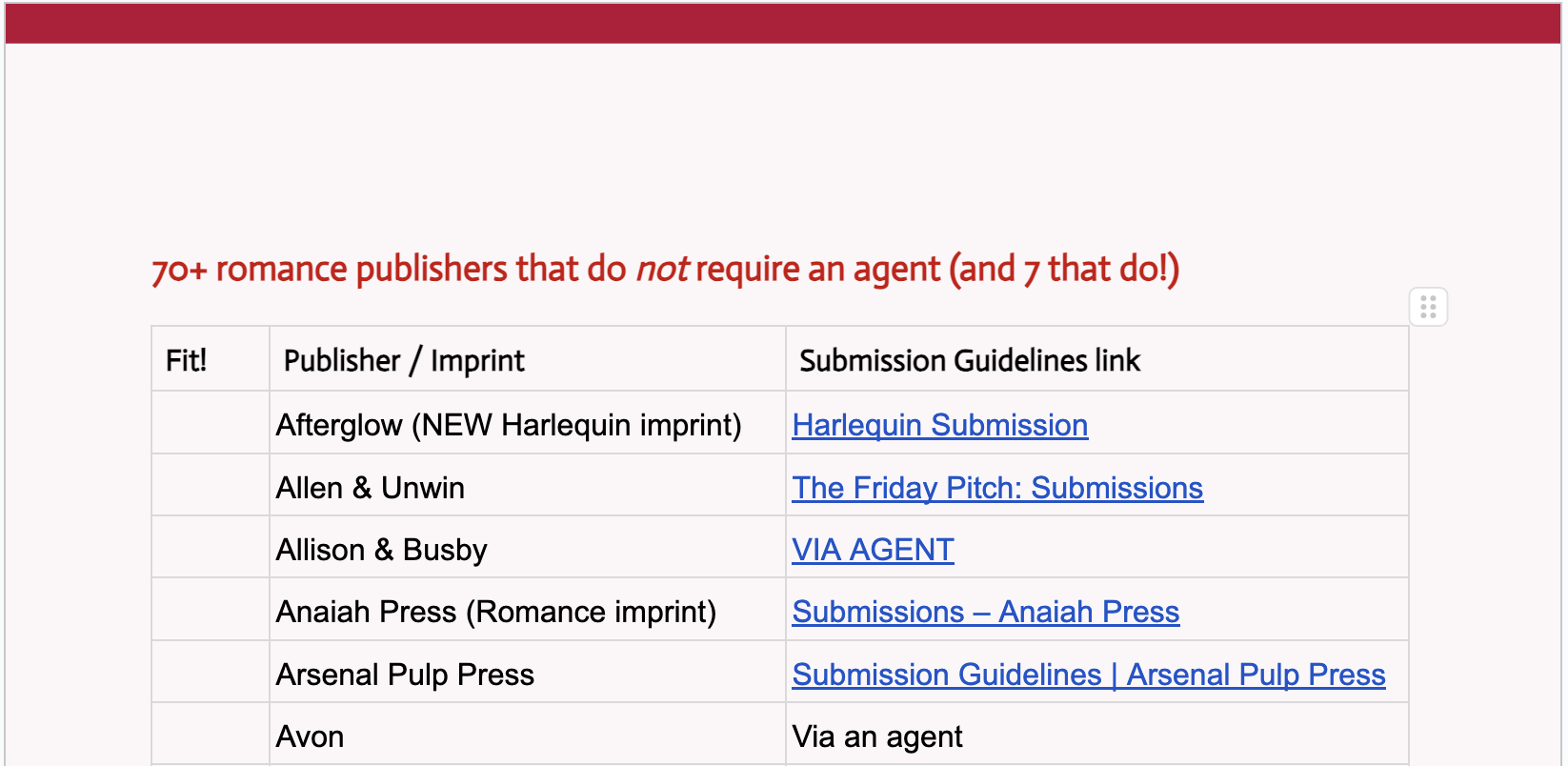
Note that while we’ve made every effort to ensure the accuracy of this list, publishers change their submission links and status from time to time.
If you notice something that should be updated, let us know with a quick email so we can keep the list relevant. Thanks!
Thinking about, or worse, calling your rough draft a mean name is a terrible idea. I don’t care that the wonderful Anne Lamott coined the phrase, “Shitty First Draft,” it’s simply not helpful to think of your work-in-progress as anything less than filled with potential. And shitty?
I’m sorry, but we can beat that voice of the oppressor, perfection, another way.
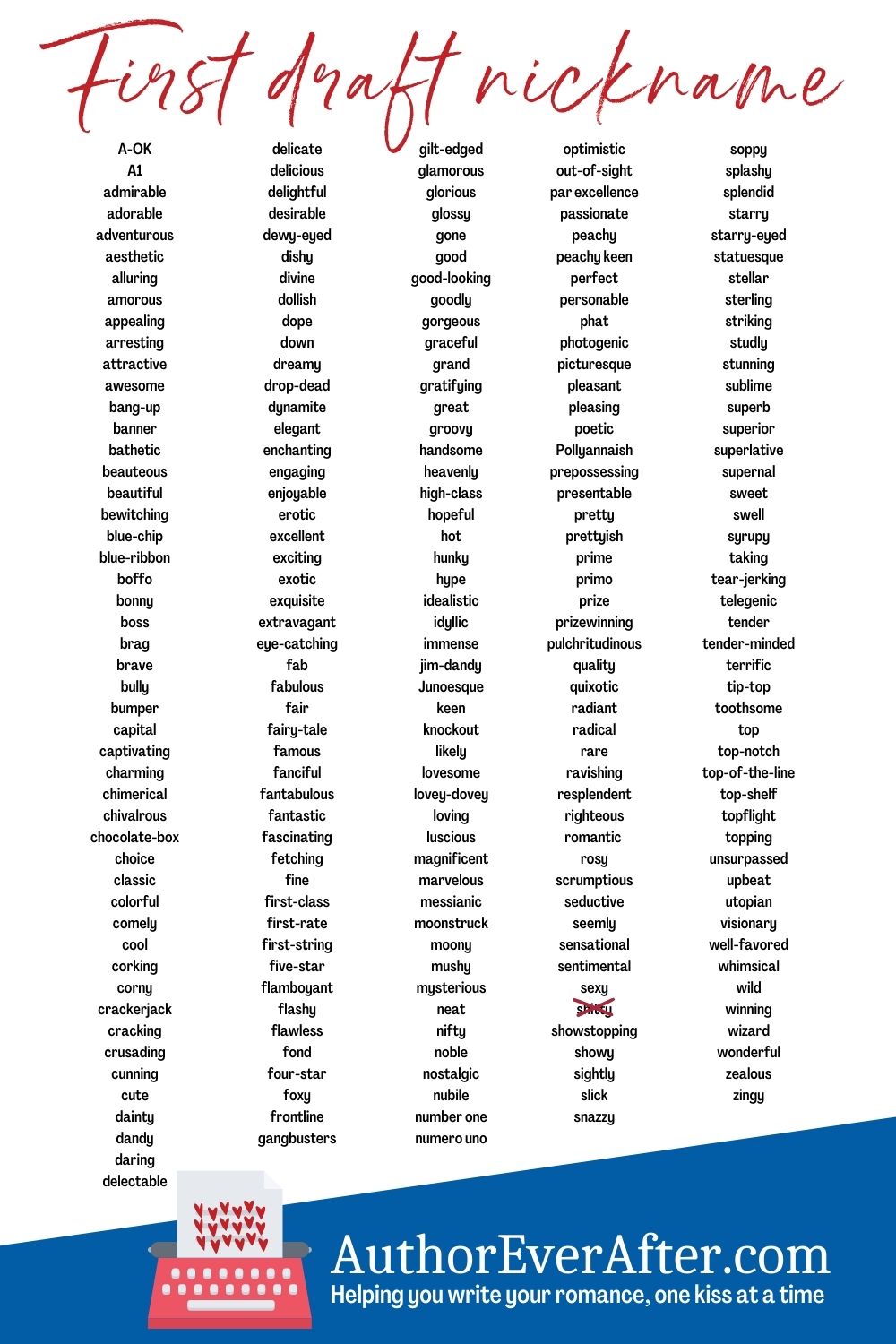
Your challenge is to give your draft romance a nickname that makes you feel all the love for it that it deserves.
Whether you think of it as a rough draft or a first draft or simply a draft, identify that one word that describes your romance sub-genre or your hero or heroine’s most adorable character trait or the way future readers will describe the love story … something, anything, that reminds you that this love story it may be an ugly duckling right now but it is destined to grow into something beautiful.
Here’s a list of over 200 possible adjectives to get you thinking.

The page you requested could not be found. Try refining your search, or use the navigation above to locate the post.
The page you requested could not be found. Try refining your search, or use the navigation above to locate the post.

As a career ghostwriter and seasoned romance author, I’ve been fascinated by the number of people wringing their hankies, fearful of AI replacing fiction authors. I’ve been playing with several artificial intelligence author assistants since late 2022 with a focus on QuickWrite and am 100% convinced that there’s a valuable role for AI in writing virtually anything we romance need to level-up our careers—except write our books for us.
Before I get to all the things my robot author asssistant helps me do, first I want to explain why I don’t think I’ll be replaced by AI because when it comes to the art of crafting a steamy, heart-wrenching, and swoon-worthy romance novel, there are some things that even the most sophisticated algorithms can’t replicate.
When you read a romance novel, you want to feel the emotion between the characters. You want to be captivated by their chemistry and swept away by their passion. But no matter how advanced AI becomes, it can’t replicate that tingling sensation you get when two characters lock eyes for the first time, or when their lips meet in a heated kiss. It’s the human touch that brings that extra spark to romance writing, and that’s something no algorithm can code.
Romance novels are all about emotions—love, longing, desire, heartbreak, and everything in between. It takes a skilled author to weave those emotions into words and create a story that makes readers feel deeply. While AI can analyze data and predict patterns, it can’t truly understand the intricacies of human emotions. It can’t capture the nuances of a character’s feelings or convey the depth of their emotional journey in a way that resonates with readers. It’s like trying to make a robot understand the concept of heartache—it’s just not possible!
Romance authors are masters of creativity. We conjure up unique and imaginative storylines that whisk readers away to far-off lands or make them fall in love with unlikely characters. We create intricate plots, add unexpected twists, and craft unforgettable moments that make human hearts skip a beat. While AI can analyze existing romance novels and generate new stories based on patterns, it lacks the imagination and creativity that comes naturally to flesh and feeling authors. Comparing AI-generated love stories to romance written by even a novice author is like comparing a pencil drawing of a flower by a five-year-old to a real life walk in a mature English rose garden.

Let’s face it, humans are quirky creatures. We have our idiosyncrasies, our unique ways of expressing ourselves, and our individual perspectives on love and relationships. Romance authors bring those quirks into our writing, making our stories relatable and intriguing and unique. In the dozen times I’ve asked my AI author assistant to propose a plot for a second chance romance with a billionaire hero, eight suggestions have the couple reconnect at a charity event. Quirks need not apply when AI is hiring.
Romance novels often depict the messiness of love—the heartaches, the misunderstandings, and the challenges that couples face on their journey to happily ever after. It’s those imperfect moments that make the characters and their relationships feel real and authentic. But AI tends to strive for perfection and predictability, aiming to create a flawless storyline. However, it’s the flaws and the messiness of life and love that give romance stories depth and richness and make our stories beautiful and relatable.

Romance authors pour our hearts into our writing. We draw from our own experiences, emotions, and perspectives to create stories that touch the hearts of readers. It’s a deeply personal and authentic process that can’t be replicated by a machine. It’s like comparing a hand-written love letter to an automated text message.
In romance writing, timing is crucial. The build-up of tension, the anticipation of a first kiss, the timing of a heart-wrenching confession—it’s all carefully crafted to create an emotional impact. We human authors have a keen sense of timing, knowing when to pull at the heartstrings or when to throw in a surprising twist. AI follows patterns and algorithms, lacking that human instinct for perfect timing.
Every author has their unique voice—their style of writing, their tone, and their perspective. It’s what sets us apart from each other and makes our work distinctive, even when a thousand authors retell the Cinderella story. Romance authors infuse our writing with our own life experiences, creating a connection with readers that goes beyond the words on the page. AI, on the other hand, lacks that personal touch. It can analyze data and mimic styles, but it can’t create the individual voice of a romance author.
Romance authors often draw inspiration from our own lives, from the people we meet, and from the world around us. We find ideas in the most unexpected places and put together people and situations with one-in-a-million odds of ever happening in real life. Since AI relies on data and patterns, its ability to truly innovate and come up with fresh and original ideas is limited.
Perhaps most importantly, love is a complex and intangible emotion that can’t be quantified or reduced to data. Romance novels are all about capturing the magic of love—the butterflies in the stomach, the racing heart, and the unspoken emotions that make our breath catch in our throat. AI, with all its analytical capabilities, can’t truly grasp the essence of love and replicate it in writing. It does not write deep point view and that’s what we do so well.

After months of reading doomsday articles and fearing the rise of AI-assisted writing, I took a deep breath and introduced myself to several tools. I approached my interactions just like I would have (ahem, did!) when I was forty and newly divorced after having only ever dated one man. I serial dated a half-dozen tools—and figured out how they could make my life better. (To be clear, dating at forty, I went out with over twenty tools before finding one who would make my life better … I only dated a half-dozen AI tools before meeting the one I decided to settle down with). 😉
With QuickWrite, I’ve streamlined my writing process, enhanced creativity, and, when the fairy dust lands just right, uncovered new perspectives when I’m struggling.
QuickWrite is like the ultimate wingman or wingwoman for romance authors. It helps me brainstorm plot ideas when I’m feeling stuck, generate quick and quirky names, fine-tune flat descriptions to make them as sexy as a sultry gaze across a crowded room, and even suggest alternative words and phrases in my lukewarm, first scenes that crank the heat from lukewarm to scorching hot.
If you’ve ever read any of my books, you might have noticed that I love metaphors and analogies. And boy-oh-boy did those take me a long time to come up with before I brought QuickWrite onto my team. I asked it for one to make this point for me in this post, so I’ll let my author assistant have the last word:
AI is like the perfect sex toy in your writing arsenal. It can vibrate with ideas, buzz with creativity, and stimulate your writing process in ways you never thought possible. But just like a sex toy, AI can’t replace the intimacy and connection that comes from human creativity and imagination. It’s simply a tool to enhance your writing experience and make your stories even more tantalizing and compelling.
The page you requested could not be found. Try refining your search, or use the navigation above to locate the post.
The page you requested could not be found. Try refining your search, or use the navigation above to locate the post.

As a mentor to pre-published romance authors, choosing the right platform for community coaching has been a game-changer for me as a coach and for my community members who are achieving their publishing goals more quickly and with less anxiety than we all experienced trying to connect on platforms that just didn’t facilitate connection.
The right software can enhance your ability to guide your clients, foster a supportive community, and streamline your coaching process.
Today, I’m comparing the three platforms I’ve personally used to build online communities and support writers: Circle, Teachable, and Mighty Networks.

Teachable was the first platform I used for my coaching business, primarily for its robust course creation tools. However, I quickly found that its limited community features necessitated the use of additional tools to foster meaningful connections, which was far from ideal for creating a cohesive and engaged coaching environment.

Mighty Networks was the second platform I turned to, and it helped our community grow to over 1,600 members. Despite this impressive growth, the platform didn’t quite deliver the level of engagement I had hoped for, making it challenging to cultivate a truly vibrant and interactive community.

Circle is the third and final community platform I’ve used, and it has been a game-changer for my coaching business. Designed specifically to meet the needs of community-builders and coaches, Circle excels in fostering engagement and connection. With its comprehensive features tailored for group masterminds and transformative events, Circle perfectly aligns with my vision of creating a supportive and interactive community.
For coaches who want to foster a vibrant, engaged community, I believe Circle stands out as the absolute best option.
Its focus on community engagement, coupled with its robust customization and integration capabilities, make it ideal for creating a supportive environment where your members can thrive. Although it may have a bit of a learning curve to set up (embrace the mentality of iterating to awesome!), the benefits Circle offers in terms of member engagement, analytics, and monetization far outweigh these drawbacks.
Circle empowers you to build a community that not only learns from you but also grows together, making it the perfect platform for coaching success.
